

For investors wanting a steady source of passive income, a systematic screening method is important. One useful way is to find companies that provide a good dividend now and also have the fundamental financial soundness to maintain and increase those payments in the future. This process usually means selecting for stocks with strong dividend scores while also confirming they show acceptable earnings power and balance sheet condition. This pairing helps prevent the mistake of high-yield stocks that could reduce their dividends because of business or financial stress. Applying such a filter can identify companies that mix income production with operational steadiness.
NIKE INC -CL B (NYSE:NKE) recently showed as an outcome from a "Best Dividend" filter set with this thinking. The filter aimed at stocks with a ChartMill Dividend Rating of 7 or more, together with minimum scores of 5 for both Profitability and Financial Condition. Nike's presence indicates it deserves further examination by investors focused on income.
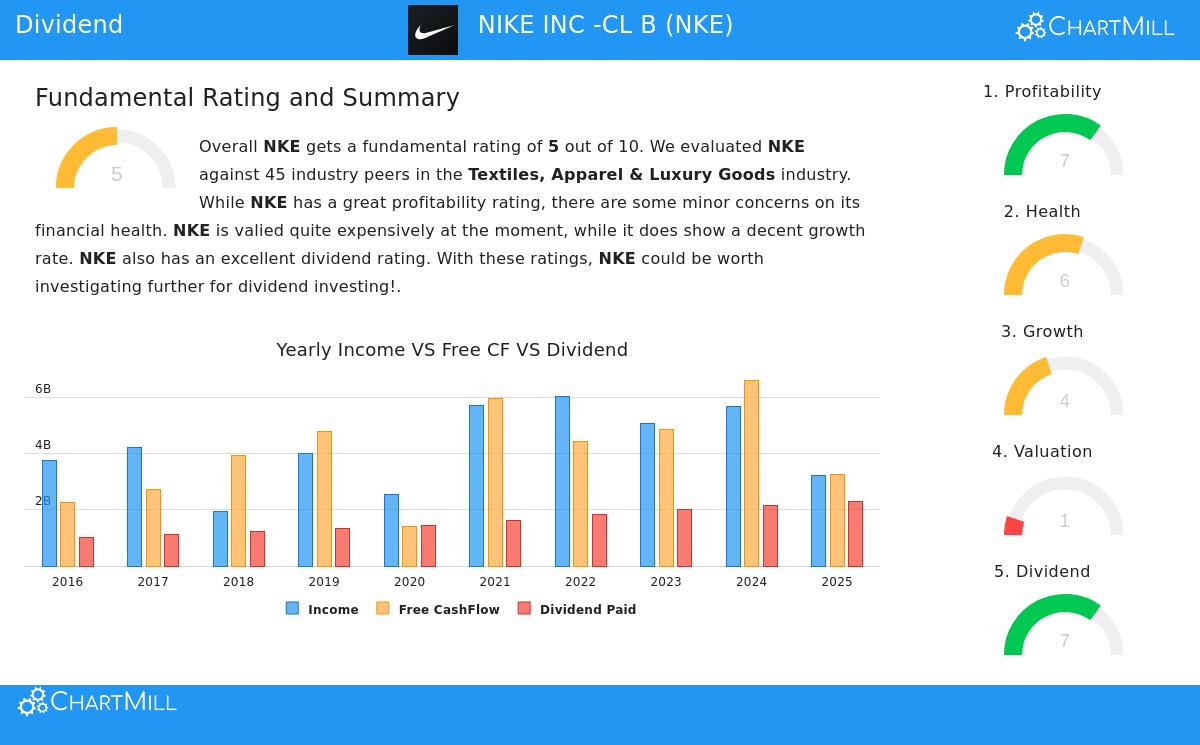
Dividend Profile: A History of Increase
Initially, Nike’s present dividend yield of 3.80% is good, especially next to the wider S&P 500 average of about 1.89%. More interesting than the current yield, though, is the firm's shown dedication to giving cash to shareholders. The basic examination shows a dividend increase narrative that is key to its attraction.
- Dependable Record: Nike has given a dividend for at least 10 straight years and has not lowered it in that time. This history offers some assurance of management’s dedication to shareholders.
- Good Increase Pace: The yearly dividend increase pace over the last five years is a notable 10.70%. This steady increase shows the company is not just keeping but actively raising its shareholder returns, which can counter inflation over time.
- Sector Position: Inside the active Textiles, Apparel & Luxury Goods field, Nike’s dividend yield is higher than about 89% of similar companies, placing it as a top income provider in its industry.
For a dividend increase plan, this record is key. It shifts the investment thesis from a basic high yield to a company that has steadily focused on and increased its shareholder payments.
Profitability and Condition: The Base for Continuation
A large dividend is only as reliable as the company’s capacity to pay for it. This is where the filter’s extra conditions for profitability and financial condition matter, and Nike’s scores give the needed background. The company’s ChartMill Profitability Rating of 7 and Condition Rating of 6 point to a firm core business, even with some points to watch.
Profitability Positives: Nike receives good scores for its essential financial results. It has been regularly profitable and cash-flow positive over the past five years. Important return figures are solid:
- Return on Assets (6.07%) and Return on Equity (15.97%) both beat more than 75% of industry competitors.
- Its Return on Invested Capital (ROIC) has been good in the past, though the report mentions a recent drop from a three-year average of 16.64% to 8.99%, a pattern that needs investor notice.
Financial Condition Review: The company’s balance sheet displays both positives and small issues, shown in the firm but not top Condition rating.
- Liquidity is adequate: A Current Ratio of 2.14 and a Quick Ratio of 1.45 show enough ability to cover near-term debts.
- Solvency gives a varied view: The Altman-Z score of 3.58 shows a small short-term chance of bankruptcy and is better than many competitors. Still, the Debt-to-Free-Cash-Flow ratio of 7.66 is called a "somewhat unfavorable" signal, meaning it would take a number of years to clear debt from present cash flow amounts. The Debt/Equity ratio of 0.50 is seen as acceptable but is larger than many in its field.
This mix of good profitability with sufficient, though not perfect, financial condition is just what the screening approach looks for. It finds companies that produce enough profit to back the dividend (profitability) while keeping a balance sheet that is not too indebted (condition), lowering the chance of a future dividend reduction.
Valuation and Increase Factors
While the filter centers on dividend, profitability, and condition, a complete view needs checking valuation and increase potential. Nike’s valuation is presently high, with a Price/Earnings ratio of 28.23, which is seen as costly compared to its own past and many industry competitors. This high valuation is probably backed by its well-known brand and market place, but it does mean investors pay a larger price for future profit and dividend increase.
On the increase side, past results have been weak, with a big year-over-year drop in Earnings Per Share (-50.17%). However, analyst forecasts point to a good rebound, with EPS expected to increase by over 18% each year in the next few years. If this happens, this speed-up in profit increase would give a much firmer base for the company’s planned dividend increase path.
Is Nike Suitable for a Dividend Portfolio?
Nike makes a strong case for dividend increase investors. It mixes a good and increasing yield with a ten-year history of dependable payments, all supported by a basically profitable worldwide business. The screening rules effectively highlighted a company where the dividend is a main part of capital use, backed by acceptable financial condition.
Still, investors must balance the appealing dividend picture against the stock’s high valuation and the recent strain on profits. The continuation of the payment, as mentioned in the full fundamental report, has a point to watch: the present payout ratio is above 100% of income, which cannot continue forever. This highlights the need for the expected profit recovery. For the dividend increase story to go on, Nike’s forecasted earnings rebound must happen.
For investors wanting to find other companies that fit similar rules of good dividends, profitability, and financial condition, the set "Best Dividend" filter that found Nike can be a useful beginning. You can see the present filter outcomes and change the settings to your own choices here.
Disclaimer: This article is for information only and is not financial guidance, a suggestion, or a bid to buy or sell any securities. The information given is from supplied data and should not be the only ground for any investment choice. Investors should do their own study and talk with a qualified financial advisor before making any investment decisions.