

For investors aiming to build a portfolio centered on dependable income, a disciplined screening process is necessary. One useful technique is to look for companies that provide an appealing dividend and also have the fundamental financial soundness to maintain and raise those payments. This tactic frequently means filtering for stocks with high dividend ratings, which evaluate elements such as yield, growth, and payout sustainability, while also demanding good scores for profitability and financial condition. This multi-step method helps steer clear of the danger of high-yield traps, companies where large payouts could be threatened by poor fundamentals, and instead finds businesses structured to compensate shareholders steadily.
MICROSOFT CORP (NASDAQ:MSFT) appears as a leading example from this type of screening, representing a strong mix of dividend dependability and corporate strength.
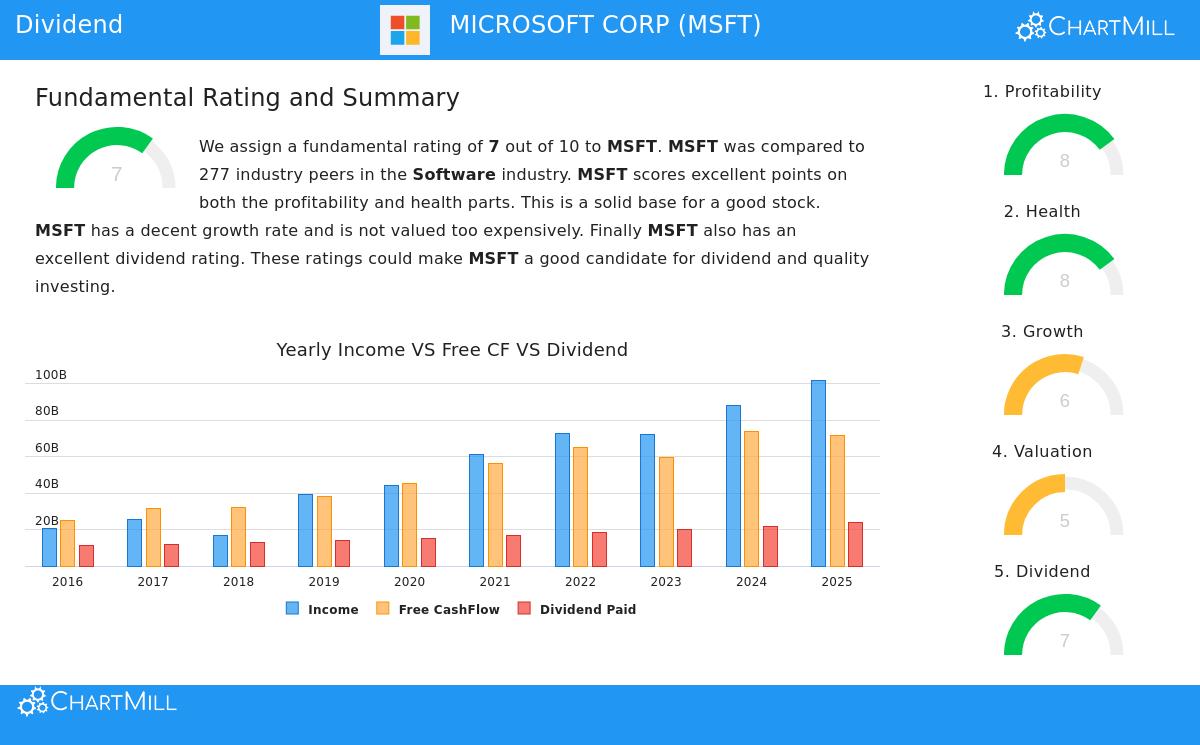
Dividend Profile: Stability and Growth
For dividend investors, the quality and direction of the payout are frequently more important than the basic yield. Microsoft demonstrates this idea. The company’s dividend might not be the largest in absolute terms, with a present yield of 0.80%, but its features are those of a high-quality income stock.
- Dependable History: Microsoft has paid and, significantly, raised its dividend for more than ten years. This extended record of yearly increases gives investors considerable assurance in management’s dedication to sharing capital.
- Notable Dividend Growth: The dividend has increased at a notable yearly rate of about 10.24% over the last five years. This growth assists in countering inflation and raises the investor’s effective yield on their initial investment over time.
- Manageable Payout Ratio: The basis of dividend safety is a reasonable payout ratio. Microsoft distributes only around 23.52% of its earnings as dividends. This small ratio leaves a wide safety margin, making certain the dividend is safe even in economic declines and allowing significant space for continued growth and business reinvestment.
Fundamental Strength: Profitability and Financial Condition
A lasting dividend is supported by a base of sound profitability and a firm balance sheet. These are the exact standards our screening approach stresses to distinguish durable payers from uncertain ones. Microsoft performs well here, with a ChartMill Profitability Rating of 8 and a Health Rating of 8.
Profitability is excellent, with main measures greatly exceeding industry norms:
- Return on Equity (ROE): 28.90%
- Return on Invested Capital (ROIC): 22.25%
- Operating Margin: 46.27%
This remarkable profitability is not a short-term event but a continuing pattern, showing a strong and protected business operation. It directly backs the dividend plan by producing the substantial, high-caliber earnings from which payments are distributed.
Financial Condition is similarly good, reducing the chance of a dividend reduction from balance sheet pressure:
- The company has a high Altman-Z score of 9.19, showing very little near-term bankruptcy danger.
- Its debt is prudent, with a Debt-to-Equity ratio of 0.24 and a Debt-to-Free-Cash-Flow ratio of only 1.25, indicating it could pay off all debt with about 15 months of cash flow.
- This strong balance sheet guarantees Microsoft can easily finance its dividend, manage market variations, and put money into future growth without financial pressure.
Valuation and Growth Setting
While the main focus of this examination is income, it is useful to consider the stock in a wider view. Microsoft’s valuation, with a P/E ratio near 32, shows its position as a high-quality asset. However, this is balanced by its outstanding growth outline. The company is projected to increase earnings per share (EPS) by almost 19% each year in the near future, giving a fundamental reason for its valuation and hinting at the possibility for ongoing dividend raises. For a dividend growth investor, this pairing of solid future earnings growth and a low payout ratio is a effective recipe for steady, increasing income.
A Standard for Dividend Growth Investing
Microsoft Corp shows exactly why the screening requirements of high dividend rating, solid profitability, and good financial condition are linked. The notable profitability finances the dividend, the clean balance sheet protects it, and the steady growth path indicates its future rise. It is a classic case of a company able to provide dependable and increasing passive income through economic periods. Investors can examine the complete fundamental analysis that backs these ratings in the full ChartMill Fundamental Report for MSFT.
For investors wishing to use this approach to find other possible examples, the screening process that identified Microsoft can be a beginning. You can investigate and adjust the "Best Dividend Stocks" screen yourself to view a broader list of companies fitting comparable standards for dividend quality, profitability, and condition.
Disclaimer: This article is for informational purposes only and does not constitute financial advice, a recommendation, or an offer to buy or sell any security. Investing involves risk, including the potential loss of principal. You should conduct your own research and consult with a qualified financial advisor before making any investment decisions.