

The investment philosophy of legendary fund manager Peter Lynch, as detailed in his book One Up on Wall Street, focuses on finding well-run, growing companies that are trading at sensible prices. Often described as a "Growth at a Reasonable Price" (GARP) method, Lynch's strategy steers clear of speculative, high-priced growth stocks in favor of businesses with steady expansion, sound financials, and prices that do not overestimate future prospects. His method applies particular quantitative filters to locate candidates, concentrating on earnings growth, profitability, balance sheet soundness, and an important valuation measure that contrasts price with growth.
One company that currently appears from a filter using Lynch's main standards is ALPHABET INC-CL C (NASDAQ:GOOG), the parent company of Google. As a leading player in digital advertising, cloud computing, and artificial intelligence, Alphabet is a well-known name, but the Lynch structure evaluates it through a strict, numbers-focused view.
Matching the Lynch Standards
A Peter Lynch-inspired filter usually looks for companies with a distinct profile. Alphabet's present fundamentals match well with many of these important rules:
- Steady Earnings Growth: Lynch wanted companies with solid but not extreme growth, usually between 15% and 30% each year, as very high growth is frequently not maintainable. Alphabet's earnings per share (EPS) has increased at an average yearly rate of about 29.0% over the last five years, putting it at the high end of this preferred range and showing strong, reliable profit growth.
- Sensible Valuation (PEG Ratio): Possibly the central part of the Lynch method is the Price/Earnings to Growth (PEG) ratio, which tries to find stocks that might be priced low compared to their growth rate. A PEG ratio at or under 1.0 is seen as good. Alphabet's PEG ratio, calculated from its past five-year growth, is 0.99. This indicates the market is pricing the company's shares nearly in direct line with its historical earnings growth, meeting Lynch's test for a sensible price.
- High Profitability (Return on Equity): Lynch demanded high profitability, often judged by Return on Equity (ROE). An ROE above 15% shows efficient use of shareholder money. Alphabet greatly passes this mark with an ROE of 31.8%, proving excellent efficiency in creating profits from its equity.
- Financial Soundness (Debt and Liquidity): A careful balance sheet was critical to Lynch. He liked companies with a Debt-to-Equity ratio below 0.6, and even preferred those under 0.25. Alphabet's ratio of 0.11 shows very little use of debt financing, giving notable stability. Also, its Current Ratio of 2.01 indicates sufficient short-term assets to meet near-term obligations, passing Lynch's liquidity check without trouble.
Fundamental Soundness Review
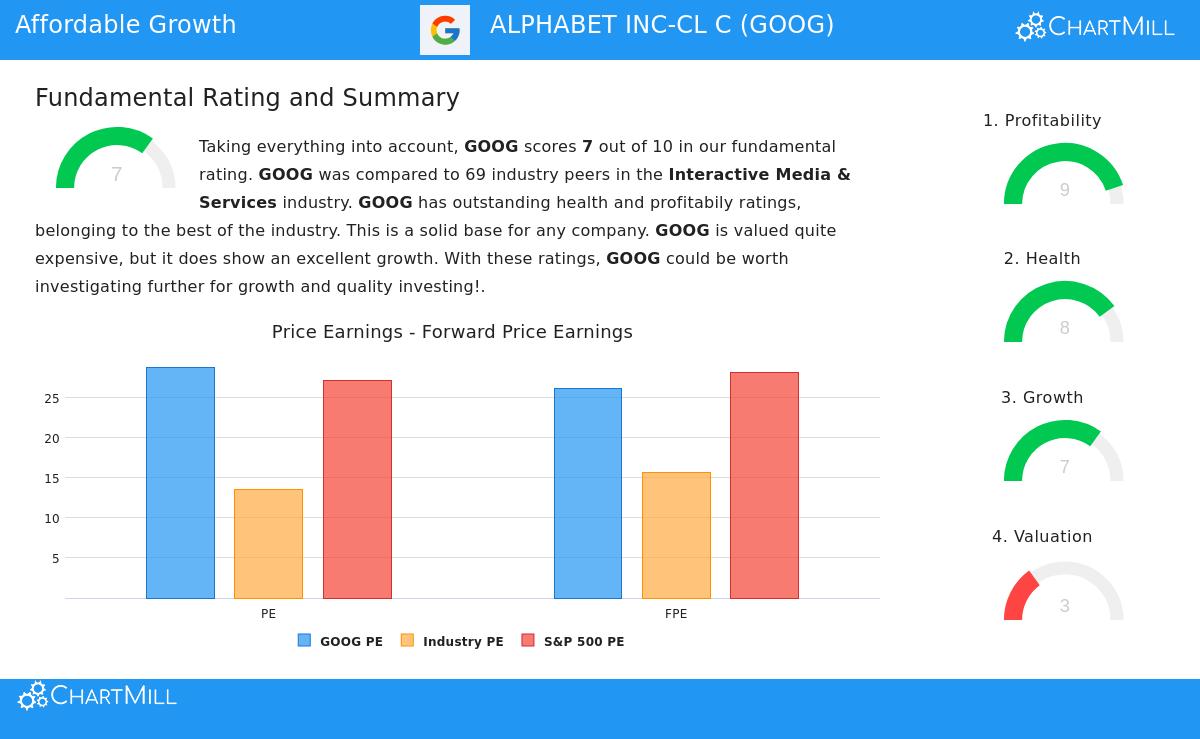
Outside the specific filter measures, a wider examination of Alphabet's fundamental picture supports its position as a GARP candidate. According to a complete fundamental analysis report, Alphabet gets a 7 out of 10 overall, with especially high scores in profitability (9/10) and financial health (8/10).
The company's advantages are clear. Its profit margins are some of the best in its field, and its return on invested capital (ROIC) of over 23% shows very efficient use of capital. The balance sheet is strong, marked by a large cash holding and an Altman-Z score that suggests almost no chance of bankruptcy. The primary area for attention, as is common with high-quality growth companies, is in valuation. While the P/E ratio is high compared to the wider market, this is partly reasonable given the company's exceptional profitability and growth history.
You can see the full fundamental analysis for Alphabet here: GOOG Fundamental Analysis Report.
A Standard "Clear" Business
While Lynch supported investing in what you know, he also stressed the need for an understandable business model. Alphabet's main Google Services part, including Search, YouTube, and the Android system, creates revenue that is straightforward and fixed in the worldwide digital economy. Its newer growth source, Google Cloud, also works on a plain, subscription-based model. This operational simplicity fits the idea of Lynch's philosophy, letting investors see the origin of the company's strong financial numbers.
Summary
For investors looking for a long-term growth-at-a-sensible-price method, Alphabet makes a strong argument when assessed through a Peter Lynch-inspired structure. It shows the uncommon mix of top-level, maintainable profitability, a very secure balance sheet, and a price that, when considered alongside its growth rate, seems sensible. While its large size means it is not a hidden high-growth stock, it represents the ideas of a financially superior company increasing at a good speed without asking for a very high price from investors.
The Peter Lynch filter is made to methodically find companies with this distinct profile. To see other stocks that currently meet this group of strict growth and value filters, you can view the complete filter results here: Peter Lynch Strategy Stock Screen.
Disclaimer: This article is for informational purposes only and does not constitute financial advice, a recommendation, or an offer to buy or sell any security. Investing involves risk, including the potential loss of principal. You should conduct your own research and consult with a qualified financial advisor before making any investment decisions.