

For investors looking for chances where a company's market price seems separate from its actual business condition, a systematic value method can be a useful rule. This process involves searching for stocks that are basically in good shape, showing acceptable growth, earnings, and financial condition, but are valued below what they might be worth. The aim is to find possible discounts before the wider market sees and fixes the difference. One stock that recently came up using such a "Decent Value" filter, which looks for a good valuation score together with acceptable fundamental grades, is Travel + Leisure Co (NYSE:TNL).
Valuation: The Heart of the Chance
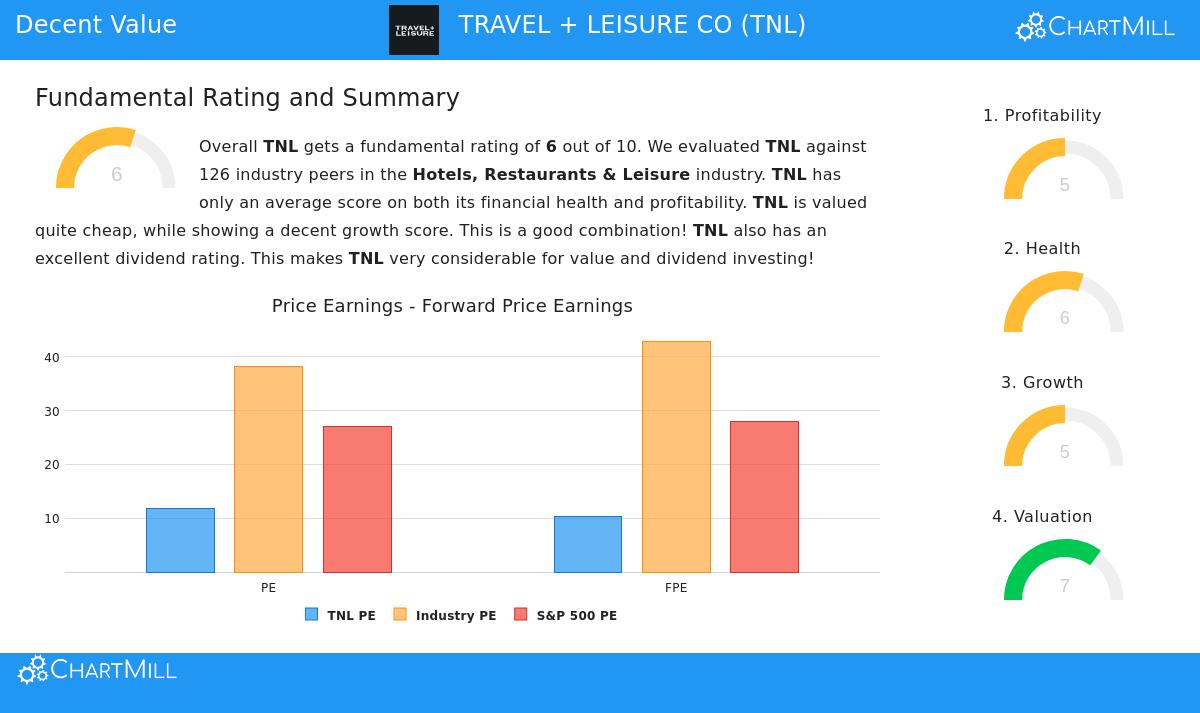
The main attraction of TNL for an investor focused on value is in its valuation numbers, which imply the stock is selling for a notable markdown. According to ChartMill's basic review, TNL gets a Valuation Grade of 7 out of 10, a main part of the filtering process. This grade is backed by specific data points that are important to value investment ideas, which look for a gap between price and calculated value.
- Price-to-Earnings (P/E) Ratio: At 11.82, TNL's P/E ratio is viewed as very acceptable. It is less expensive than 84% of similar companies in the Hotels, Restaurants & Leisure field and sits notably under the S&P 500 average of about 27.
- Forward P/E Ratio: An even more interesting number is the forward P/E of 10.36, showing a fair price based on future profit forecasts. This ratio is better than 87% of industry rivals.
- Price-to-Free Cash Flow: The company also seems inexpensive based on its cash production, selling at a lower Price/Free Cash Flow ratio than 92% of its industry.
For a value investor, these figures are not just statistics; they form the measurable base for judging if a stock is priced too low. A low P/E alongside stable basics can signal a possible purchase chance if the market is missing the company's lasting profit ability.
Reviewing Financial Condition and Earnings
A low price by itself can be misleading if the company's base is poor. So, the filtering plan needs acceptable grades in Financial Condition and Earnings to confirm the business is steady and able to continue. TNL's Condition Grade of 6 and Earnings Grade of 5, while middling, meet this level of basic stability.
The financial condition review shows clear positives in cash availability, an important reserve for any company. TNL's Current Ratio of 3.51 and Quick Ratio of 2.64 are solid, doing better than over 90% of its industry counterparts and pointing to a good ability to cover near-term debts. Debt measures are varied, with an acceptable Altman-Z score but a high Debt-to-Free Cash Flow ratio, indicating borrowing that needs watching.
On earnings, TNL displays a steady history, having made a profit with positive operating cash flow in each of the last five years. Its Operating Margin of 14.47% is good, exceeding 64% of the industry and displaying recent gain. While the overall Profit Margin matches the industry average, the steady cash flow creation backs the dividend and allows for financial choices.
Growth and Dividend: Backing the Idea
Value investment does not overlook growth; lasting growth helps support and possibly raise calculated value over time. TNL's Growth Grade of 5 mirrors a stable past performance, with Earnings Per Share (EPS) increasing at an average yearly pace of 12.07% over recent years. Looking forward, analysts think this trend will persist with EPS growth estimated at 14.28% per year.
Also, the company provides a good yield, getting a Dividend Grade of 7. With a yearly dividend yield of 2.96%, it pays more than 87% of its industry equals and is above the current S&P 500 average. The dividend has a steady 10-year past and has been increasing at a yearly pace of 7.61%, adding a real return element while investors anticipate a possible price adjustment.
A Pick for the Value List
When judged through the view of a systematic value plan, Travel + Leisure Co shows an interesting outline. It trades at valuation levels that are inexpensive both compared to its past and to its industry, giving the desired "gap of safety." This lower price exists together with signs of a basically working business: it produces steady profit and cash flow, keeps a good cash position, and is predicted to keep growing profits. The better-than-average, rising dividend also improves total return possibility.
This mix of low price measures, financial steadiness, and modest growth is exactly what the "Decent Value" filter is made to find. It implies the market could be setting too low a price on TNL's lasting business plan in the vacation ownership and travel services area.
Interested in reviewing other stocks that match this value-focused outline? You can use the "Decent Value" filter yourself to find more options here.
Disclaimer: This article is for information only and is not financial guidance, a suggestion, or a deal to buy or sell any security. The review uses given data and certain filtering rules; investors should do their own complete study, including a look at the company's full basic report, financial reports, and risk details, before making any investment choices.