

In the world of investing, few strategies have the lasting history of value investing. Established by Benjamin Graham and made famous by Warren Buffett, the central idea is simple: look for companies selling for less than their true value. This method needs discipline, patience, and a concentration on basic financial condition instead of short-term market feeling. One useful way to find such chances is to search for stocks that show good valuation measures, trading at a lower price than similar companies and the wider market, while still keeping acceptable scores in profitability, financial condition, and expansion. This mix is important; a low-priced stock is only a worthwhile purchase if the business itself is good and has a chance to expand. A "Decent Value" search, which sorts for these joined traits, can help investors steer clear of "value traps" and find companies that are not just low-cost by the numbers but are also set up for possible improvement.
Sanofi ADR (NASDAQ:SNY), a worldwide pharmaceutical leader based in Paris, recently appeared from such a search. The company's varied collection includes prescription drugs, consumer health products, and vaccines, with major products like Dupixent. For value investors, the attraction is in the gap between the company's good operational basics and its present market price, pointing to a possible chance for those ready to see past recent distractions.
Valuation: An Attractive Starting Price
The foundation of any value investment is a good price. Sanofi's valuation measures are notable as especially attractive, particularly within the frequently high-priced pharmaceuticals field.
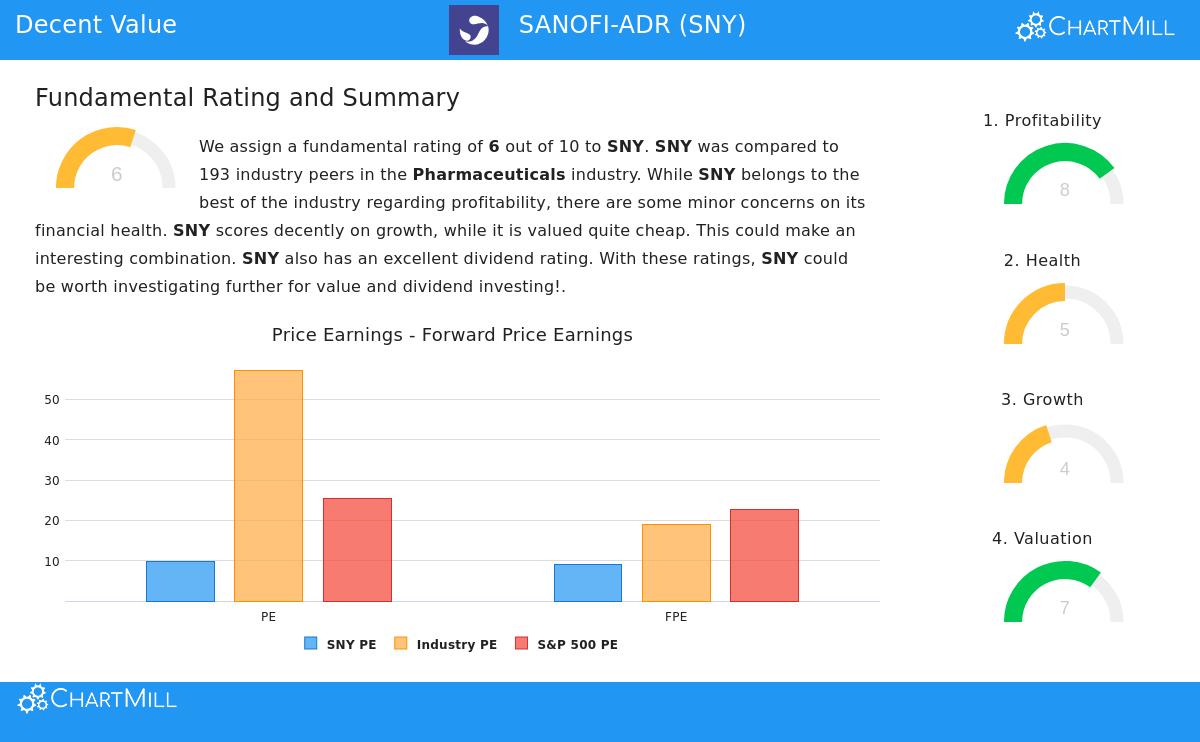
- Price-to-Earnings (P/E): Sanofi trades at a trailing P/E ratio of 9.88. This is much lower than the S&P 500 average of about 25.5 and also less expensive than 91% of similar companies, whose average P/E is above 57.
- Forward P/E: Looking forward, the view stays much the same. With a forward P/E of 9.11, the stock is priced lower than almost 89% of the field, compared to a market average of 22.67.
- Price-to-Free-Cash-Flow: The company also seems inexpensive on a cash flow basis, trading at a ratio that is below 93% of its pharmaceutical rivals.
This lower valuation gives what value investors name a "margin of safety." It makes a cushion against mistakes in study or unexpected difficulties, meaning an investor is paying a price that already expects little or no expansion. If the company merely meets expectations, the chance for price increase is better.
Profitability: A Base of Firmness
A low price means little if the business does not make money. Here, Sanofi does very well, getting a high ChartMill Profitability Rating of 8 out of 10. Firm and steady profitability is a main sign of a company's competitive edge and operational effectiveness, traits greatly valued in value investing.
- High Returns: The company shows very good returns on capital, with a Return on Invested Capital (ROIC) of 13.76%, doing better than 93% of the field. Its Return on Equity of 17.49% is also in the top group of similar companies.
- Good Margins: Sanofi keeps solid profit margins. Its operating margin of 23.28% and profit margin of 17.71% both do better than about 90% of the pharmaceutical industry, showing price strength and expense management.
- History: Importantly, the company has been steadily profitable and produced positive operating cash flow over the last five years, showing the dependability of its earnings.
This profitability supports the investment idea. It verifies that the lower stock price is not a sign of a failed business model but may instead be because of short-term issues or field-wide negative views.
Financial Health: An Acceptable Financial Position
Financial condition is essential for a value investor, as it makes sure a company can survive economic drops and put money into its future without too much risk. Sanofi gets an average Health Rating of 5, which shows a firm but not perfect situation.
- Firm Solvency: The company's debt situation is acceptable. Its Debt-to-Equity ratio of 0.22 is good, and more notably, its Debt-to-Free-Cash-Flow ratio of 1.86 is very good. This means it could pay off all its debt with less than two years of cash flow, a situation better than 95% of its field.
- Liquidity Note: A small point to note is liquidity. The Current and Quick Ratios are both at 1.09, which is enough for meeting near-term debts but falls behind many industry peers. For a large, steady company with dependable cash flows, this is often seen as a minor point rather than a serious problem.
In total, the financial position backs the value argument. The company does not have too much debt, and its firm cash production gives room for dividends, share repurchases, and strategic research investments.
Growth and Dividend: Steady Outlook with Income
While pure value stocks sometimes do not have expansion, Sanofi gives a fair view. Its Growth Rating of 4 shows slight but steady growth. Revenue has grown about 5% each year, and earnings per share (EPS) expansion is expected to rise to over 8% in the next few years. This even, predictable growth is often more lasting and wanted for value collections than unsteady, high-growth guessing.
Also, the stock gives a large dividend yield of 5.27%, which is a key part for many value plans. This yield is not only much higher than the S&P 500 average but also better than 97% of pharmaceutical stocks. The dividend has a dependable 10-year history, and while its growth has been slight, its continued payment is backed by the company's firm earnings.
Conclusion
Sanofi shows a case that matches central value investing ideas. It is a financially firm, very profitable business in a necessary field, trading at a notable discount to both the market and similar companies. The mix of a low price (giving a margin of safety), high profitability (showing a good business), acceptable financial condition, and a good dividend makes an attractive outline for investors looking for underpriced chances. The stock seems to be priced for no change while the business itself keeps producing large cash and growing steadily.
For investors wanting to find other companies that match this "Decent Value" outline, stocks with good price, acceptable profitability, health, and growth, you can look further using the set search on ChartMill.
Disclaimer: This article is for information only and does not make financial advice, a suggestion, or an offer to buy or sell any security. Investing includes risk, including the possible loss of original money. Always do your own complete study and think about your personal money situation before making any investment choices.