

For investors looking for steady income, a methodical screening process can find companies that provide more than a high stated yield. A frequent approach uses filters for stocks that join a good dividend history with sound core business traits. This involves searching for companies that not only distribute an appealing dividend now but also have the earnings to keep those payments and the financial strength to handle economic shifts. By focusing on a high dividend score together with acceptable ratings for earnings power and financial condition, investors can create a list of prospects made for longevity, not just current yield.
Sanofi (NASDAQ:SNY) appears from this screening process as a notable candidate for portfolios centered on dividends. The large worldwide drug company, with its varied collection of prescription medicines, vaccines, and consumer health items, shows a character that fits the main ideas of cautious, income-focused investing.
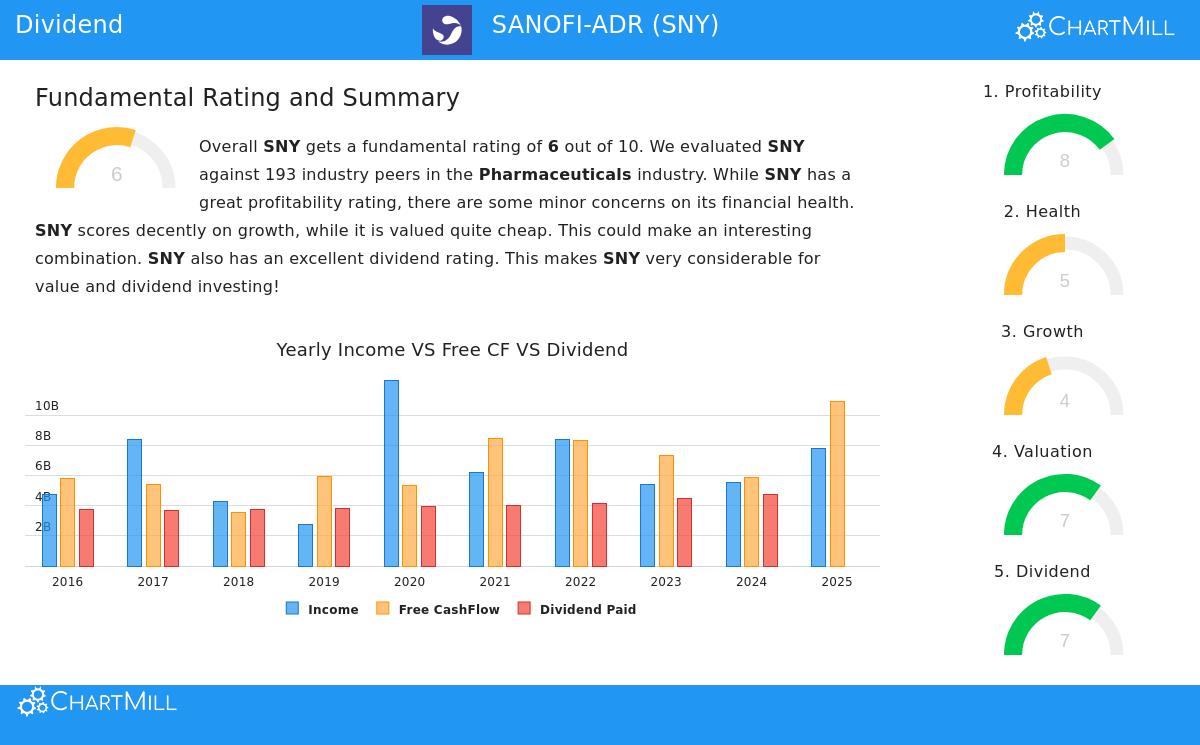
A Notable Dividend Character
The central part of SNY's attraction for income investors is its solid dividend, which gets a good score of 7 out of 10 in ChartMill's assessment.
- Good Present Yield: Sanofi now gives a yearly dividend yield near 5.30%. This is a significant return next to the wider S&P 500 average (near 1.82%) and its own comparison group in the drug sector, where it pays more than 97% of companies.
- History of Consistency: The company has built a consistent history, having given dividends without break for at least 10 years. This past record offers some trust in management's dedication to giving capital back to shareholders.
- Maintainable Payment: A vital test for any dividend stock is whether its payment can be maintained. The review shows that Sanofi's profits are increasing at a speed that backs its dividend, hinting the present level is workable within its earnings.
While the yearly dividend increase rate has been a small 4.30% and has had drops in the latest three-year span, the main point for many income investors is the safety and appeal of the present yield, fields where SNY gets high marks.
Supported by Good Earnings Power
A high dividend is only as reliable as the company's skill to pay for it. This is where Sanofi's very good earnings score of 8 out of 10 gives important backing. A company must create steady and good-quality profits to keep and raise its dividend over time.
- Steady Profit Ability: Sanofi has been profitable with positive operating cash flow in every one of the last five years, showing durable operations.
- Effective Use of Money: Key earnings measures are notable. The company states a Return on Invested Capital (ROIC) of 13.76% and a Return on Equity (ROE) of 17.49%, both numbers placed in the high end of its industry. This signals management is good at creating profits from the money used.
- Good Margins: Strong operating and profit margins (23.28% and 17.71%, in order) further highlight the company's pricing ability and operational effectiveness inside the competitive drug field.
This earnings base is necessary; it means the dividend is paid from real business results, not from borrowing or selling assets, which is a key danger to skip in dividend investing.
Reviewing Financial Condition
The screening rules also ask for acceptable financial condition, a protection against dividend reductions during weak periods. Sanofi gets a middle condition score of 5 out of 10. The review shows a varied image, with clear positives and some points to watch.
- Good Solvency State: The company's debt situation looks controllable. A small Debt-to-Equity ratio of 0.22 shows little dependence on debt funding. Most of all, its Debt to Free Cash Flow ratio is a very good 1.86, meaning it could in theory clear all its debt with under two years of cash flow—a mark of good financial room.
- Liquidity Points: The main areas of care come from liquidity measures. Its Current and Quick Ratios are both at 1.09, which, while showing an ability to meet near-term debts, are under the industry average. This proposes investors should observe working capital handling, though it is not a direct warning sign given the company's good cash creation.
For an established company like Sanofi, the good solvency measures and outstanding debt-to-cash flow profile are often seen as more important for dividend continuation than very high current ratios.
Price and Increase Setting
From a price view, Sanofi looks fairly valued, scoring a 7 out of 10. With a Price-to-Earnings (P/E) ratio of 9.56 and a Forward P/E of 8.82, the stock is priced lower than over 90% of its industry group and the wider market. This proposes the appealing dividend yield is not an illusion caused by a high stock price, but could show some market underrating.
Increase is modest, with a score of 4, marked by stable but low single-digit gains in sales and earnings per share in the past. However, future profits are predicted to rise to an average growth speed near 8.5% each year. For dividend investors, this expected rise in profit growth is a good sign, as it improves the future possibility for dividend maintenance and potential raises.
A Unified Investment Case
When combined, Sanofi's character draws an image of a standard dividend investment candidate. It provides a high, well-supported yield from a business with a tested profit maker and a firm balance sheet. The screening method, focusing on a high dividend score together with acceptable earnings and condition, is made to find exactly this kind of company: one where the income comes from basic business soundness. The complete fundamental review report for Sanofi, which lists all these scores and measures, can be seen here.
Sanofi shows one result of a methodical dividend screening plan. For investors wanting to look at more companies that fit similar rules of good dividends, earnings power, and financial condition, the ready-made "Best Dividend Stocks" screen gives a selected beginning point for more study.
Disclaimer: This article is for information and learning only and does not form investment advice, a suggestion, or a bid or request to buy or sell any securities. The information given is based on supplied data and should not be the only ground for any investment choice. Investors should do their own separate research and talk with a skilled financial advisor before making any investment choices. Past results do not show future outcomes.