

For investors using a disciplined value method, the search often starts with finding companies trading below their intrinsic worth. A typical plan involves looking for stocks that seem fundamentally inexpensive based on valuation measures, while also showing enough financial soundness, earnings, and expansion to indicate the low price may be a market error rather than a lasting problem. This approach aims to sidestep the classic "value trap" by confirming that a seemingly low-cost stock is not inexpensive for a just cause, like worsening fundamentals or high debt.
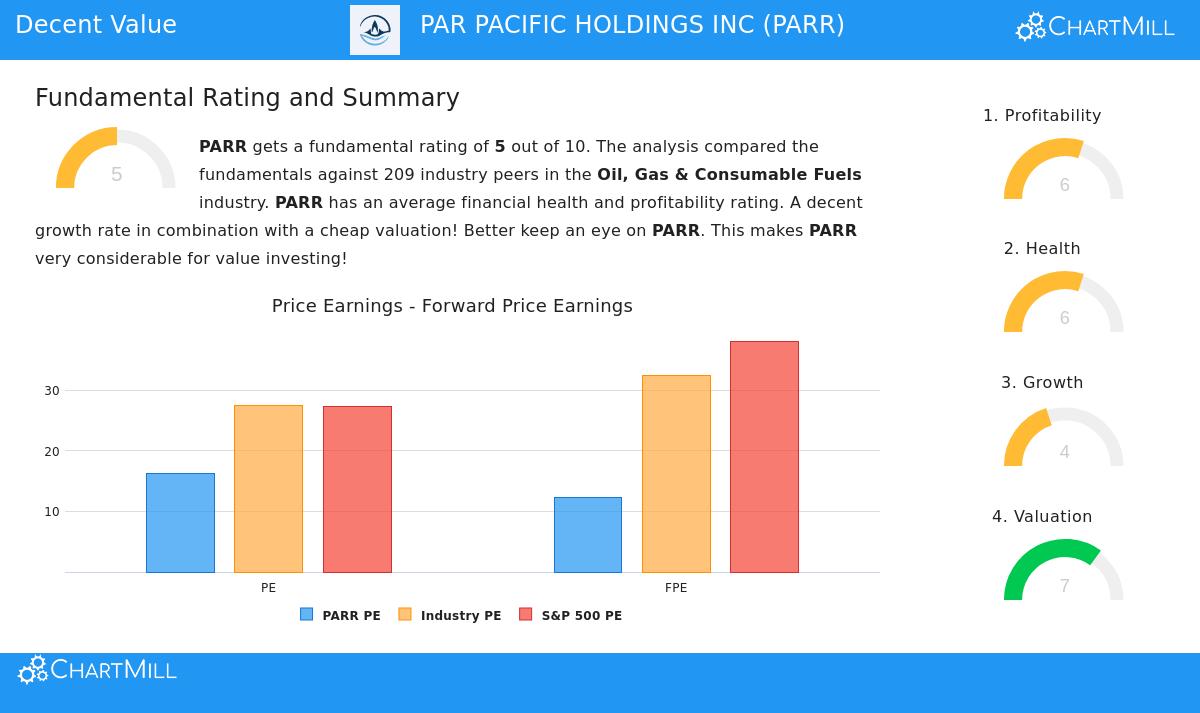
Par Pacific Holdings Inc (NYSE:PARR), a Houston-based operator of refineries and retail fuel outlets in the Pacific Northwest and Hawaii, recently appeared from such a search process. The company's fundamental profile, as shown in a detailed analysis report, makes a case for investors to study it more carefully as a possible value find.
Valuation: The Foundation of the Idea
The main attraction of Par Pacific from a value view is in its valuation measures, which indicate the stock is priced modestly compared to both its industry and the wider market. For value investors, a low valuation relative to earnings and cash flow is the first sign that a safety margin may be present.
- Price-to-Earnings (P/E): PARR trades at a P/E ratio of 16.35, which is lower than 60% of its peers in the Oil, Gas & Consumable Fuels industry and sits below the current S&P 500 average of about 27.3.
- Forward P/E: Looking forward, the valuation seems even more interesting. With a forward P/E ratio of 12.26, the company is less expensive than over 72% of its industry rivals and stands at a marked discount to the S&P 500's forward P/E.
- Cash Flow and EBITDA: The case is supported by other important valuation multiples. The stock's Price-to-Free Cash Flow and Enterprise Value-to-EBITDA ratios show it is valued lower than roughly 83% and 78% of its industry, in turn.
This set of measures forms the base of the value argument, showing the market is giving a modest price to the company's earnings and cash-producing ability.
Financial Health: Reviewing the Balance Sheet
An inexpensive stock is only a sound investment if the company is financially stable enough to withstand economic cycles and use future chances. Par Pacific's financial health rating is middling, but key solvency measures are good, which is important for value investors who focus on capital protection.
- Solvency is a Positive: The company's Altman-Z score of 3.61 shows a very low near-term chance of financial trouble, doing better than 83% of the industry. This is a vital check for value searches, as a fundamentally poor balance sheet can rapidly remove any clear valuation benefit.
- Debt Management: PARR's debt-to-free-cash-flow ratio of 2.75 is seen as sound, indicating it could pay off all its debt in under three years using its present cash flow. This ratio is stronger than 80% of industry peers.
- A Point on Liquidity: While the company's overall liquidity position is varied, with an acceptable current ratio but a lower quick ratio, the good solvency scores help reduce worries, indicating the company is not over-burdened with debt even though it works in a capital-heavy sector.
Profitability: Creating Returns on Capital
Value investing is not only about buying low-cost assets; it is about buying good assets at a low price. Profitability measures help assess that quality. Par Pacific's profitability rating is firm, with several notable numbers that suggest effective use of capital.
- High Returns on Capital: The company's Return on Invested Capital (ROIC) of 14.77% and Return on Equity (ROE) of 24.44% are some of the top in its industry, doing better than 92% and 89% of peers, in turn. For a value investor, a high ROIC shows that the business is fundamentally skilled at creating profits from its capital base, which should, over time, be seen in the share price.
- Margin Direction: Although operating and gross margins are currently near or below industry medians, the report states they have been getting better lately. This positive move in operational efficiency is a good sign that management is performing well.
Growth: The Driver for Re-assessment
Lastly, a value stock needs a catalyst for the market to re-evaluate its price. While PARR's overall growth rating is fair, it contains strong positive signs that fit with a value-growth balance.
- Notable Recent EPS Growth: Over the past year, the company's Earnings Per Share increased by a remarkable 1,234%. While this is partly because of a recovery from pandemic-period lows, it shows major operational recovery and earnings ability.
- Good Long-Term Revenue Trend: Measured over several years, PARR's revenue has increased at an average yearly rate of over 19%, showing the core business has been getting larger.
- Positive Future Earnings View: Analysts expect EPS to keep growing at a solid rate of nearly 18% each year in the coming years. This forward growth expectation, when paired with its low valuation, leads to an interesting PEG ratio, further backing the undervaluation idea.
Conclusion
Par Pacific Holdings shows a profile that matches a practical value-seeking plan. It trades at a clear discount to the market and a large part of its industry based on standard valuation measures. Importantly, this low valuation is combined with good returns on capital, a solvent balance sheet with low bankruptcy risk, and an interesting mix of strong recent earnings growth and a firm forward earnings view. This combination helps answer the central test of value investing: telling a truly undervalued company from a value trap.
For investors curious about finding similar chances that meet these standards of reasonable valuation, soundness, profitability, and growth, more study can start with the Decent Value Stocks screen used to find PARR.
Disclaimer: This article is for informational purposes only and does not constitute financial advice, a recommendation, or an offer to buy or sell any security. The analysis is based on data and sources believed to be reliable, but its accuracy cannot be guaranteed. Investing involves risk, including the potential loss of principal. You should conduct your own research and consult with a qualified financial advisor before making any investment decisions.