

For investors aiming to construct a portfolio using value investing principles, the central task is finding companies priced below their inherent value. This established method, created by Benjamin Graham and used by Warren Buffett, requires a systematic hunt for good businesses the market has incorrectly priced for now. A useful first step in this hunt is to look for stocks with good fundamental condition and earnings, combined with a price that seems separate from those basic strengths. This method aids in sorting for possible situations where a low price may not match the company's lasting earnings ability or financial soundness.
NICE LTD - SPON ADR (NASDAQ:NICE) offers a modern example for this filtering method. The enterprise software company, which supplies customer interaction and financial crime compliance products, displays a financial picture that justifies more examination from a value viewpoint.
Valuation: An Interesting Beginning
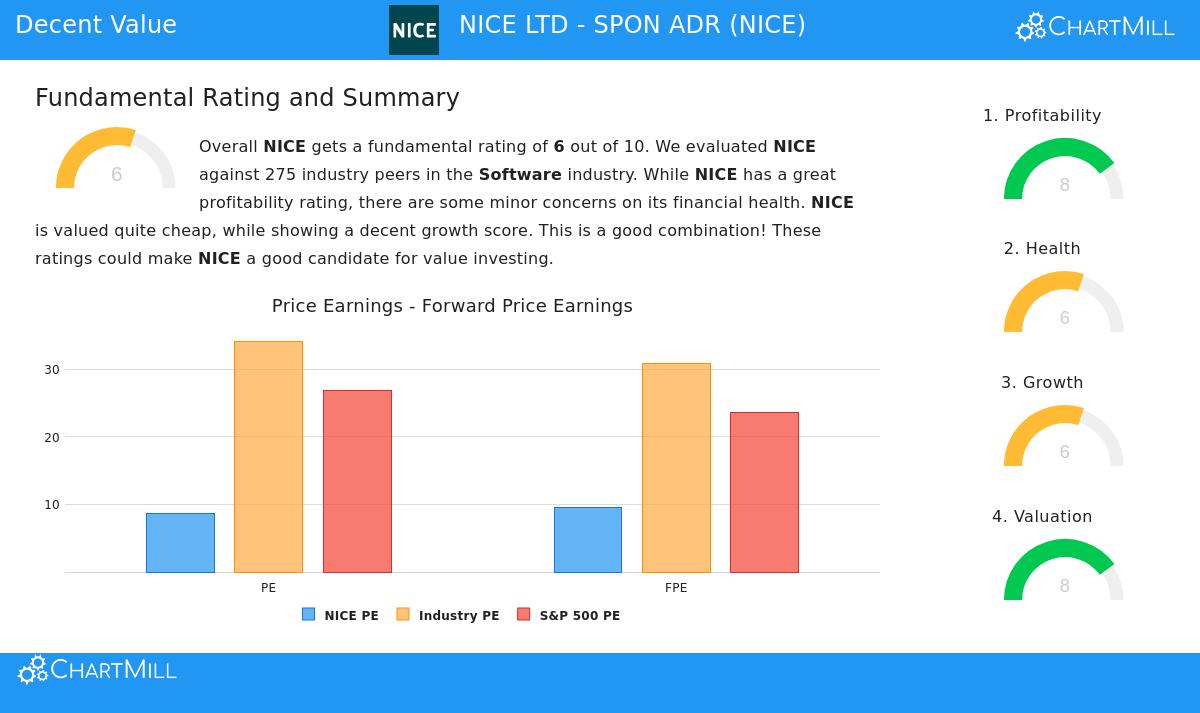
The most noticeable part of NICE's present picture is its price, which differs greatly from many in its software industry. According to ChartMill's fundamental analysis, the stock gets a high Valuation Rating of 8 out of 10. This number comes from measures that imply the market is valuing the company cautiously.
- Price-to-Earnings (P/E) Ratio: At 8.73, NICE's P/E ratio is much lower than the industry average near 34.2. This means the company costs less than about 89% of its software sector counterparts.
- Forward P/E Ratio: The price stays interesting looking forward, with a Price/Forward Earnings ratio of 9.60, which is also under the industry average.
- Enterprise Value to EBITDA & Price/Free Cash Flow: The stock also seems inexpensive using these other price measures, standing better than over 90% and 87% of industry rivals, in order.
For a value investor, this low price is the necessary initial filter. It signals a possible margin of safety, a cushion between the market price and a higher calculated inherent value, which is a key part of the value investing idea to guard against mistakes in study or unexpected declines.
Profitability and Financial Health: The Base of Quality
An inexpensive stock is only a sound investment if the core business is strong. This is where the danger of a "value trap" appears, a company that is cheap for a cause, often because of worsening fundamentals. NICE's report reduces much of this worry, displaying a business with good profitability and firm financial health.
Profitability is a definite positive, getting a high rating of 8. The company shows steady earnings ability:
- It has earned money with positive operating cash flow in each of the last five years.
- Important return measures like Return on Assets (11.99%) and Return on Invested Capital (12.43%) stand in the high group of its industry, doing better than almost 90% of counterparts.
- Both its Profit Margin (20.78%) and Operating Margin (22.23%) are with the best in the sector and have gotten better in recent years.
Financial Health receives an acceptable rating of 6. The balance sheet shows clear positives with little reason for concern:
- A major plus is the company's absence of debt, giving a Debt/Equity ratio of zero. This offers great financial room and lowers risk in times of economic doubt.
- Liquidity measures, like the Current and Quick Ratios near 1.55, are sufficient and match industry standards, meaning the company can likely meet its short-term needs.
For the value investor, these points are vital. Good profitability verifies the company's capacity to create value, while a sound, debt-free balance sheet offers durability. This pairing implies the low price is not a sign of basic problems but could be a market mistake.
Growth: Maintaining Future Worth
While strict value stocks occasionally miss high growth, NICE displays a consistent and reasonable growth path, getting a Growth Rating of 6. This adds another layer to the investment case, as it suggests the inherent value of the business is probably rising over time.
- The company has reached a firm average yearly Revenue growth of 12.31% over recent years.
- Earnings Per Share (EPS) has increased at a stronger average yearly rate of 16.51%.
- Looking forward, analysts think this pace will persist, with predictions for average yearly Revenue growth over 10% and EPS growth near 8%.
This steady growth is significant because it backs the idea that the company's inherent value is not fixed. A value investor looks for not just a cheap asset now, but one that is gaining more worth over the ownership time, which can result in price increase as the market finally sees the growth.
A Prospect for the Value Investor's Watchlist
The combination of these factors shows an interesting image. NICE seems to be a financially sound, very profitable software company with a lasting growth picture, yet it is priced at a deep reduction compared to its own industry. This separation is exactly what value-focused filters try to find. The high valuation rating indicates a possible margin of safety, while the firm ratings in profitability, health, and growth show the quality required to escape a value trap. Investors can see the complete, itemized fundamental analysis for NICE here.
Naturally, this automatic filtering is only the initial stage. A complete value investment thesis would need more detailed study of the company's competitive edges, market directions in customer experience and compliance software, and management's capital use plan. However, for those using an orderly method to locate underpriced quality, NICE stands as an interesting prospect that deserves more study.
Find Other Possible Value Prospects This study of NICE was found using a "Decent Value" filtering plan. If you want to examine other stocks that fit similar standards of good price combined with acceptable fundamentals, you can see the full filter outcomes here.
Disclaimer: This article is for information only and does not make financial guidance, a suggestion, or a deal to buy or sell any securities. The study uses data and ratings from ChartMill. Investors should do their own separate study and think about their personal financial situation before making any investment choices.