

The investment philosophy of legendary fund manager Peter Lynch focuses on finding well-run, growing companies available at sensible prices, a strategy often called Growth at a Reasonable Price (GARP). Lynch supported a careful, long-term method, concentrating on lasting earnings growth, sound financial condition, and good value, while steering clear of speculative, highly-priced stocks. A central measure in his approach is the Price/Earnings to Growth (PEG) ratio, which aids in assessing if a stock's price matches its growth rate.
One company that recently appeared from a filter using Lynch's standards is NICE LTD - SPON ADR (NASDAQ:NICE), a worldwide supplier of cloud and on-site enterprise software for customer engagement and financial crime compliance. We can look at how NICE fits with the ideas of long-term, sensible-price growth investing.
Fit with Lynch's Main Standards
Peter Lynch's method highlights an equilibrium between growth, earnings, and price. NICE seems to satisfy a number of his numerical filters, which are made to search for lasting compounders.
- Lasting Earnings Growth: Lynch preferred companies with steady, but not extreme, earnings growth, usually between 15% and 30% each year over five years. NICE states a 5-year EPS growth rate of 16.5%, fitting within this desired band. This shows a record of stable, controlled increase rather than a speed that could be hard to keep up.
- Good Value Using PEG Ratio: The central part of Lynch's value test is a PEG ratio (P/E divided by growth rate) of 1.0 or lower, hinting the market may not completely account for the company's growth. With a PEG ratio near 0.58, NICE sells at a notable markdown to its past growth rate, a good sign for value-aware growth investors.
- Solid Earnings Power (ROE): A Return on Equity (ROE) over 15% was a Lynch standard for effective use of investor money. NICE's ROE of 15.8% meets this level, showing the company is skilled at creating earnings from its equity.
- Sound Financial Condition: Lynch gave importance to companies with good balance sheets to endure economic shifts. NICE does well here, having a Debt/Equity ratio of 0.0, meaning it functions with no interest-bearing debt. Its Current Ratio of 1.55 also indicates sufficient cash to meet near-term responsibilities.
Fundamental Condition Review: A High-Level Summary
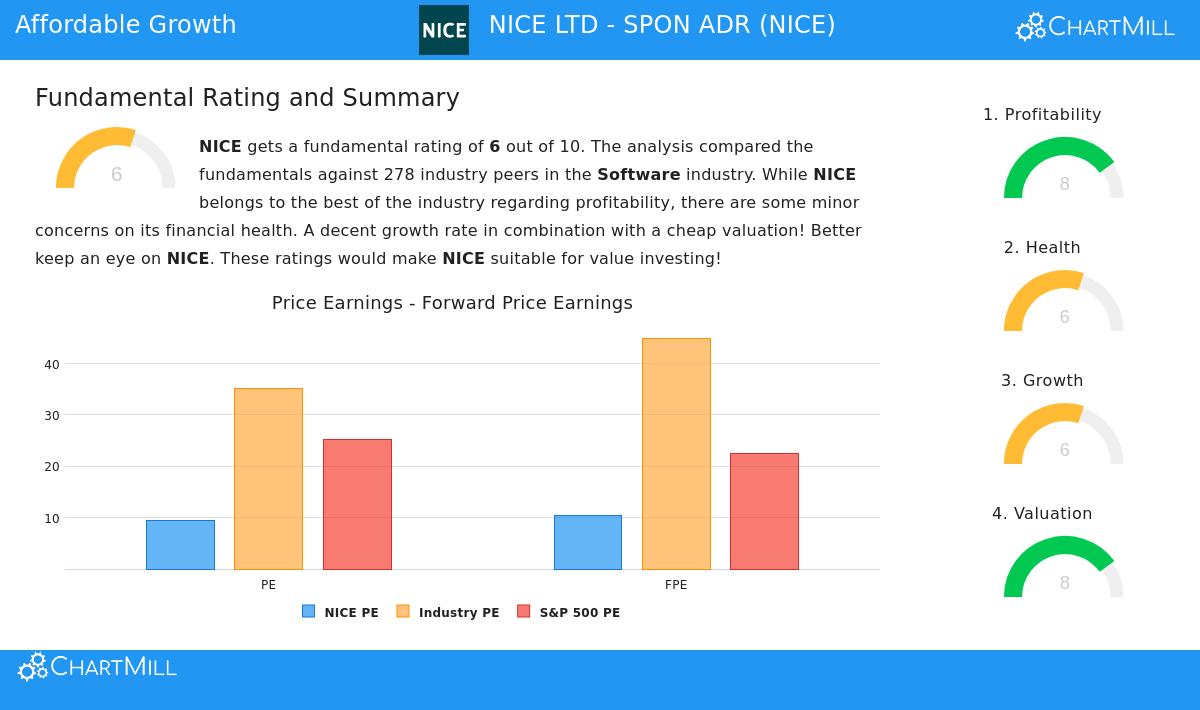
A wider fundamental analysis of NICE supports the image shown by the Lynch filter. The company receives an overall good score, with specific high points in earnings and value.
- Earnings Power is a Main Positive: NICE rates well on earnings measures, with margins and returns (ROE, Return on Invested Capital) that place in the top group of its software industry counterparts. Its profit and operating margins have displayed good directions in recent years.
- Value Stays Sensible: In spite of its good results, the stock seems priced low compared to both its industry and the wider market. Its P/E ratio of 9.5 and Forward P/E of 10.4 are much under the industry and S&P 500 averages. Most value measures indicate it is less expensive than most of its rivals.
- Growth is Consistent: While future EPS growth is estimated to slow a bit compared to the past five years, analysts still predict good high-single to low-double-digit growth in both earnings and sales, signaling ongoing increase.
- Financial Condition is Good: The lack of debt is a major benefit, giving operational choice and lowering risk. The company has also been lowering its share count through repurchases, an action Lynch saw as good since it can improve per-share value over time.
A Stock for the Long-Term Investor?
For an investor following Peter Lynch's philosophy, NICE offers a strong example. It is not a showy, high-theme stock but a company working in the necessary, though somewhat "ordinary," areas of customer service software and compliance, fields with constant need. Its financials show a careful business: profitable, without debt, and increasing at a maintainable rate. Most significantly, this comes at a price that does not appear to require ideal conditions, as shown by the low PEG ratio.
This mix of features, lasting growth, high earnings, a strong balance sheet, and a sensible price, is exactly what GARP and Lynch-type investors carefully look for in a long-term portfolio asset.
Interested in finding other companies that match this careful growth model? You can use the filter yourself and view the complete list of outcomes through the Peter Lynch Strategy stock screener.
Disclaimer: This article is for information only and does not form financial guidance, a suggestion, or an offer to buy or sell any security. Investing carries risk, including the possible loss of original capital. You should perform your own study and talk with a certified financial consultant before making any investment choices.