

For investors aiming to construct a portfolio using value investing principles, the central task is finding companies whose present market price is notably below their actual worth. This method, established by Benjamin Graham and prominently supported by Warren Buffett, depends on a systematic, numbers-based process to find chances where market negativity or inattention has produced a bargain. A vital step in this method is filtering for stocks that display good basic business qualities, such as reliable profitability, stable finances, and steady expansion, while also being priced at a good level. This pairing helps reduce risk; a low-priced stock is only a real chance if the company is financially stable and able to increase its profits over time.
WORKDAY INC-CLASS A (NASDAQ:WDAY), a top supplier of enterprise cloud applications for finance and human resources, recently appeared through such a systematic filtering process. The company's basic profile indicates it may be the kind of underrated chance value investors search for, mixing a good price level with strong operational measures.
Valuation: Priced at a Lower Level
The most notable part of Workday's present profile is its price level. In a market where many software-as-a-service (SaaS) companies have high multiples, Workday's measures appear as relatively low-cost. This is exactly the beginning for a value investor: seeing a difference between price and estimated value.
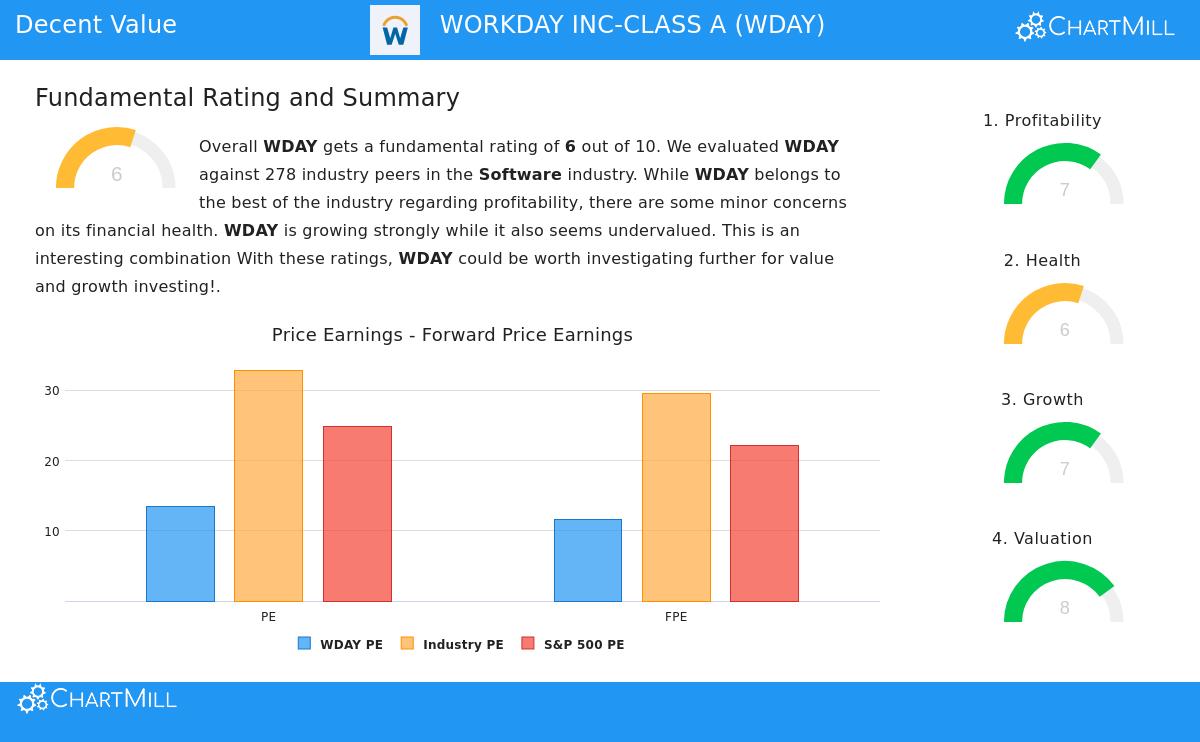
- Price-to-Earnings (P/E): Workday's P/E ratio of 13.45 is much lower than the industry average of 32.89, showing it is less expensive than over 81% of its software industry counterparts. It also rests below the present S&P 500 average of 24.88.
- Forward P/E: The view stays good looking forward, with a forward P/E of 11.56, which is also less expensive than 81% of the industry.
- Enterprise Value to EBITDA & Price/Free Cash Flow: These wider price multiples support the idea. Based on these measures, over 80% and 85% of industry rivals, respectively, are priced higher than Workday.
For a value-focused plan, these price scores are important. They suggest the market may not fully recognize Workday's earnings ability and cash flow creation compared to its sector, forming a possible safety margin—a cushion between the price paid and the investor's calculation of actual value.
Profitability: A Base of Soundness
A low price alone can be misleading if the basic business is poor. Value investing needs the company to be basically profitable. Workday's profitability ratings are good, giving assurance that the reduced price is linked to a high-standard business.
- Margin Soundness: The company has an operating margin of 16.65%, doing better than 84.5% of its industry. Its profit margin of 13.19% and gross margin of 75.70% are also above industry averages.
- Return on Capital: Workday produces a sound return on invested capital (ROIC) of 10.27%, putting it in the top group of its software peers. This measure is key as it shows how well the company is using its capital to create profits.
This degree of profitability is essential for a good value investment. It points to a business with pricing ability, operational effectiveness, and the capacity to steadily benefit shareholders—elements that support a higher actual value than the present market price may suggest.
Financial Health: A Stable Stance
Financial health is the foundation that lets a company withstand economic changes and spend for future expansion. Workday's balance sheet shows a mostly stable stance, though with some detailed points.
- Solvency: The company has a workable debt-to-equity ratio of 0.38 and, more significantly, a very good debt-to-free-cash-flow ratio of 1.08. This means it could in theory pay off all its debt with just over a year's worth of free cash flow, showing low financial danger.
- Liquidity: Its current and quick ratios are both at 1.32, which is sufficient to meet near-term needs and is similar to industry averages.
While the report mentions a somewhat higher Altman-Z score, the overall solvency view is positive. For a value investor, a sound balance sheet lowers the danger of a "value trap"—where a seemingly low-cost stock becomes cheaper due to basic financial pressure.
Growth: The Mechanism for Value Achievement
Finally, for the price difference to shrink, the company needs a path of expansion. A still business may stay low-cost forever. Workday shows a solid growth profile that can act as a driver for its share price.
- Past Results: Over the last year, revenue expanded 13.1% and earnings per share jumped 26.4%. The five-year pattern shows an average yearly revenue growth of over 17%.
- Future Projections: Analysts expect this pace to continue, with projected EPS growth of nearly 11% and revenue growth of 10.75% each year.
This steady expansion is necessary. It supplies the route for market feeling to match basics, as increasing earnings can support a higher market price level over time. It changes a static value situation into an active one.
Conclusion
WORKDAY INC-CLASS A presents a good example for value-focused filtering. It is not only a numerically low-cost stock; it is a profitable, expanding company with a fairly sound balance sheet that is currently priced at a lower level compared to both its industry and the wider market. This match, where good price level meets stable basics across profitability, health, and expansion, is exactly what systematic value plans try to find. The company's good market place in enterprise cloud software supplies a lasting competitive advantage, while its financial measures suggest the present price may not completely show its actual worth.
A detailed look at Workday's basic ratings can be seen in its full ChartMill Fundamental Analysis report.
Investors curious about finding other companies that match this profile of stable basics combined with good price levels can examine the filtering details more via this Decent Value Stocks screen.
Disclaimer: This article is for informational purposes only and does not constitute financial advice, a recommendation, or an offer to buy or sell any security. The analysis is based on data and sources believed to be reliable, but its accuracy cannot be guaranteed. Investing involves risk, including the potential loss of principal. Readers should conduct their own research and consult with a qualified financial advisor before making any investment decisions.