

For long-term investors aiming to assemble a portfolio of good companies without paying too much, the principles established by famous investor Peter Lynch remain a useful guide. Lynch’s method, often called Growth at a Reasonable Price (GARP), centers on finding profitable companies with durable growth, sound financial condition, and prices that do not account for their future prospects. It is a structured method that emphasizes basic strength over market trends, trying to find “tenbaggers” – stocks that can increase ten times in value – by putting money into comprehensible businesses for the long term.
A recent filter using Lynch’s main rules has identified United Therapeutics Corp (NASDAQ:UTHR) as a possible candidate. The biotechnology company, which creates and sells treatments for pulmonary arterial hypertension and other severe illnesses, seems to match several important Lynch ideas. We can look at how its financial picture compares to the method’s rules.
Match with Peter Lynch Rules
Peter Lynch liked companies increasing earnings at a good, but not extreme, rate, financed carefully, and selling at a price that rewards investors for that growth. United Therapeutics shows a good match across these calculated filters.
- Durable Earnings Growth: Lynch wanted companies with a 5-year earnings per share (EPS) growth between 15% and 30%, fast enough to be interesting but slow enough to be durable. United Therapeutics has a 5-year EPS growth rate of 19.2%, putting it directly in this preferred range. This shows a record of steady, above-average profit increase without the warning sign of extreme growth that can be hard to continue.
- Sensible Price Compared to Growth: The Price/Earnings to Growth (PEG) ratio is a central part of the GARP method, as it relates a stock’s price to its growth rate. Lynch wanted a PEG ratio at or below 1. With a PEG ratio of 0.93, UTHR’s current price seems sensible compared to its past earnings growth, implying the market may not completely recognize its history.
- Outstanding Financial Condition: A careful balance sheet was essential for Lynch, who preferred companies financed by ownership rather than borrowed money. United Therapeutics is very strong here, having a Debt/Equity ratio of 0.0, meaning it functions with no interest-bearing debt. This gives great financial options and lowers risk during economic declines.
- Good Short-Term Cash Position: The need for a Current Ratio of at least 1 makes sure a company can pay its upcoming bills. UTHR’s Current Ratio of 6.6 shows a very solid cash position, well above the minimum requirement and offering a large safety buffer.
- High Profit Generation: Lynch required a high Return on Equity (ROE) to ensure management was using owner money productively. UTHR’s ROE of 18.8% easily exceeds the 15% mark, showing efficient use of capital to create profits.
Basic Condition and Quality
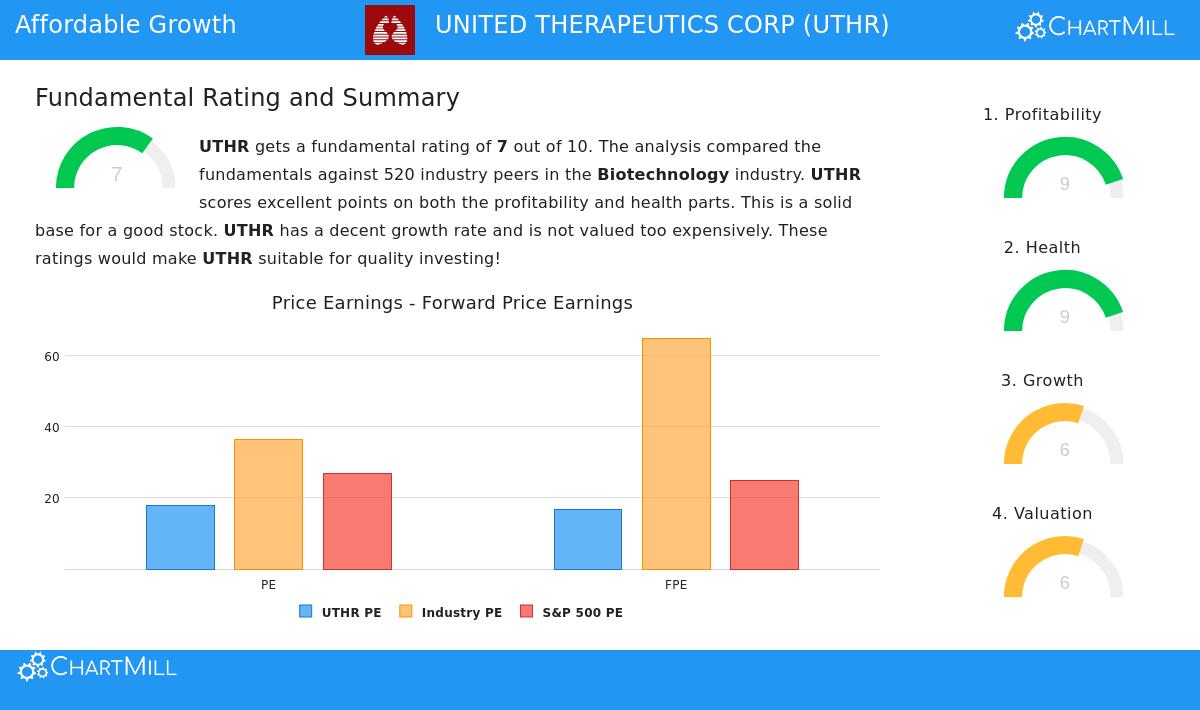
Beyond the exact filter rules, a wider view of United Therapeutics’ basic picture supports its quality traits, which are important for any long-term investment. According to a detailed basic examination, the company gets a high total score of 7 out of 10, with special force in profit generation and financial condition.
The company’s profit measures are notable:
- It keeps very good margins, including a Profit Margin of 41.9% and an Operating Margin of 47.6%, which are in the best group of its biotechnology industry.
- Returns on capital (ROE and ROIC) are regularly high, pointing to a lasting edge in its specific treatment areas.
From a condition view, the balance sheet is a main benefit:
- The lack of debt and large cash holdings lead to a top-level Altman-Z score, showing almost no failure risk.
- The company has been lowering its share count over time, a move Lynch saw as positive because it raises each owner’s share of future earnings.
Price and Growth Prospects
While the Lynch filter uses past growth to find the PEG ratio, investors must also think about what is ahead. UTHR’s price shows a varied image. Its P/E ratio of 17.9 is lower than the wider market and most of its industry peers. However, experts predict a future earnings growth rate that is somewhat lower than its past speed. This is a key area for more study: the investment idea depends on whether the company can maintain its high profit generation and discover new paths for growth to support or improve its current price over the next ten years.
Is It a Lynch-Method Chance?
United Therapeutics Corp makes a strong argument for investors who follow the Peter Lynch idea. It functions in a comprehensible, though complicated, area (treating long-term illnesses), shows a history of durable growth, and has a very strong balance sheet with high profit generation. Most significantly, it meets a number-based filter built on Lynch’s particular rules for growth, price, and financial force.
For investors doing their own study, this stock acts as a clear model of the kind of company the GARP method tries to find: a high-quality business selling at a sensible price compared to its established growth path.
You can view the complete Peter Lynch filter and find other companies that currently meet these rules here.
Disclaimer: This article is for information only and does not make up financial advice, a suggestion, or an offer to buy or sell any securities. The Peter Lynch method is a historical model, and past results are not a guide to future results. Investors should do their own complete study and think about their personal financial situation before making any investment choices.