
There are days when the market gets hit from all sides at once. Tuesday for example... If you were looking for a green light to buy, Tuesday didn't give you one.
The Rundown
- Brent crude breaks through $100 for the second consecutive session as Iran ceasefire negotiations stall, keeping the Strait of Hormuz effectively closed
- Fed chair nominee Kevin Warsh tells the Senate he made no rate cut promises to Trump, cooling market expectations for near-term monetary easing
- UnitedHealth Group posts a strong quarter with better-than-expected margins, standing out as one of the few clear winners in an otherwise difficult session
$100 Oil Is Back — and This Time It Has Company
Brent crude closed at $100.50 a barrel on Tuesday, up close to 5% for the second session in a row.
Last Friday, Brent was trading below $90 after Iran briefly declared the Strait of Hormuz open. That opening lasted roughly 48 hours before the hardliners of the Revolutionary Guard walked it back. Since then, oil has recovered all of Friday's losses and then some.
What changed on Tuesday specifically? Two things.
- Vice President JD Vance canceled his planned trip to Islamabad, where he was supposed to join negotiations between US and Iranian delegates.
- And Iran itself, via its semi-official Tasnim news agency, confirmed it wouldn't participate in those talks at all.
Add to that Trump's announcement - posted on Truth Social Tuesday evening - that the ceasefire deadline is being extended indefinitely, with no new hard date attached. The diplomatic situation, in other words, is simultaneously extended and more stuck than it was 24 hours earlier.
Trump made clear that the US naval blockade of Iranian ports will continue regardless. Iran considers that blockade a ceasefire violation, and has said as much publicly. One adviser to the Iranian parliament's speaker put it bluntly: "The losing party cannot impose conditions." That's not the language of a side getting ready to sign anything.
The practical result: the Strait of Hormuz remains closed to most commercial shipping. Oil, gas, kerosine, and other commodities that flow through that corridor stay bottlenecked. And markets are pricing that reality in, day by day.
"The losing party cannot impose conditions."*
Warsh at the Podium: "Absolutely Not"
The second headwind came from an unexpected direction, the Senate Banking Committee. Kevin Warsh, Trump's nominee to replace Jerome Powell as Fed chair, testified Tuesday and delivered a message markets didn't particularly want to hear: he made no promises to Trump about cutting rates, and he won't make any now.
When Senator John Kennedy asked directly whether Warsh would be Trump's "human sock puppet," Warsh answered without flinching: "Absolutely not. The president never asked me to pre-determine, commit, fix, or decide on any interest rate decision in any of our discussions, nor would I agree to do so."
He went further, calling central bank independence "essential" and proposing what he termed "regime change" at the Fed, potentially fewer policy meetings per year and a revised inflation framework. On the rate cut question specifically, his stance is clear: he'll follow the data, not the White House.
A meaningful portion of the equity rally over the past two weeks was built, at least partly, on the assumption that a Trump-aligned Fed chair would lean toward easing.
Warsh is signaling something more nuanced and the S&P 500 (SPX | ▼0.63%), Nasdaq Composite (COMPX | ▼0.59%), and Dow Jones (DJI | ▼0.59%) each closed around 0.6% lower on the day. Not a collapse, a recalibration.
One complication: Senator Thom Tillis is threatening to hold up the confirmation entirely until the DOJ drops its investigation into current chair Jerome Powell. Warsh's hearing was substantively solid, but his confirmation path is not straightforward.
Apple Keeps Sliding as the Transition Sinks In
Apple (AAPL | ▼2.52%) fell a further 2.5% on Tuesday, building on Monday's initial post-announcement dip.
The market announced Tim Cook's departure, effective September 1, when John Ternus takes over as CEO, just after Monday's close. Tuesday was the first full session with that news fully digested.
The reaction feels measured but persistent. Investors quietly repricing the premium they were willing to attach to a company whose leadership story just changed. Cook's era was defined by operational precision and compounding margin. Ternus inherits an AI race where Apple has been slower than peers, and a hardware-first background that is both reassuring and slightly beside the point given where the next competitive battles will be fought.
The immediate event to watch is WWDC in June. Ternus's first major public moment as incoming CEO will be defining, not for what he says about hardware, but for what he shows about Apple's AI roadmap.

Amazon Doubles Down on Anthropic and the Numbers Are Enormous
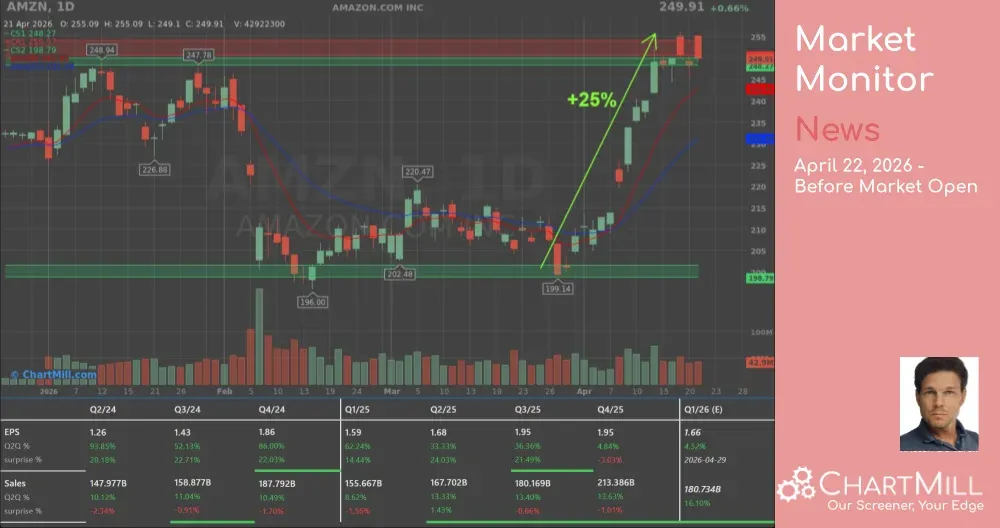
The one bright spot on Tuesday that investors could point to unambiguously was Amazon (AMZN | ▲0.66%), which gained ~0.6% after announcing a fresh commitment to Anthropic - the AI company behind Claude - worth up to $25 billion.
The structure: $5 billion in new investment now, with the potential to reach $25 billion over coming years. In return, Anthropic has committed to using a minimum of $100 billion in Amazon Web Services cloud capacity.
That last number is worth sitting with. A $100 billion cloud commitment, in exchange for a $25 billion investment ceiling. The margin logic for AWS (Amazon Web Services) is obvious. The strategic logic is equally clear: Amazon is building a long-term dependency that keeps Anthropic's compute - and therefore its infrastructure spend - squarely on AWS for years.
Marvell Technology (MRVL | ▲2.35%), which supplies chips and networking components to hyperscalers including Amazon, also moved higher on the news. When Amazon commits to AI infrastructure at this scale, the suppliers get lifted with it.

UnitedHealth: The Session's Clearest Win
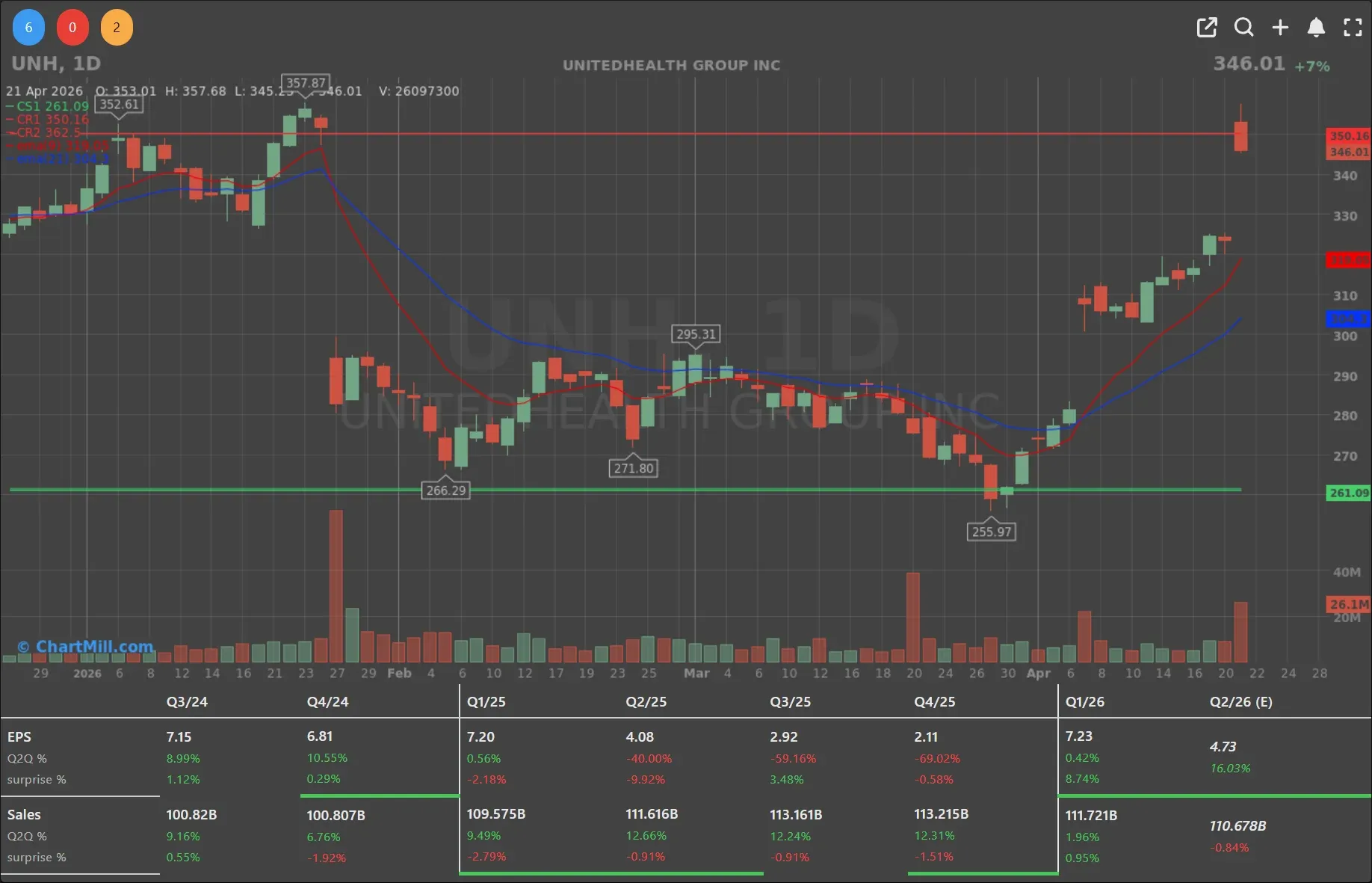
In a session short on reasons to buy, UnitedHealth Group (UNH | ▲6.96%) gave investors one.
The company posted Q1 revenue of $111.7 billion and adjusted EPS of $7.23, ahead of the $6.57 consensus. The medical benefit ratio - the share of premiums paid out in claims - came in at 83.9%, better than the 85.5% analysts had penciled in.
That metric is watched closely because it directly determines how profitable the underlying insurance business is. A better-than-expected ratio is a meaningful positive signal.
The company raised full-year guidance to adjusted earnings of more than $18.25 per share, up from the prior floor of $17.75. A gain of 7% in a session where the broad market fell 0.6% makes UNH one of the more decisive single-day earnings reactions of this reporting season so far.
Adobe's $25 Billion Statement
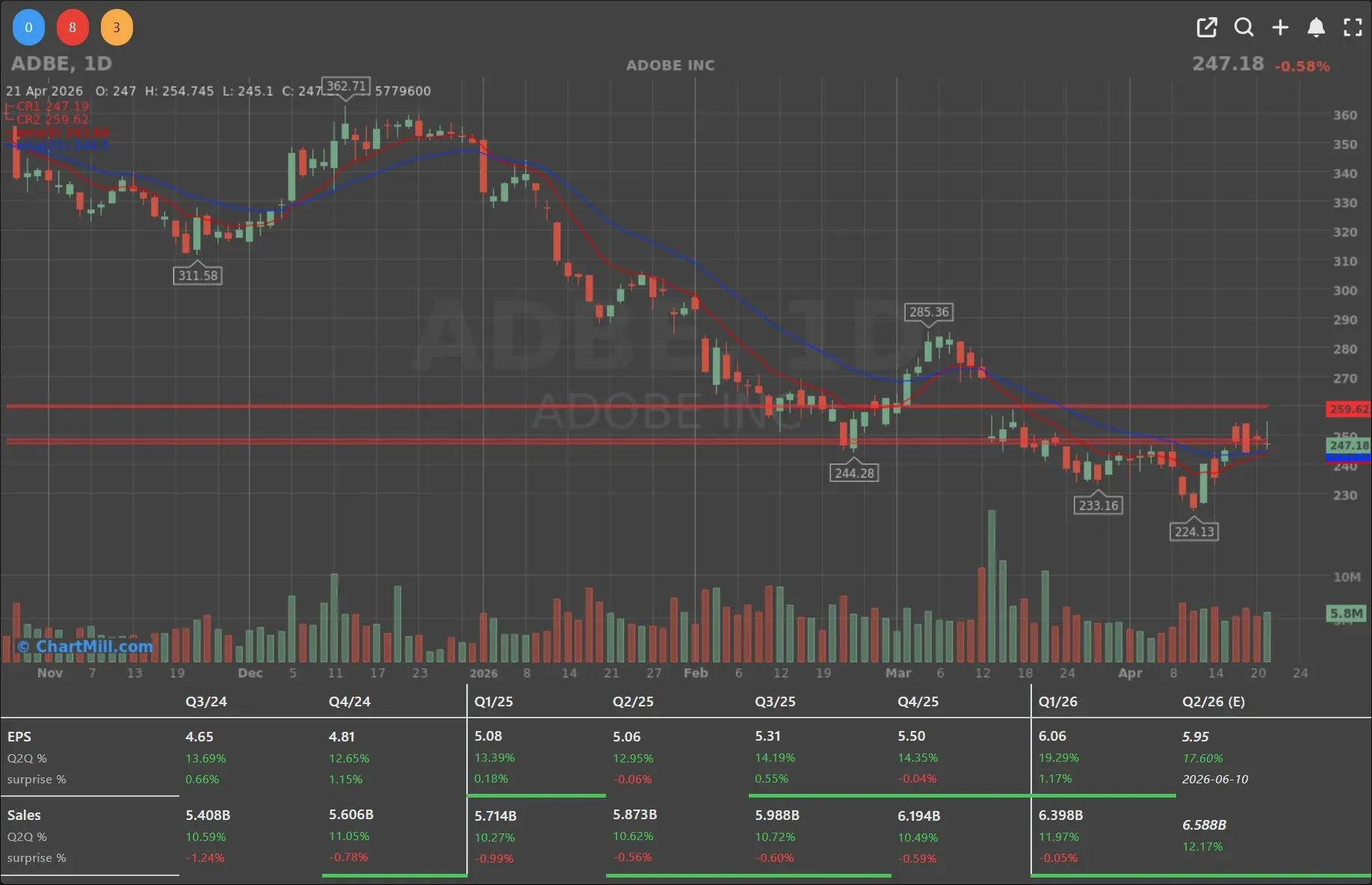
After the bell, Adobe (ADBE | ▼0.58%) announced a $25 billion share buyback program, roughly a quarter of its current market capitalization. The stated goal is straightforward: signal confidence in the company's cash flow and long-term value, at a time when the stock has lost more than 25% since the start of the year.
The pressure Adobe is under is also straightforward. Generative AI has upended the market's assumptions about software companies whose core product is creative tools. If AI can generate images, video, and design assets at scale, the question investors are sitting with is whether Adobe's pricing power holds. The buyback is management's answer: we think the stock is mispriced, so we're buying it.
CFO Dan Durn framed it as "a sign of confidence in our cashflow and the long-term value we deliver to investors."
That framing is deliberate. The company isn't saying AI isn't a challenge, it's saying the challenge is already reflected in the price. Whether that turns out to be true depends on what Adobe shows at its next developer conference and what the subscriber numbers look like through the rest of the year.
Bottom Line
Tuesday's session gave the market three separate reasons to pull back: oil through $100, a Fed nominee who won't promise rate cuts, and an Apple that's still finding its footing post-Cook.
The indices each fell roughly 0.6%, which looks orderly, but the composition of the session was less comfortable than that number implies.
Iran's response to the extended deadline, oil's direction from here, and whatever emerges from the diplomatic silence will set the tone.
ednesday's open will tell you a lot about whether Tuesday was a pause or the start of something more consequential.
ChartMill Market Desk - Kristoff
This daily update is prepared by ChartMill for informational purposes only and does not constitute investment advice. Always do your own due diligence before making investment decisions.
Next to read: Market Breadth Stays Constructive, but the Tape Is Losing Some Urgency