

Investors looking for a disciplined, long-term method for constructing a portfolio frequently consider the principles of legendary fund manager Peter Lynch. His strategy, described in One Up on Wall Street, centers on finding growing companies that are financially sound and available at sensible prices. It is a mix of growth and value investing, commonly called Growth at a Reasonable Price (GARP). The central concept is to locate businesses with maintainable, but not extreme, growth rates, good profitability, and firm balance sheets, then keep them for the long term, paying no attention to short-term market fluctuations. A stock screener using Lynch’s guidelines can reveal possible candidates, which then need more detailed fundamental study.
One company that recently appeared from such a screen is The Trade Desk Inc. (NASDAQ:TTD), a provider of a cloud-based platform for digital advertising buyers. For investors following Lynch's ideas, TTD offers a strong case for more examination based on several important quantitative filters.
Fit with Peter Lynch's Main Guidelines
The Lynch-based screen uses particular filters to find companies with a maintainable growth history, sensible valuation, and financial soundness. The Trade Desk fits these basic needs, as shown by the given data.
- Maintainable Earnings Growth: Lynch preferred companies with good, but not overly high, growth that could be continued. The screen looks for a 5-year average EPS growth between 15% and 30%. TTD's EPS has increased at an average yearly rate of 21.2% over the last five years, fitting inside this target zone. This shows a record of solid, yet possibly maintainable, profit growth.
- Sensible Valuation (PEG Ratio): Maybe the most important Lynch measure is the Price/Earnings to Growth (PEG) ratio, which tries to find stocks that might be priced low compared to their growth rate. Lynch wanted a PEG of 1 or lower. TTD's PEG ratio, using its past five-year growth, is 0.56. This implies the market might be pricing the company below its historical growth path, a main point for GARP investors.
- Good Profitability (Return on Equity): Lynch searched for companies that create profits from shareholder equity in an efficient way. The screen requires an ROE above 15%. TTD's ROE of 17.8% is higher than this level, showing management is using invested capital well to produce earnings.
- Financial Soundness (Debt & Liquidity): A careful balance sheet was very important to Lynch. The screen looks for a Debt/Equity ratio below 0.6 and a Current Ratio of at least 1. TTD does very well here, reporting no debt (Debt/Equity of 0.0) and a Current Ratio of 1.61. This means a very strong balance sheet with good liquidity to cover short-term needs, offering a notable safety buffer.
Fundamental Soundness and Growth History
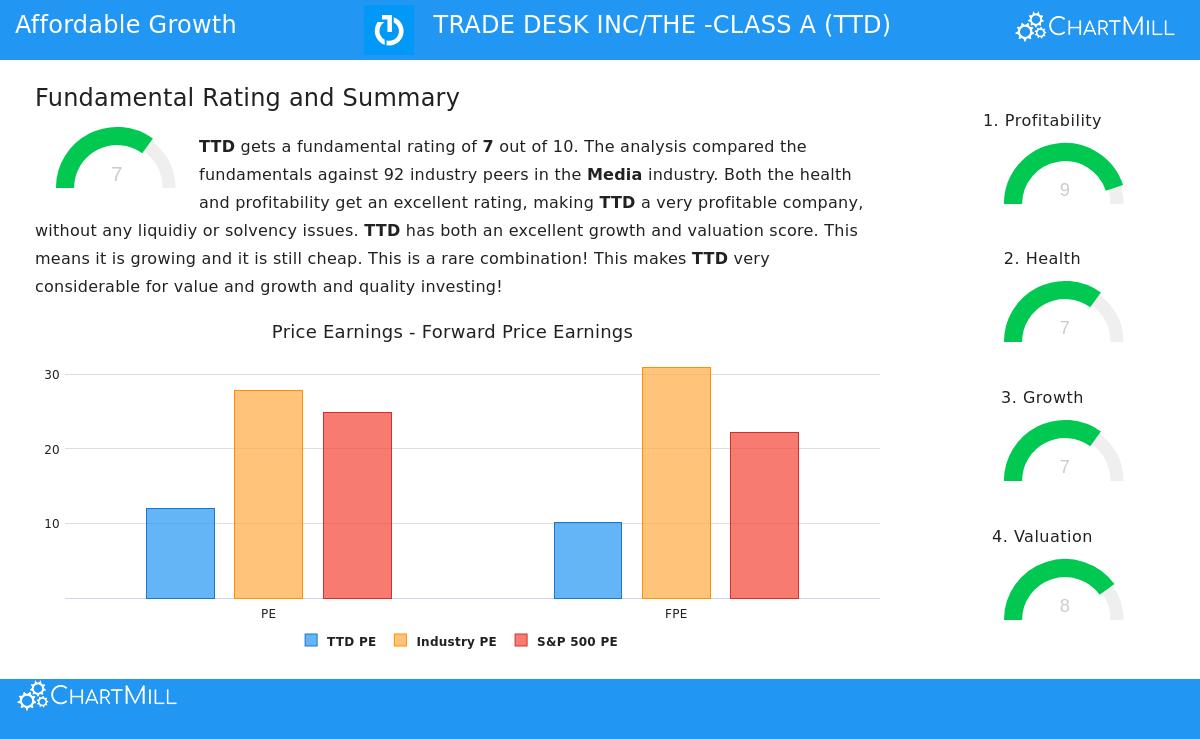
A wider view of The Trade Desk's fundamental report supports the image shown by the Lynch screen. The company receives a high total fundamental score, with specific high points in profitability and financial health.
Its margins lead the industry, with a gross margin close to 79% and a strong operating margin above 20%. While recent yearly EPS growth has slowed, the long-term path stays good, backed by steady double-digit revenue growth. The valuation measures also seem appealing compared to both its industry group and the wider S&P 500, with its P/E and forward P/E ratios at a lower level. This mix of high profitability, good growth history, and sensible valuation is exactly the profile long-term investors look for.
For a complete look at these measures, you can see the full fundamental analysis report for TTD.
Points for the Long-Term Investor
While the quantitative filters fit well, Lynch stressed knowing the business behind the data. The Trade Desk works in the competitive and changing digital advertising field, a sector with long-term growth trends, especially in areas like connected TV (CTV). An investor's required study would include judging the strength of the company's competitive position, its skill in handling industry shifts like privacy rules, and if its growth rate can be maintained close to its historical average. The company's lack of debt and good cash flow give it options to spend and adjust.
Finding More Investment Options
The Trade Desk is one instance of a company that meets a strict group of filters drawn from a tested long-term method. For investors wanting to build a varied group of similar candidates, a systematic screen is a good first step.
You can locate more companies that fit these Peter Lynch investment guidelines by using the Peter Lynch Strategy stock screener. Keep in mind, any screen produces a research list, not a list of purchases. Each company needs complete individual study to understand its specific business model, competitive strengths, and future possibilities before any investment choice is made.
Disclaimer: This article is for information only and is not financial advice, a suggestion, or an offer to buy or sell any security. Investing has risk, including the possible loss of the amount invested. You should do your own research and talk with a qualified financial advisor before any investment choices.