

In the hunt for lasting, high-grade investments, many long-term investors apply the ideas of quality investing. This strategy centers on finding companies with durable competitive strengths, sound financial condition, and a record of producing steady, high returns on capital over extended periods. One methodical way to locate these companies is the "Caviar Cruise" stock screen, a process built on quality investing ideas. This screen looks for firms with a track record of good revenue and profit increase, high returns on invested capital, good free cash flow production, and reasonable debt amounts. The aim is not to locate temporary discounts, but to discover businesses constructed to last and build wealth for shareholders over time.
A recent use of this screen has brought attention to Tapestry Inc (NYSE:TPR), the owner of well-known brands such as Coach, Kate Spade, and Stuart Weitzman. The company's financial picture seems to match several main quality investing standards, making it an interesting subject for more study by investors looking for lasting business models.
Matching the Main Quality Standards
The Caviar Cruise screen uses a multi-step sorting process, and Tapestry's shown numbers indicate good performance in important areas:
-
Profitable Increase: The screen requires at least a 5% compound annual growth rate (CAGR) for both revenue and EBIT (earnings before interest and taxes) over five years. Tapestry passes these limits easily, with a revenue CAGR of 5.5% and a notably strong EBIT CAGR of 26.1%. Significantly, a key sign of a good business is rising profitability, which is shown when EBIT increase is faster than revenue increase. Tapestry’s clear lead on this measure points to good operational efficiency and pricing ability within its group of brands.
-
Outstanding Capital Efficiency: For quality investors, the return on invested capital (ROIC) is a crucial measure. It calculates how well a company produces profits from the capital it has used. The screen establishes a high limit with an ROIC (leaving out cash, goodwill, and intangibles) over 15%. Tapestry not only reaches this but goes beyond it, stating a number of 64.9%. This shows a very efficient business model where the company's brands produce large profits without needing very big continuous capital spending.
-
Financial Soundness and Cash Flow Character: A good company should be financially stable. The screen checks this by calculating how many years it would take to repay all debt using current free cash flow, looking for a number under 5. Tapestry’s number of 1.48 is very good, showing little debt load compared to its cash production. Also, the screen checks for "high-grade" earnings by comparing free cash flow to net income, favoring a five-year average over 75%. Tapestry’s number of 208.5% is excellent, showing it turns accounting profits into actual, usable cash at a rate over two times its stated net income. This gives great room for strategic moves like new investment, purchases, or shareholder payments.
A Broad Fundamental Picture
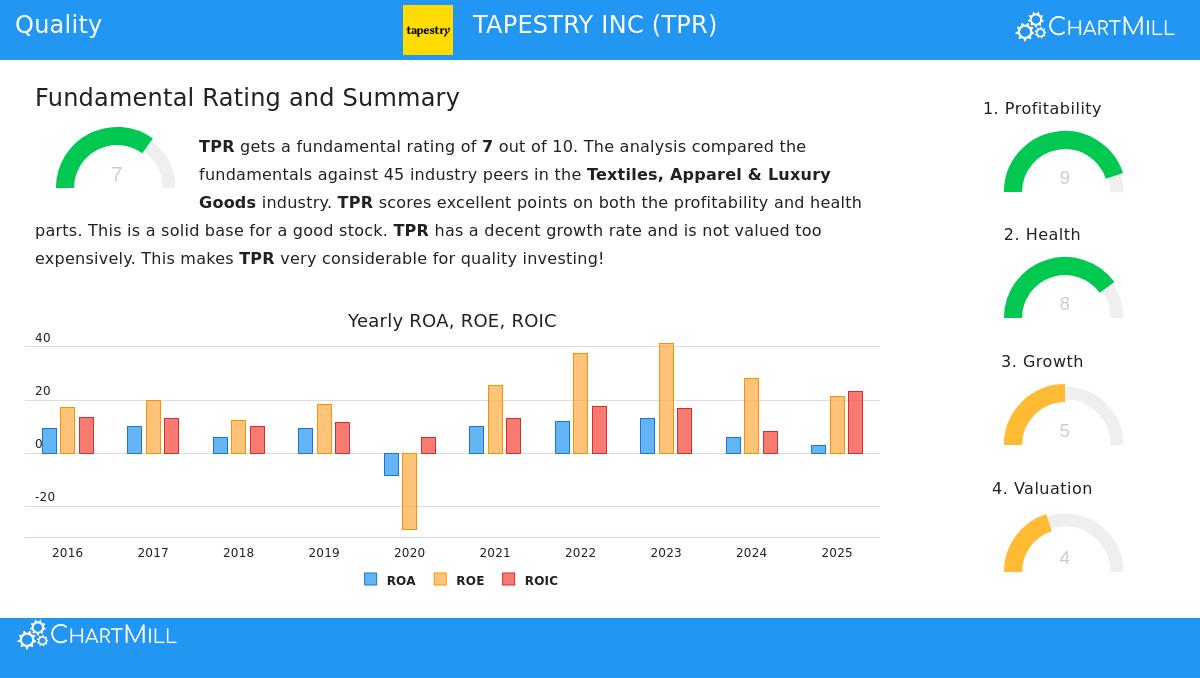
An examination of Tapestry’s detailed fundamental analysis report supports the results from the screen. The report gives Tapestry a good overall fundamental score of 7 out of 10. The leading areas are profitability and financial condition, where the company gets a 9 and 8, in order. Main advantages listed include top-tier margins, a very high ROIC, and the good debt-to-free-cash-flow situation mentioned before.
The valuation and growth scores are more average, at 4 and 5. The stock’s price-to-earnings ratio is seen as somewhat high in simple terms, though it matches both the wider market and its luxury goods competitors. Growth is anticipated to persist, but possibly at a less fast rate than the strong speeds of the last few years. For a quality investor, paying a reasonable, not always low, price for a better business is often suitable, if the long-term competitive strengths are secure.
Is Tapestry a Quality Investment Prospect?
Judging by the numerical filters of the Caviar Cruise screen, Tapestry Inc makes a good argument for review by quality-oriented investors. The company displays the necessary features the method looks for: a confirmed history of profitable increase, top-tier returns on capital, a strong balance sheet supported by excellent free cash flow conversion, and leading profitability in its industry. These qualities point to a business with lasting competitive strengths, often called a "moat," around its group of accessible luxury brands.
While the numerical screen gives a very good beginning, quality investing also requires qualitative assessment. Investors would need to further evaluate the strength of Tapestry’s brands, its management’s choices on capital use, its worldwide competitive standing, and its stability through economic changes before reaching any investment conclusion.
Interested in examining other companies that pass the Caviar Cruise quality screen? You can see and adjust the current screen results here.
Disclaimer: This article is for information only and is not financial guidance, a suggestion, or a bid to buy or sell any securities. The information provided should not be the only foundation for any investment choice. Investors should perform their own complete study and talk with a qualified financial advisor before making any investment decisions.