

For investors looking to assemble a portfolio of lasting, high-achieving businesses, the quality investing method provides a structured system. This approach centers on finding companies with durable competitive strengths, reliable earnings, sound financial condition, and the capacity to produce significant returns on capital. The "Caviar Cruise" stock screen puts this thinking into practice by selecting for firms with a record of rising revenue and profit, high returns on invested capital (ROIC), acceptable debt, and profits supported by solid cash flow. The aim is not to locate temporary discounts, but to discover businesses deserving of long-term holding.
One company that appears from using this strict screen is TIM SA-ADR (NYSE:TIMB), a top supplier of mobile and fixed-line telecommunications services in Brazil. A detailed look shows that TIMB matches many central ideas of quality investing, offering a strong argument for more study by investors concentrated on business basics.
Matching the Central Standards for Quality
The Caviar Cruise screen uses a series of filters to separate companies displaying quality traits. TIMB's financial picture indicates a solid match with these numerical standards:
- High Profitability and Capital Use: A central idea of quality investing is a high return on invested capital (ROIC), which gauges how well a company produces profits from its capital. TIMB performs well here, with an ROIC (excluding cash, goodwill, and intangibles) of 27.94%. This greatly exceeds the screen's 15% minimum and shows the company has a lasting competitive edge, letting it gain notable returns on its investments.
- Strong Profit Growth: The screen demands a 5-year compound annual growth rate (CAGR) for EBIT (earnings before interest and taxes) of at least 5%. TIMB's EBIT growth of 16.27% over this span is much higher than this requirement. Significantly, this EBIT growth also exceeds its 5-year revenue growth (3.23%), a main filter that points to better operational efficiency and pricing ability, traits of a quality business growing well.
- Notable Financial Soundness and Cash Flow: Quality companies are defined by resilient balance sheets and the skill to turn accounting profits into actual cash. TIMB shows this through two important measures:
- Debt/FCF of 1.88: This number shows it would take the company under two years of its present free cash flow (FCF) to eliminate all its debt, pointing to a very workable debt load and financial room.
- 5-Year Average Profit Quality of 233.86%: This ratio, which compares free cash flow to net income, is very high. While a figure regularly above 100% can at times signal one-time events or careful accounting, it mainly stresses that TIMB's reported earnings are more than completely supported by cash production, a mark of high-grade, maintainable profits.
A Broad Look from the Fundamental Analysis
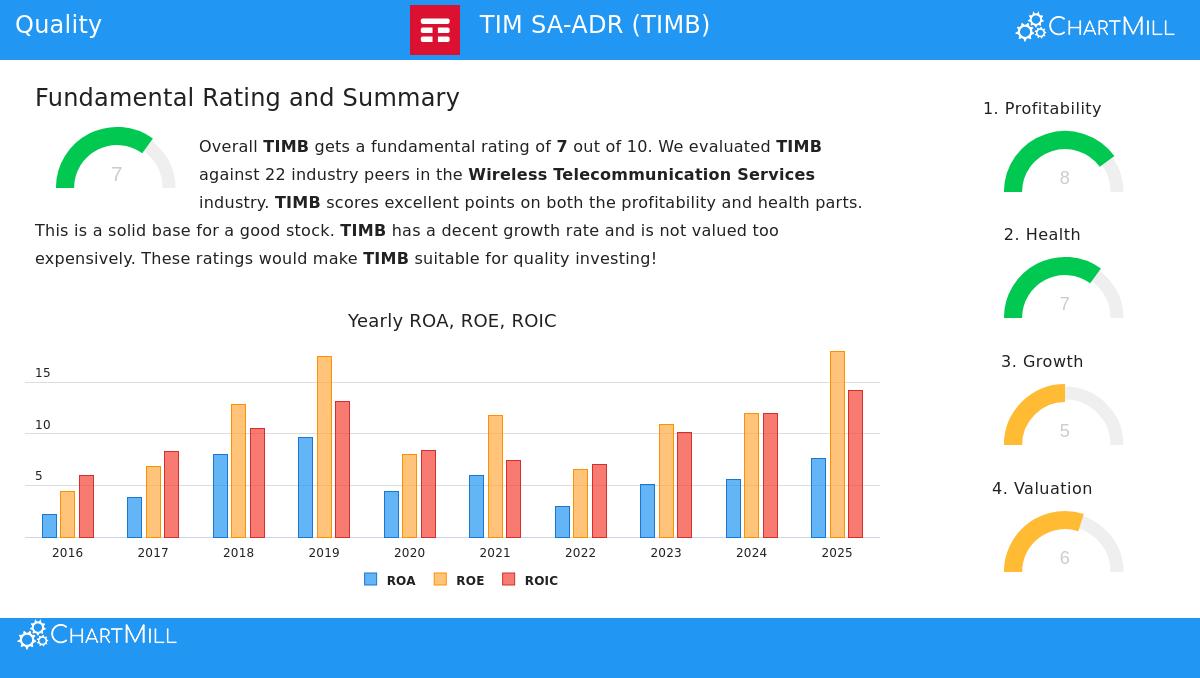
A detailed fundamental analysis report on Chartmill gives TIMB a total score of 7 out of 10, stating it "could be worth investigating further for quality investing." The report separates this evaluation across main areas:
- Profitability (Score: 8/10): TIMB gets high scores here, with leading industry positions for its Return on Equity (17.98%), Profit Margin (16.20%), and Operating Margin (24.57%). Both profit and operating margins have displayed positive trends.
- Financial Condition (Score: 7/10): The company's condition is viewed as good. Its outstanding Debt/FCF ratio is noted as "with the best of the industry." While some short-term liquidity ratios (Current and Quick Ratio) seem low, the analysis states that given its strong solvency and profitability, these may be less worrying and should be assessed within the context of the telecom business model.
- Dividend (Score: 6/10): TIMB provides a high dividend yield of 8.43%, which is appealing. However, the report notes sustainability questions, as the current payout ratio is high and dividend growth has recently risen faster than earnings growth.
- Valuation (Score: 6/10): The stock seems fairly priced. Its P/E ratio of 15.08 is lower than most industry competitors and the wider S&P 500. Measures like Price/Free Cash Flow and Enterprise Value/EBITDA also suggest a valuation lower than the industry.
- Growth (Score: 5/10): This is the most varied area. The company has a solid history of EPS and revenue growth over the past five years. However, analyst projections for future revenue and earnings growth are more limited, and the growth rate is expected to slow.
Points for the Quality Investor
While TIMB achieves high marks on the numerical filters for profitability, capital use, and cash flow strength, the central part of the Caviar Cruise method, a quality investor must also weigh non-numerical and future-looking elements. The telecom sector requires heavy capital and is competitive, though TIMB's top market position in Brazil gives it size. The high dividend, while appealing, needs watching for long-term maintainability. Also, the expected reduction in growth calls for examination to decide if it shows a short-term stage or a new, slower-growth pattern for the business.
For investors who emphasize sound financials, high returns on capital, and solid cash production, TIM SA-ADR offers a significant candidate that meets a demanding quality investing screen. Its fit with these central financial rules makes it a stock deserving of more thorough investigation.
Find Other Quality Options: The Caviar Cruise screen is made to methodically find companies with strong fundamental traits. You can review the present screen results and change the settings for your own study via this link.
Disclaimer: This article is for informational purposes only and does not constitute financial advice, a recommendation, or an offer to buy or sell any security. The analysis is based on data believed to be reliable, but its accuracy cannot be guaranteed. Investing involves risk, including the potential loss of principal. You should conduct your own research and consult with a qualified financial advisor before making any investment decisions.