

For investors looking for a dependable source of passive income, a methodical screening process is needed to distinguish genuinely lasting dividend payers from those with only surface-level attraction. A frequent approach uses filters for companies that provide a good dividend and also have the basic financial soundness to keep and possibly increase those payments. This requires examining more than just the stated yield to evaluate the company's earnings, its balance sheet condition, and the lasting viability of its payout. By concentrating on these core standards, investors can construct a portfolio intended for income stability.
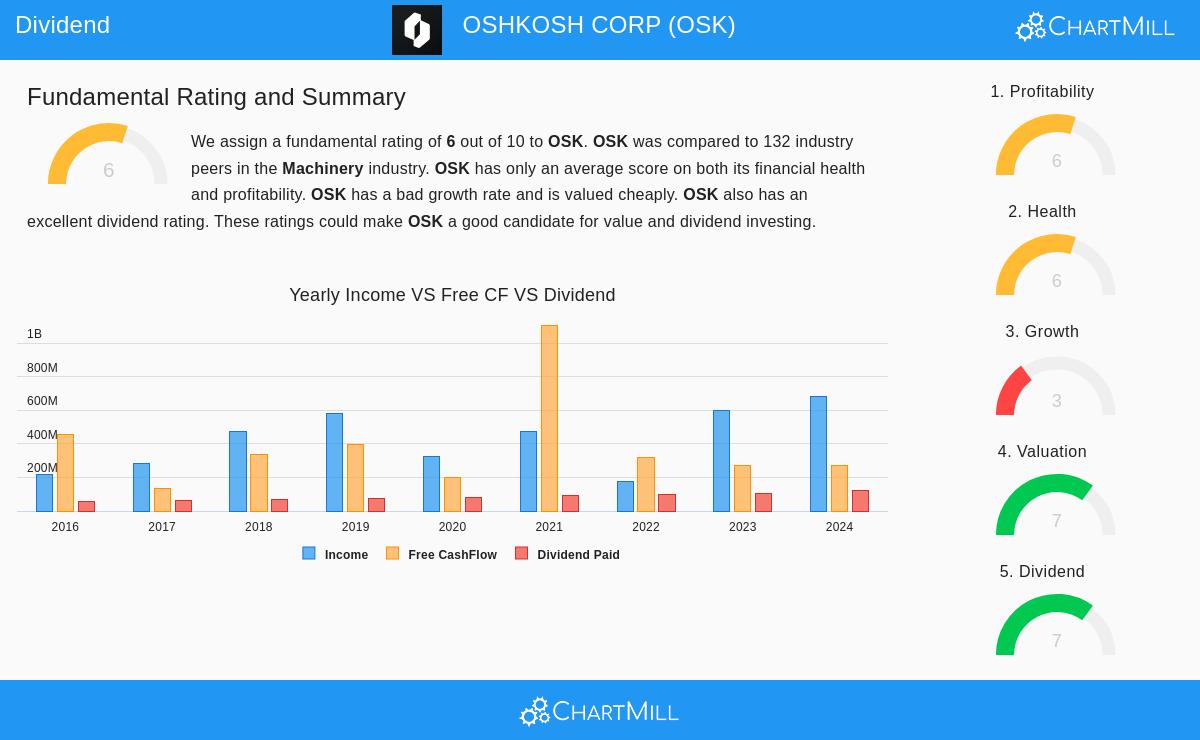
One stock that appears from such a methodical screen is OSHKOSH CORP (NYSE:OSK), a top designer and maker of specialized vehicles and equipment for access, defense, and vocational markets. With a ChartMill Dividend Rating of 7 out of 10, it merits additional examination by income-oriented investors.
Dividend Strength and Sustainability
The central attraction for a dividend investor is OSK's set and increasing distribution. The company has created a dependable history that serves as the foundation of its dividend attraction.
- Dependable History: OSK has paid dividends for at least ten years and has not lowered its payout during that time. This steadiness is a good sign, showing a management dedication to giving capital back to shareholders.
- Good and Increasing Yield: The stock provides a yearly dividend yield of 1.62%. It is not the highest available, but it is almost twice the average yield of others in its industry (0.85%) and compares well with the wider S&P 500. Significantly, the dividend has increased at a notable average yearly rate of 11.40% over the last five years.
- Viable Payout Ratio: A key test for viability is the payout ratio, the part of earnings given as dividends. OSK's ratio is at a very manageable 19.24%, so the company keeps most of its earnings for reinvestment and expansion. This low ratio gives a wide safety margin, making sure the dividend is secure even if earnings experience a short-term decline.
Supporting Fundamentals: Profitability and Financial Health
A solid dividend depends on the company supporting it. For a dividend plan to last, the core business must be earning money and financially stable. OSK's scores in these areas give important backing.
Profitability (Rating: 6/10) OSK shows firm, though not extraordinary, profitability. Its Return on Equity (14.68%) and Return on Invested Capital (10.19%) are both better than most in its industry, showing good use of shareholder money. While gross margins are somewhat narrow, a typical feature in its industrial field, the company's operating margin has gotten better lately. This adequate profitability is necessary, as it creates the earnings required to pay for the dividend without stressing the business.
Financial Health (Rating: 6/10) The company's balance sheet is mostly sound, which is important for enduring economic changes without threatening the dividend.
- Solvency is Firm: OSK has a good Debt/Equity ratio of 0.24 and an Altman-Z score of 3.40, both pointing to a small immediate chance of financial trouble. Importantly, its debt compared to free cash flow is very small, meaning it could clear all its debts in slightly more than one year from its cash flow.
- A Point on Liquidity: The analysis indicates one possible area to watch: the Quick Ratio of 0.99 implies the company might face some difficulty meeting immediate bills without selling stock. However, this is balanced by a firm Current Ratio of 1.98 and the overall firm solvency measures.
Valuation and Growth Context
From a valuation view, OSK seems priced appealingly. With a Price/Earnings ratio of 13.09 and a Forward P/E of 11.69, the stock is valued lower than more than 90% of its industry and much below the S&P 500 average. This implies the market might not completely recognize its steady cash production and reliable dividend.
The main warning for investors is the company's growth outlook, which is limited. Revenue and earnings growth have been low recently, and future predictions are for only small percentage gains. For a dividend investor focused on income steadiness instead of large share price gains, this could be a reasonable compromise, particularly with the low valuation.
Conclusion
OSKOSH CORP makes a strong argument for dividend investors who value dependability and viability over maximum yield amount. It joins a secure, increasing dividend with a ten-year history of steady payments. This income is supported by a profitable operation and a basically stable balance sheet, lowering the chance of a future reduction. While growth expectations are low, the stock's price provides a safety buffer.
For investors wanting to see other companies that fit similar standards of solid dividends, adequate profitability, and financial stability, you can see the complete results of the screening method here.
Disclaimer: This article is for information only and is not financial advice, a suggestion, or an offer to buy or sell any security. Investors should do their own study and think about their personal money situation before making any investment choices. The fundamental data and scores mentioned, including the full ChartMill report for OSK found here, are based on past performance and analyst projections, which are not promises of future outcomes.