

In the search for lasting, high-grade businesses, many investors use the ideas of quality investing. This extended-timeframe, buy-and-hold approach centers on finding companies with durable competitive strengths, sound financial condition, and the capacity to produce steady and increasing profits. To methodically find these candidates, investors frequently use stock screeners with exact numerical filters. One such method is the "Caviar Cruise" screen, built on quality investing ideas, which stresses past growth, high returns on capital, sound cash production, and a careful balance sheet.
A recent use of this screen has identified The New York Times Company (NYSE:NYT) as a possible candidate for quality-oriented portfolios. The newspaper and digital media company seems to fit many of the strategy's central financial standards, pointing to a business model that is both money-making and durable.
Fitting the Central Quality Filters
The Caviar Cruise method uses a group of basic filters to judge a company's past results and financial soundness. Using the given data, NYT matches these important measures:
- High Return on Invested Capital (ROIC): A central part of quality investing, ROIC calculates how well a company produces profits from its capital. The screen needs a ROIC (leaving out cash, goodwill, and intangibles) over 15%. NYT not only passes this mark but does very well, with a present ROICexgc of 33.87%. This shows very good management skill and a strong, expandable business model.
- Sound Profit Quality: This measure compares free cash flow to net income, showing how much reported profit becomes real, usable cash. The screen wants a five-year average over 75%. NYT shows very good cash conversion, with a five-year average Profit Quality of 121.45%, meaning it creates more free cash flow than its stated net income. This gives important financial room for dividends, share repurchases, or strategic spending.
- Careful Debt Position: Quality companies should not be weighed down by debt. The screen uses a Debt-to-Free Cash Flow ratio below 5. NYT is notable with a ratio of 0.0, showing a balance sheet with no net debt. This very strong financial condition greatly lowers risk and gives a buffer in economic declines.
- Continued Profit Growth: The screen requires that a company's Earnings Before Interest and Taxes (EBIT) has increased by at least 5% each year over five years. NYT's EBIT has increased at a compound yearly rate of 20.51%, well above the need. This shows not only growth, but also widening profitability from its main activities.
Fundamental Condition and Profitability Overview
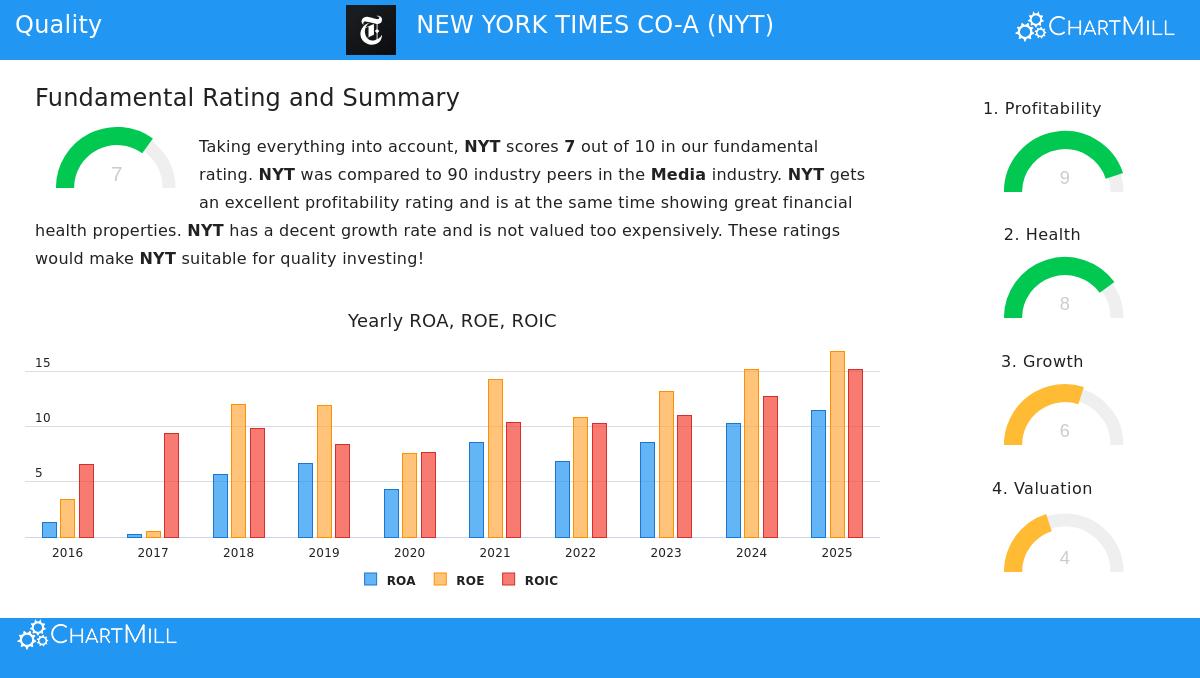
A look at NYT's wider fundamental analysis report supports the results from the quality screen. The company gets a sound total fundamental score of 7 out of 10. The report notes two especially sound sections:
- Very Good Profitability: NYT gets a 9 out of 10 for profitability. Main strong points include sector-leading margins and returns. Its Return on Invested Capital of 15.25% is better than 96.7% of its media industry competitors, and both its Operating and Profit Margins have shown steady gain in recent years.
- Very Good Financial Condition: The company gets an 8 out of 10 for financial condition. Its debt-free position is a main reason, leading to high-grade solvency ratios. The Altman-Z score of 10.82 points to a very small chance of financial trouble, performing better than 95.6% of the industry.
You can see the complete, itemized split of these measures in the detailed fundamental analysis report for NYT.
Valuation and Growth Points
While the quality filters center on the business's built-in strengths, valuation is still a point for any investor. The fundamental report states that NYT's present Price-to-Earnings ratio of 31.99 is high in an absolute sense, though it matches the wider S&P 500 average. Its Price-to-Free Cash Flow ratio, however, is seen more positively compared to industry competitors. For quality investors, who often agree to pay a higher price for very good businesses, the central question is whether the company's lasting competitive strengths, its strong brand, subscription system, and digital shift, support the valuation for a long-term holding.
A Candidate for Quality Portfolios
The New York Times Company makes a strong example for quality investing ideas. It passes a strict numerical screen by showing very good capital use (high ROIC), faultless cash creation (sound Profit Quality), a risk-avoiding balance sheet (no debt), and a confirmed history of profit growth. These numerical strengths are supported by non-numerical assets: a globally known brand, a successful move to a digital subscription model, and a business that gives a product largely seen as essential for its central audience. While its valuation needs thoughtful review, its financial and operational character matches closely with the traits quality investors look for in long-term ownership.
Find More Quality Candidates The Caviar Cruise screen that found NYT can be a useful beginning for more study. To see the present list of companies passing these strict quality filters, you can open the screen directly here.
Disclaimer: This article is for information only and is not financial advice, a suggestion to buy or sell any security, or a support of any investment plan. Investors should do their own complete study and think about their personal financial situation and risk comfort before making any investment choices.