

The investment philosophy of famous fund manager Peter Lynch, as explained in his book One Up on Wall Street, focuses on finding well-run, expanding companies trading at sensible prices, a method often called Growth at a Reasonable Price (GARP). Lynch supported a long-term, buy-and-hold method, concentrating on businesses with durable earnings expansion, sound financial condition, and prices that do not overestimate future prospects. A central idea is the Price/Earnings to Growth (PEG) ratio, which tries to find stocks where the price is supported by the company's expansion path.
One company that recently appeared from a filter using Lynch's main standards is Logitech International S.A. (NASDAQ:LOGI). The Swiss-American maker of computer accessories and software is a known name to many customers, matching another Lynch rule of investing in clear businesses with goods you might see in daily life.
Match with Lynch's Main Standards
A Peter Lynch-influenced filter usually looks for companies with a distinct mix of expansion, earnings, and financial soundness. Logitech's present measurements show a solid match with these ideas:
- Durable Earnings Expansion: Lynch preferred companies with strong but not extreme expansion, which is more probable to be continued. Logitech's Earnings Per Share (EPS) has expanded at an average yearly rate of 17.67% over the last five years. This fits well within a goal span of 15-30%, proposing a speed of increase that is notable yet possibly durable, steering clear of the warning of very fast expansion that can be hard to sustain.
- Sensible Valuation (The PEG Ratio): Maybe the most important Lynch measurement is the PEG ratio, which contrasts a stock's Price-to-Earnings (P/E) ratio to its expansion rate. A PEG of 1.0 is often seen as fair price, with smaller numbers suggesting a more appealing valuation. Logitech's PEG ratio, calculated from its past five-year expansion, is 0.94. This shows the market is pricing the company's shares at a small reduction to its historical expansion record, a main sign for GARP investors looking for value within expansion.
- Outstanding Earnings (Return on Equity): Lynch searched for companies that skillfully produce profits from shareholder equity. Logitech's Return on Equity (ROE) of 30.47% is outstanding, greatly exceeding the 15% level often used in such filters. A high ROE shows management is successfully using investor money to create earnings, a sign of a well-run business.
- Very Sound Financial Condition: The filter highlights a sound balance sheet. Logitech is strong here with a Debt-to-Equity ratio of 0.0, meaning the company functions with no interest-bearing debt. Also, its Current Ratio of 2.21 shows sufficient short-term assets to meet near-term obligations, giving notable financial room and strength, which Lynch thought important for enduring economic slowdowns.
Basic Condition Review
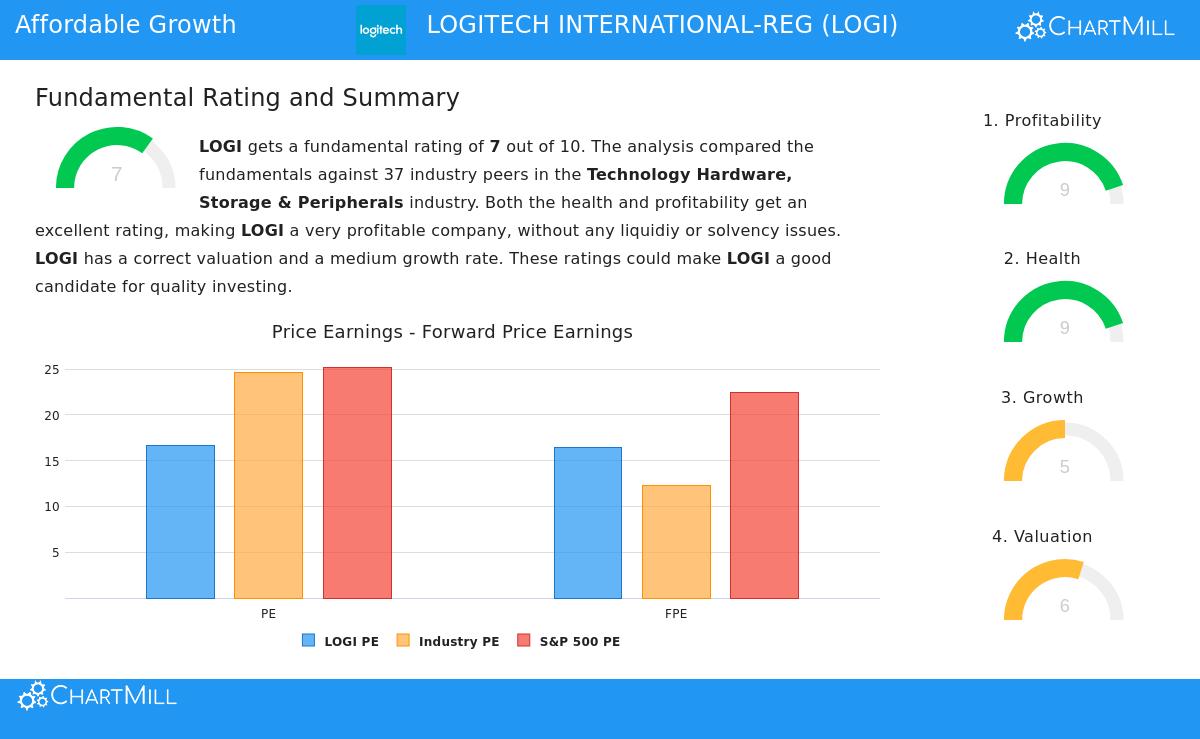
A wider basic examination of Logitech supports the image shown by the Lynch filter. The company receives a high total basic rating, with special force in two important sections:
- Earnings: Logitech gets a 9 out of 10 for earnings. Its margins, including Gross, Operating, and Profit Margin, are some of the top in its field. Measurements like Return on Assets (17.38%) and Return on Invested Capital (22.38%) also do better than most competitors, confirming very effective operations.
- Financial Condition: The company also gets a 9 out of 10 for condition. Besides having no debt, it has a very good Altman-Z score (8.46), showing very small failure risk. The company has also been steadily lowering its share count using buybacks, an action Lynch saw positively as it can raise the value of existing shares.
The valuation score is neutral to good, with Logitech's P/E ratio seeming less expensive than both the wider S&P 500 and most of its field competitors. The primary section showing moderation is expansion; while past results have been solid, experts predict a slowdown in both sales and earnings expansion in the next few years. For a Lynch-type investor, this highlights the importance of the "sensible price" part, as the stock is not priced for very fast, unsustainable future expansion.
A Choice for the Long-Term Portfolio
For an investor using a Peter Lynch-type GARP method, Logitech offers a notable example. It is an earning, financially solid company with a leading place in a known market. Its historical expansion has been solid and steady, and it presently trades at a price that seems to allow for a more measured future expansion track instead of an hopeful extra cost. This mix of quality, historical results, and sensible price is exactly what the method aims to discover.
It is valuable to note that a filter is only a beginning step for more study. Lynch himself highlighted the need to know the business behind the figures. Possible investors would have to evaluate Logitech's capability to handle a post-pandemic adjustment of demand, its product development line, and market challenges.
Interested in examining other companies that meet this structured investment method? You can use the Peter Lynch filter yourself and see the present outcomes here.
Disclaimer: This article is for information only and does not make financial guidance, a suggestion, or a deal to buy or sell any security. Investing includes risk, including the possible loss of original money. You should do your own study and talk with a registered financial consultant before making any investment choices.