

For investors looking to assemble a portfolio of lasting, high-achieving businesses, the quality investing philosophy offers a persuasive framework. This method centers on finding companies with durable competitive strengths, high profitability, and sound financials, with the plan of owning them for an extended period. One useful tool for finding these companies is the "Caviar Cruise" stock screen, which uses a set of numerical filters to separate firms with better past performance and financial soundness. The screen focuses on consistent revenue and profit increase, high returns on invested capital, solid free cash flow production, and an acceptable debt level.
A recent search using this process has identified Lennox International Inc (NYSE:LII), a top supplier of heating, ventilation, air conditioning, and refrigeration products. A detailed look shows that LII's financial picture matches the central principles of quality investing.
Matching the Central Quality Standards
The Caviar Cruise screen rests on several basic filters, each made to gauge a particular element of business quality. Lennox International's financial numbers show a good match with these needs:
-
Consistent Increase: The screen calls for a minimum 5% compound annual growth rate (CAGR) for both revenue and EBIT (earnings before interest and taxes) over five years. LII surpasses this, with a 5-year revenue CAGR of 9.24% and a higher EBIT CAGR of 16.65%. Importantly, EBIT increase exceeding revenue increase—as seen here—is a central screen filter. This points to better operational efficiency and pricing ability, indicating the company gains from economies of scale or a firm competitive standing in its markets.
-
Outstanding Capital Effectiveness: For quality investors, a high Return on Invested Capital (ROIC) is likely the most important number, as it shows how well a company produces profits from its capital base. The screen needs an ROIC (leaving out cash, goodwill, and intangibles) above 15%. LII reports a notable figure of 36.93%, pointing to outstanding management performance and a possibly lasting competitive edge in the building products industry.
-
Financial Soundness and Cash Flow Character: The strategy emphasizes financial well-being by requiring that a company's debt could be paid off with its free cash flow within five years. LII's Debt-to-Free Cash Flow ratio of 2.17 is comfortably below this limit, showing a sound and acceptable balance sheet. Also, the screen checks for high-grade earnings by needing that, on average, at least 75% of net income changes into free cash flow over five years. LII's Profit Quality number of 77.42% meets this standard, verifying that its reported profits are supported by actual cash production, which can fund dividends, share repurchases, or new investment.
Fundamental Analysis Summary
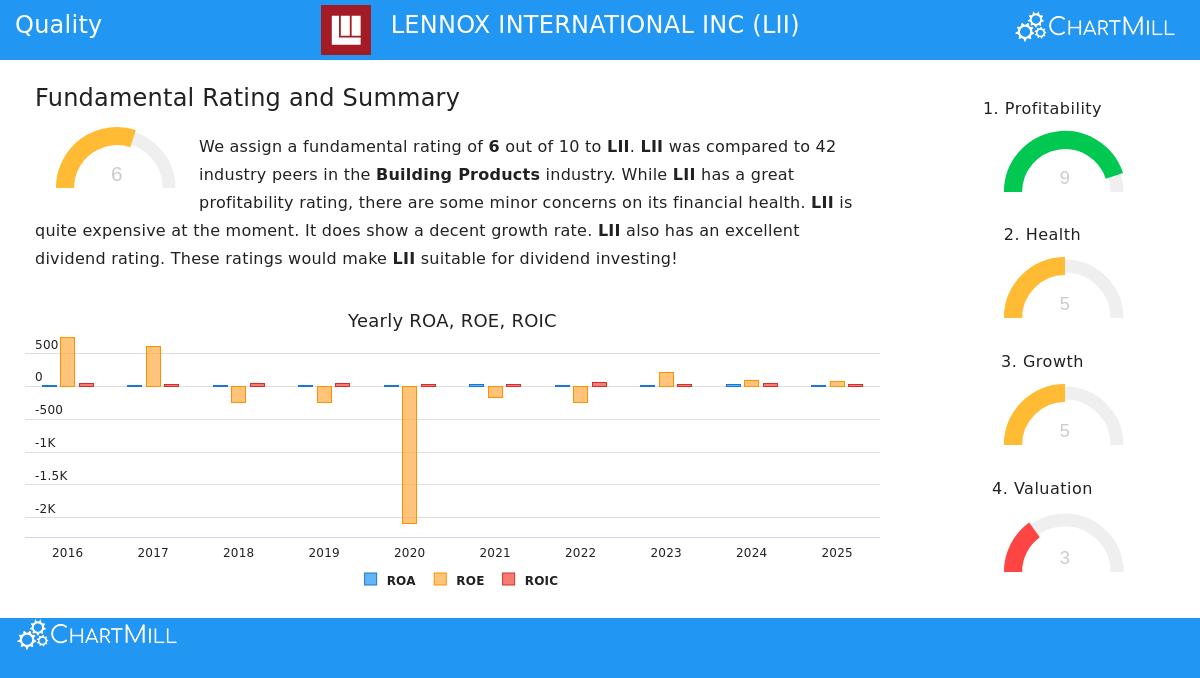
A wider check of LII's fundamental analysis report on Chartmill gives a more detailed view that backs the quality argument while observing points for attention. The company receives a good total score of 6 out of 10, with clear positives and some notes of care.
Key Positives:
- Profitability Leader: LII gets a near-maximum 9 out of 10 for profitability. Its margins are best in class, with an Operating Margin of 20.28% and a Return on Equity of 69.28%, both beating most competitors.
- Steady Income: The dividend score is firm (7 out of 10), backed by a 10-year history of consistent and rising payments. The dividend growth rate of almost 10% each year is maintainable, as it is well-supported by earnings.
- Solvency: Even with a high debt-to-equity ratio, the company's strong free cash flow leads to a good Debt-to-FCF ratio, resulting in a favorable view of its overall solvency.
Aspects to Watch:
- Valuation: The valuation score is a middle 3 out of 10. While its P/E ratio matches the industry, it is viewed as somewhat high on an absolute scale. Quality often gets a higher price, but investors must judge if the current cost is reasonable.
- Liquidity: The financial health score is balanced (5 out of 10) by lower liquidity numbers, including a Quick Ratio under 1. This is usual for industrial companies with inventory but needs recognition.
- Recent Increase: Past growth scores a neutral 5, reflecting a small decrease in revenue over the last year, though the long-term pattern stays positive.
You can review the full, interactive fundamental analysis for LII here.
Is LII a Quality Investment Prospect?
Lennox International Inc makes a persuasive argument for quality investors. It performs well in the measurable numbers that form the core of the Caviar Cruise screen: outstanding returns on capital, a record of profitable increase where earnings grow faster than sales, firm free cash flow conversion, and a balance sheet where debt is kept in check by cash production. These are the signs of a well-managed business with potential endurance.
The wider fundamental analysis affirms central positives in profitability and shareholder returns, while also noting that the stock sells at a higher valuation and has some near-term liquidity traits common to its industry. For a quality investor, the choice would depend on whether LII's lasting competitive strengths in the HVAC market—like its brand recognition and distribution system—support its price and can maintain the future growth analysts forecast.
Find Other Quality Ideas
The Caviar Cruise screen is made to methodically find companies with firm quality traits. LII is one of the present outcomes from this continuous search. To see the whole, current list of companies meeting these strict filters, you can open the screen through this Caviar Cruise Stock Screener.
Disclaimer: This article is for information only and does not form financial advice, a suggestion to buy or sell any security, or a support of any investment plan. Investors should do their own complete research and think about their personal financial situation and risk tolerance before making any investment choices.