

For investors looking for chances where the market price may not completely show a company's real value, a disciplined value investing method can be a useful plan. This system, created by Benjamin Graham and famously used by Warren Buffett, means finding stocks selling for less than their calculated true value while still showing good basic condition. The aim is to find good businesses that are temporarily unpopular or not noticed, offering a possible "margin of safety" for people investing for a long time. One way to find such companies is by searching for firms with good valuation numbers along with fair scores in profit generation, money stability, and expansion.
Lazard Inc (NYSE:LAZ), the worldwide financial advice and asset management company, appears as a stock that matches this description based on a basic review. Its present ratings imply it may be an underpriced chance in the capital markets area for investors using this method.
Valuation Numbers: The Center of the Chance
The main attraction for a value investor is in a stock's valuation, and Lazard's numbers show it is priced cautiously compared to both its future possibility and wider market measures. A main idea of value investing is buying a dollar's worth of assets for fifty cents, valuation ratios help spot such differences.
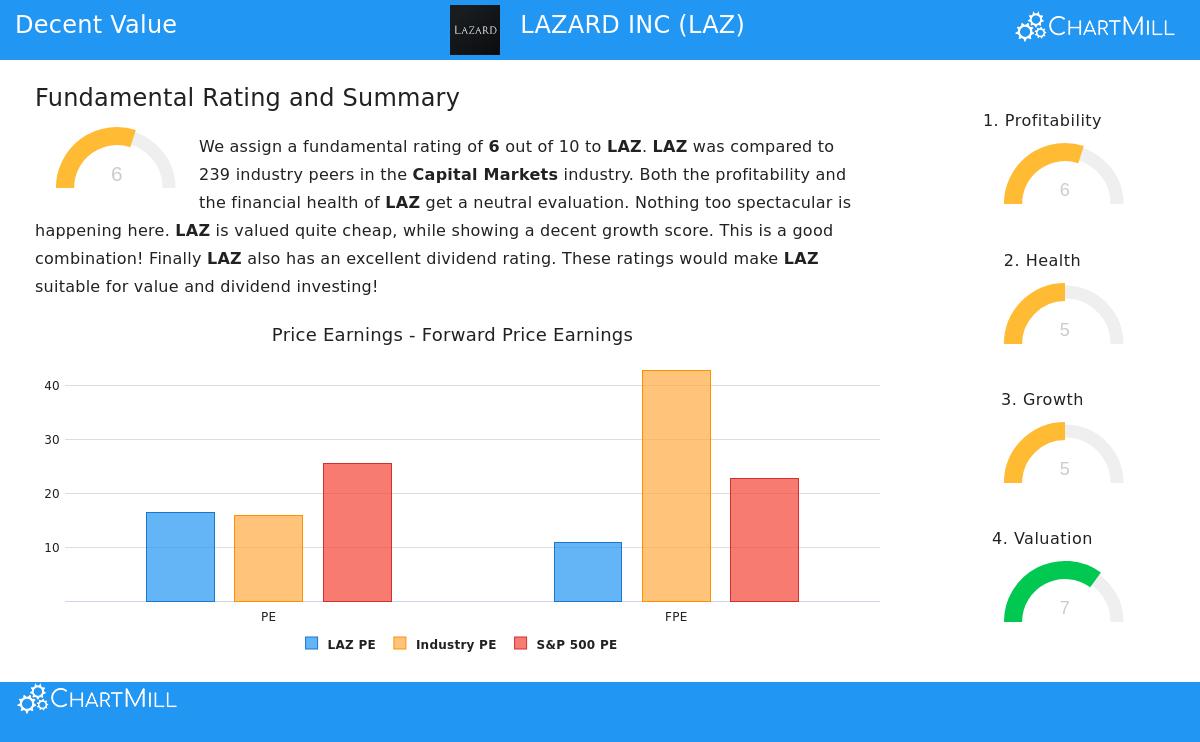
- Good Earnings Multiples: LAZ sells at a Price-to-Earnings (P/E) ratio of 16.46, which is clearly under the S&P 500 average of about 25.5. More interesting is its forward P/E ratio of 10.89, which is less than half the S&P 500's forward average and implies the market is using a large discount to the company's short-term earnings possibility.
- Less Costly than Similar Companies: When measured against its industry, LAZ seems low-priced. Its Enterprise Value to EBITDA ratio is under that of 88% of its peers in the capital markets industry, and its Price-to-Free Cash Flow ratio is less costly than almost 78% of industry firms.
- Growth Consideration: The low PEG ratio, which changes the P/E ratio for expected earnings expansion, shows the stock's valuation may not be completely including its future growth path. This makes a possible situation where investors are paying a fair price today for quickening earnings later.
For a value plan, these valuation numbers are important as they measure the difference between market price and seen value, forming the start for a possible margin of safety.
Reviewing Money Stability and Profit Generation
A low valuation by itself can be a "value trap" if the company's base is weak. So, value investing needs checking that the business is financially stable and profitable. Lazard's basic report shows a varied but generally acceptable view in these parts, backing the idea that it is a steady, continuing company.
Money Stability (Rating: 5/10): LAZ shows acceptable cash availability, with a Current and Quick Ratio of 1.47, doing better than over two-thirds of its industry. This suggests it can easily meet near-term debts. The company's Altman-Z score, a gauge of bankruptcy danger, is in a steady "grey zone" and is better than 69% of peers. A clear worry is a high Debt-to-Equity ratio of 2.40, showing large use of debt financing, which is normal in its industry but stays a point for watching.
Profit Generation (Rating: 6/10): The company displays strong returns on capital, which is a good sign of management skill and a lasting competitive edge, a quality highly valued by value investors.
- Its Return on Equity (ROE) of 26.43% is very good, putting it in the top 10% of its industry.
- The Return on Invested Capital (ROIC) of 8.29% is also strong, doing better than 80% of industry peers and showing gain over its three-year average.
While its profit and operating margins have seen pressure and are under industry averages, its very high Gross Margin of 93.42% (top 5% of industry) shows the basically high-margin nature of its advice and asset management business model.
Growth Path and Dividend Attraction
Value investing is not only about still companies, it often includes firms ready for a comeback or speed-up. Lazard's growth outline shows a clear turning point, changing from a difficult past to a hopeful future, which could start a re-rating of its shares.
- Past against Future: While income and EPS growth have been small to negative over recent years, analyst guesses point to a large speed-up. Earnings Per Share are forecast to grow at an average of 33.12% each year in the coming years, with Income expected to grow at 13.57%.
- Dividend Income: With a dividend yield of 5.02%, LAZ gives a good income flow while investors wait for possible price gain. This yield is more than two times the S&P 500 average. The company has a dependable history, having paid and not lowered its dividend for at least ten years, adding a layer of shareholder return steadiness.
This mix of a high starting yield and quickening expected growth is especially attractive, as it gives both immediate return and a basic reason for the stock's under pricing to fix over time.
Conclusion
Lazard Inc presents an example of a possible value investment, a settled, profitable firm with strong returns on capital, selling at a discount to the market and its own growth expectations. Its high debt level is a balance that needs noting, but its good cash availability, industry-leading gross margins, and interesting forward earnings guesses suggest the basic business is solid. For investors using a value method, LAZ's valuation numbers give the measured margin of safety, while its profit generation, bettering growth view, and large dividend offer qualitative reasons to trust in its true value.
This review of LAZ came from a methodical search for stocks fitting certain value-focused conditions. You can examine other stocks that passed this "Fair Value" search by viewing the full search results here.
Disclaimer: This article is for information only and does not make financial advice, a suggestion, or an offer to buy or sell any security. The review is based on data and ratings given by ChartMill. Investors should do their own complete study and think about their personal money situation and risk comfort before making any investment choices. Past results are not a guide for future results.