

The investment method of Peter Lynch, the noted manager of the Fidelity Magellan Fund, focuses on locating well-run, expanding companies available at sensible prices. His plan, often called Growth at a Reasonable Price (GARP), highlights lasting earnings expansion, sound financial condition, and a price that does not overvalue future potential. It is a lasting, buy-and-keep method that depends on fundamental study instead of predicting market movements. A central idea is the Price/Earnings to Growth (PEG) ratio, which Lynch made common as a way to find stocks where the price matches the company's expansion rate.
Assessing KOF Using Lynch's Main Standards
Coca-Cola FEMSA SAB-SP ADR (NYSE:KOF), the biggest franchise bottler of Coca-Cola products globally, appears as a possibility from a filter created using Lynch's ideas. The method selects for companies with a particular mix of expansion, earnings, and balance sheet soundness. Here is how KOF compares to several of these important filters:
- Lasting Earnings Expansion: Lynch looked for companies increasing earnings per share (EPS) between 15% and 30% each year, fast enough to be interesting, but not so high as to be unstable. KOF's five-year EPS expansion rate of 18.29% sits directly within this goal area, showing a record of steady, solid growth.
- Sensible Price (The PEG Ratio): This is the foundation of the GARP method. The PEG ratio contrasts a stock's Price-to-Earnings (P/E) ratio to its expansion rate, with a number at or under 1.0 hinting the market may not be completely valuing the expansion. KOF's PEG ratio, using its past five-year expansion, is 0.83, indicating it might be sensibly priced compared to its historical earnings path.
- Sound Earnings (Return on Equity): Lynch liked companies that produce high returns on shareholder equity, a mark of effective management. A minimum ROE of 15% is a typical standard. KOF's ROE of 16.72% meets this level, proving its capacity to profitably put capital back to work.
- Financial Condition (Debt & Liquidity): A careful balance sheet is important for enduring economic declines. Lynch wanted a Debt-to-Equity ratio under 0.6. KOF's ratio of 0.54 shows a measured amount of debt financing that matches others in the field. Also, its Current Ratio of 1.10 reveals it keeps enough short-term assets to meet its near-term debts, passing another of Lynch's basic financial condition tests.
Fundamental Condition Review: Positives and Points to Examine
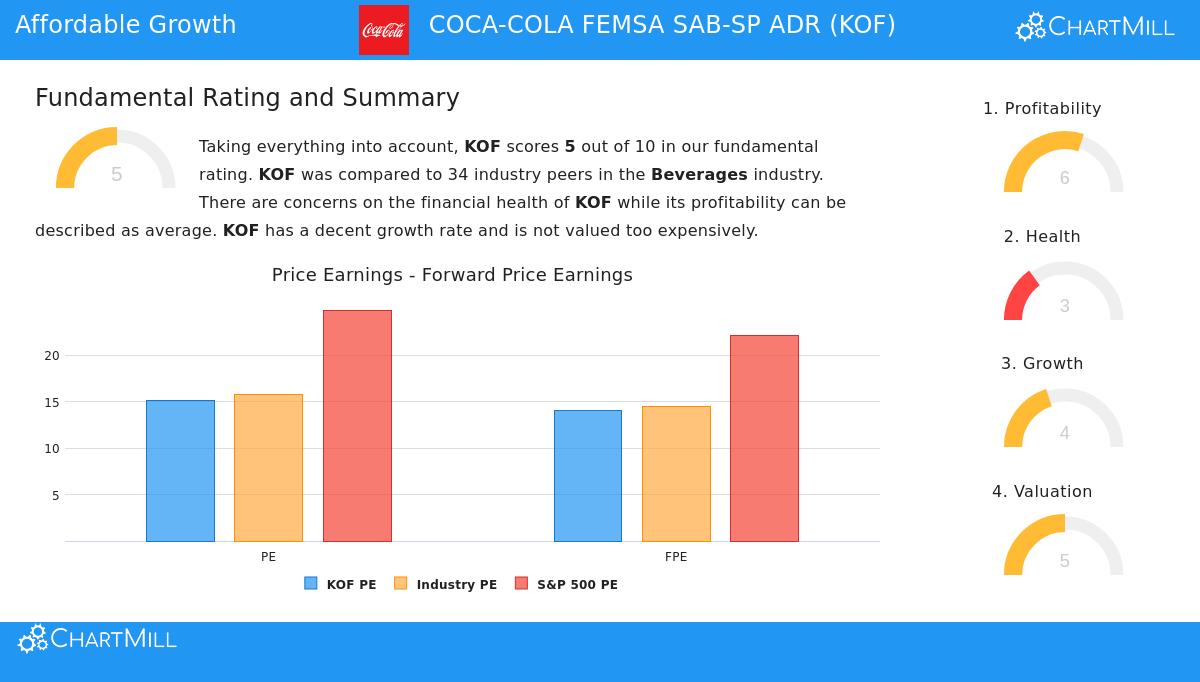
A wider view of KOF's fundamental details, as explained in its full study report, gives a more detailed image. The company receives an average total score, with definite positives in some parts balanced by questions in others.
On the good side, KOF shows steady earnings and cash flow creation over a long period. Its price seems appealing compared to both the wider S&P 500 and its field, with P/E and forward P/E ratios trading lower. The company also provides shareholders a notable dividend yield of 3.76%, with a record of yearly raises.
Still, the report notes several items for more careful examination. While the historical EPS expansion is sound, recent income has fallen, and future expansion projections are more limited. The financial condition score is a relative soft spot, mainly because of a high Debt-to-Free-Cash-Flow ratio and a low Quick Ratio, which implies a more constrained cash position. Also, the dividend, while appealing, is mentioned as having questions about lasting due to a high payout ratio.
A Possibility for More Study
For an investor following Peter Lynch's method, Coca-Cola FEMSA offers an interesting case. It works in the clear, if not "simple," trade of drink distribution, a structure Lynch liked. It meets several of his number-based filters for lasting expansion, sensible price (through the PEG ratio), and basic financial steadiness. The company's leading market place in important areas like Mexico and Brazil supplies a lasting competitive edge.
As with any filter result, this finding is a beginning for more examination, not a final suggestion. The Lynch method needs knowing the business behind the figures. A potential investor would have to evaluate the causes for the recent income weakness, the methods for handling debt and cash, and the long-term expansion outlook in its main markets.
Find Other Possible Choices
The filter that found Coca-Cola FEMSA is built on a structured use of Peter Lynch's investment rules. If this GARP method fits your plan, you can review the complete list of present companies meeting these filters by going to the Peter Lynch Strategy stock screener.
Disclaimer: This article is for information only and is not financial guidance, a suggestion, or an offer to buy or sell any security. The study uses data and a set filter method; investors should do their own complete research and think about their personal money situation before making any investment choices.