

Investors looking for dependable income often use dividend investing, a method centered on finding companies with secure, lasting payouts. A typical method uses filters for stocks that have a high dividend rating and also display good basic financial condition and earnings. This process helps sidestep the danger of high-yield traps, companies where an appealing dividend could be in jeopardy because of weak business foundations. By emphasizing a strong dividend record together with adequate business performance, investors can create a portfolio intended for steady income generation.
J.B. Hunt Transport Services Inc. (NASDAQ:JBHT), a major firm in the logistics and transportation industry, recently appeared from this kind of methodical filtering process. The company works in various areas, such as intermodal and dedicated contract services, creating a varied foundation for its sales and income. Its presence on a filter set for high dividend caliber, along with acceptable condition and earnings marks, makes it a prospect deserving of more detailed review for income-oriented portfolios.
Dividend Dependability and Increase
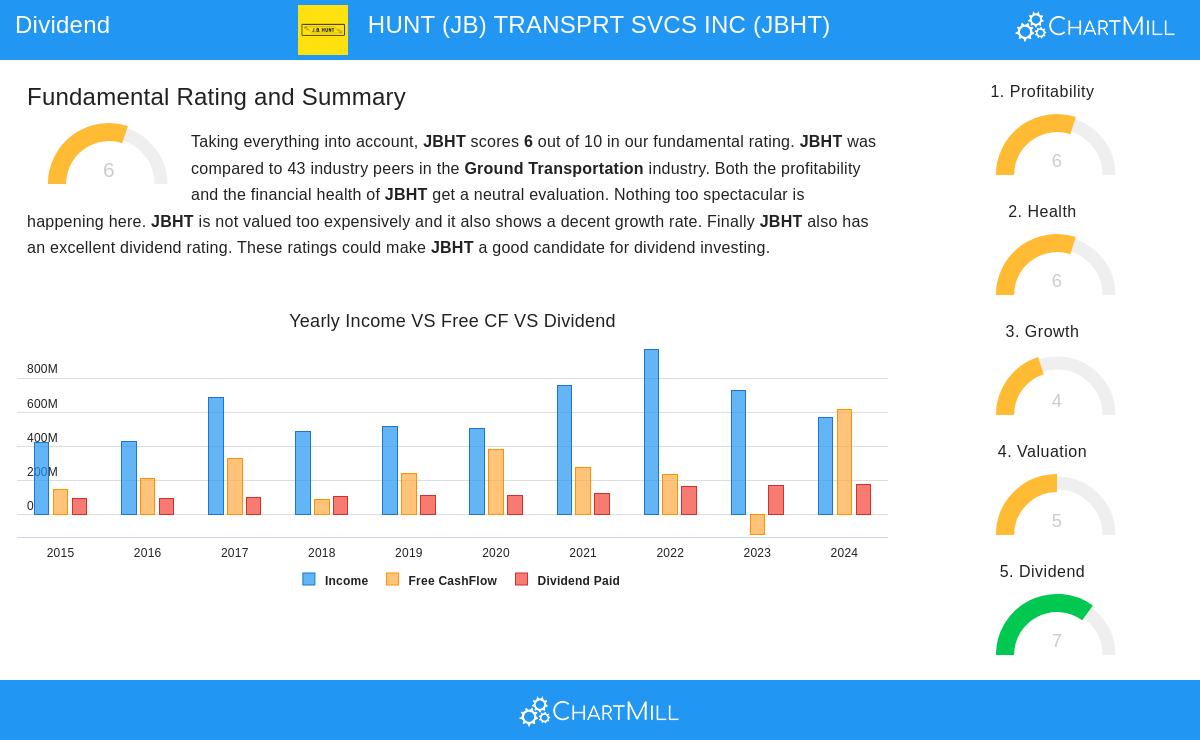
The foundation of any dividend investment idea rests on the security and increase path of the payment. J.B. Hunt's dividend record is defined by a noteworthy past and a positive increase percentage, which are important for long-term income investors aiming to preserve and improve their spending ability.
- Dividend Increase: The company has shown a firm dedication to giving capital back to shareholders, with a yearly dividend increase percentage of 10.61% over the last several years. This steady increase is a good sign of management's belief in the company's future money generation.
- Payout Security: A small payout percentage is necessary for dividend safety, and J.B. Hunt performs well here, distributing only 30.14% of its earnings as dividends. This provides a large buffer for the company to put money back into the business and handle economic declines without putting the dividend in danger.
- History: The company has a dependable history, having paid and not reduced its dividend for a minimum of ten years. This record of steadiness gives investors some assurance about the ongoing nature of payments.
While the present dividend percentage of 1.04% is moderate next to the wider S&P 500 average, the mix of good increase and a very secure payout percentage makes it an interesting option for investors who value dividend growth more than a large immediate percentage. A large percentage can sometimes be a caution, while a growing dividend from a financially stable company can result in better overall gains over many years.
Basic Financial Condition
A company's capability to sustain and increase its dividend is directly connected to its financial strength. J.B. Hunt's condition rating shows a financial position that, while having some points to monitor, is basically sound and backs its shareholder payments.
- Solvency Position: The company's Altman-Z score of 5.26 shows a very small chance of financial failure and puts it in the high group of its field. Also, its Debt-to-Free-Cash-Flow percentage of 2.03 is very good, indicating it could settle all its debt in slightly more than two years using its present money generation, a mark of good financial management.
- Liquidity Factor: One point to observe is the company's liquidity, with a Current Ratio and Quick Ratio both at 0.87. This is lower than the field average and suggests the company might depend on operational money flow and credit facilities to manage immediate liabilities, a standard approach in fields requiring large capital investment like transportation.
The general condition picture supports the dividend plan by verifying that the company is not excessively in debt and has the solvency to endure economic shifts, therefore lowering the chance of a future dividend reduction.
Earnings and Price Assessment
For a dividend to be truly secure, it must be supported by a profitable and fairly priced business. J.B. Hunt's earnings measurements show a company that uses its capital effectively, though it is currently managing some profit pressures.
- Return on Capital: The company produces a good Return on Invested Capital (ROIC) of 10.23%, doing better than most of its field competitors. This shows that management is using capital efficiently to create earnings.
- Profit Patterns: While its Profit Margin and Operating Margin are acceptable within the field, both have experienced a drop in recent years. This is a key measure for investors to watch in the future, as rising margins would give even more safety for the dividend.
- Price: The stock's price presents an unclear image. Its Price-to-Earnings percentage is similar to the S&P 500, but its Price-to-Free-Cash-Flow percentage is significantly low relative to the field. This indicates that the market might not completely value the company's ability to generate money, which is the actual origin of dividend payments.
The adequate earnings confirm the company has the profit capacity to finance its dividend, while the price is not so high as to discourage new investment. The filter's need for adequate earnings is confirmed by these effective capital returns, which are a fundamental part of dependable dividend payments.
For a complete summary of all these basic factors, you can examine the full fundamental analysis report for JBHT.
J.B. Hunt Transport Services presents an interesting example of how a methodical filtering process can find possible dividend growth prospects. It might not provide the largest percentage, but its mix of a good increase history, a very secure payout percentage, and a basically sound financial position matches well with a plan focused on long-term, dependable income. Investors are advised to perform their own complete investigation to determine how JBHT aligns with their individual investment goals.
This review was obtained from a specific filter for good dividend stocks. If you want to find other companies that match similar standards for high dividend caliber, good condition, and adequate earnings, you can use the "Best Dividend Stocks" filter yourself.
,
Disclaimer: This article is for informational purposes only and does not constitute financial advice, a recommendation, or an offer or solicitation to buy or sell any securities. All investment decisions involve risk, and readers should conduct their own research and consult with a qualified financial advisor before making any investment decisions.