

In the world of long-term investing, few strategies have earned as much respect as the one outlined by legendary fund manager Peter Lynch. His approach, detailed in One Up on Wall Street, focuses on finding companies with lasting growth, sound financial health, and fair prices, a philosophy often called Growth at a Reasonable Price (GARP). The central idea is to locate businesses that are increasing steadily but are not overhyped or overpriced, letting investors gain from compounding returns over many years without accepting too much risk. A methodical filter based on Lynch’s main standards can help locate such companies, and one present example is Hamilton Lane Inc. - Class A (NASDAQ:HLNE).
A Good Match for the Lynch Framework
Hamilton Lane, a top provider of private markets investment solutions, seems to match well with several of Peter Lynch’s basic rules. The strategy stresses lasting earnings growth, careful valuation, and a solid balance sheet. Here is how HLNE compares to the specific filter standards:
- Lasting Earnings Growth: Lynch preferred companies with steady, but not extreme, growth. HLNE’s earnings per share (EPS) have increased at an average yearly rate of 20.18% over the past five years. This easily meets the filter’s lowest limit of 15% while staying under the 30% upper bound Lynch proposed to avoid unstable "hot" growth.
- Fair Valuation (PEG Ratio): A key part of the GARP method is the Price/Earnings to Growth (PEG) ratio, which modifies a stock’s P/E ratio for its growth rate. Lynch sought a PEG of 1 or lower, showing the market is not paying too much for future growth. HLNE’s PEG ratio, based on its past five-year growth, is about 1.0, meeting this important valuation test.
- Financial Health and Profitability: Lynch required companies with strong balance sheets and high returns on capital.
- Debt/Equity Ratio: HLNE’s Debt/Equity ratio of 0.32 is far below the filter’s maximum of 0.6 and even under the stricter 0.25 level Lynch himself liked, showing a careful capital structure funded mainly by equity.
- Current Ratio: The company’s Current Ratio of 1.20 meets the filter’s need to be at least 1, meaning it has enough short-term assets to meet its near-term liabilities.
- Return on Equity (ROE): With an ROE of 26.61%, HLNE greatly exceeds the 15% minimum, indicating very efficient use of shareholder capital and strong profitability.
Fundamental Strength Outside the Filter
While the filter gives a good beginning point, Peter Lynch supported deeper investigation. A look at Hamilton Lane’s detailed fundamental report shows a business that rates highly on several extra metrics Lynch considered important.
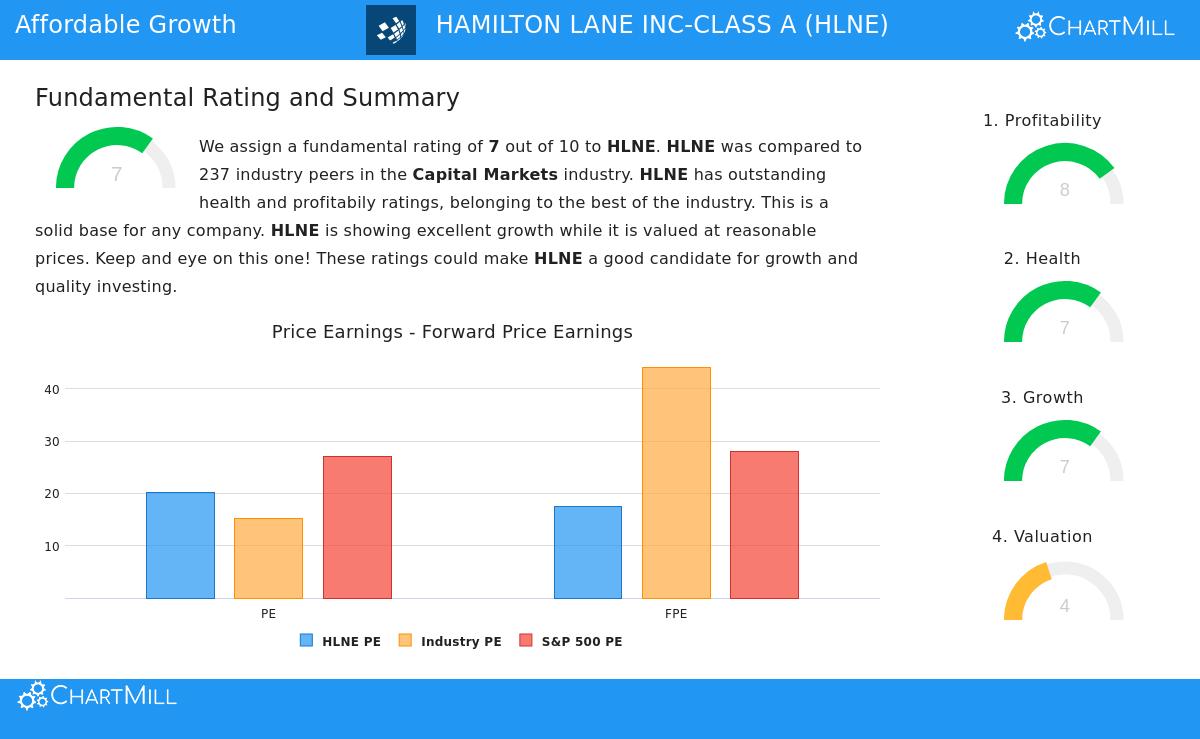
The report gives HLNE a total fundamental rating of 7 out of 10, with special force in Profitability and Health. The company’s margins and returns on assets and invested capital are very good compared to others in the Capital Markets industry. Its financial stability is sound, with a very low debt-to-free-cash-flow ratio. While the valuation rating is neutral, with a P/E ratio that seems fair next to the S&P 500 but somewhat high within its industry, this is likely reasonable given the company’s better growth and profitability picture. The Growth rating is also firm, noting a strong historical record in revenue and earnings increase, with analysts expecting continued double-digit growth in the coming years.
The GARP Case for HLNE
For an investor looking for long-term growth at a fair price, Hamilton Lane offers a persuasive argument. It works in the specialized and increasing area of private markets, a sector that has seen more institutional and individual investor allocation. The company’s business model has shown it can compound earnings at a good rate while keeping a very strong balance sheet with little debt. Importantly, its stock price does not seem to show too much excitement; the PEG ratio means the market is valuing its growth fairly, without the extra cost often given to more uncertain growth tales.
This mix, a profitable, financially stable company in a growing specialty, available at a price that accounts for but does not overstate its growth potential, is exactly the type Peter Lynch’s method tries to find. It indicates a business that an investor could buy and keep for the long term, depending on the underlying company’s results to create shareholder returns.
Locating Other Possible Investments
The Peter Lynch strategy is a useful tool for creating a varied, long-term portfolio. Hamilton Lane is one instance that passed the first filter based on number-based rules. Investors curious about finding other companies that fit this GARP type can view the complete list of results using the Peter Lynch Strategy stock screener.
Disclaimer: This article is for information only and does not form financial advice, a suggestion, or an offer to buy or sell any security. The analysis uses data and a particular investment strategy structure. Investors should do their own complete research and think about their personal financial situation and risk tolerance before making any investment choices. Past results do not guarantee future outcomes.