

For investors aiming to create a portfolio centered on dependable income, a disciplined selection process is necessary. One good technique uses filters for companies that provide an appealing dividend and also have the fundamental financial soundness to maintain and increase those payments. This method chooses quality and durability over seeking the highest current yield. A practical initial step is a filter that finds stocks with a high ChartMill Dividend Rating, while also demanding good scores for Profitability and Financial Health. This layered method helps identify companies where the dividend is supported by a sound business model, not only a low stock price.
EATON CORP PLC (NYSE:ETN) appears as a strong candidate from this type of filter. As a global power management company, Eaton's work in electrical components, aerospace, and vehicle systems places it in cyclical but necessary industrial areas. The company’s basic profile indicates it fits well with the standards of a good dividend investment.
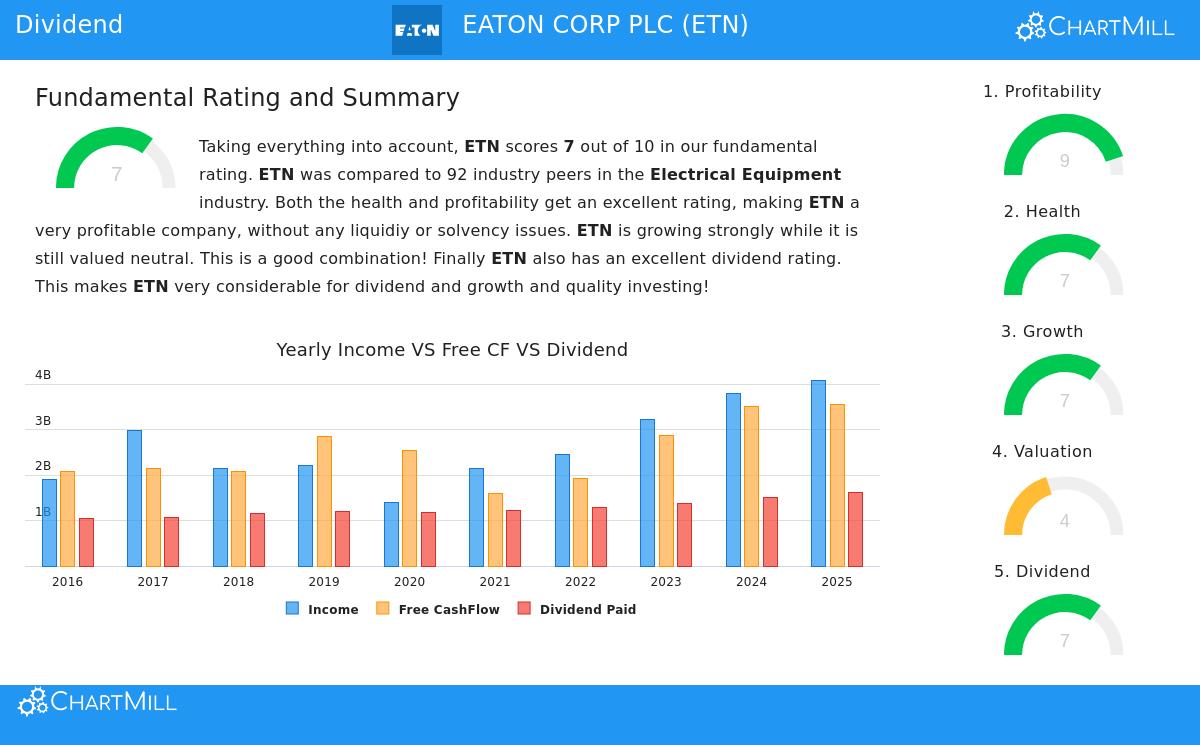
Dividend Reliability and Growth
For dividend investors, the steadiness and growth path of payments are frequently more important than the yield alone. Eaton’s dividend details show force in these main areas.
- Track Record: The company has given a dividend for at least 10 straight years and has not lowered it in that time. This long record offers a degree of trust in management’s dedication to giving capital to shareholders.
- Sustainable Growth: The dividend is increasing at a good yearly rate of about 7.53% over the last five years. Significantly, this increase is backed by greater growth in earnings, showing the raises are durable and not stressing the company’s funds.
- Payout Ratio: A key gauge of durability, Eaton’s payout ratio is at a manageable 39.77%. This means under 40% of its earnings are used to pay for the dividend, leaving plenty of space for putting money back into the business, lowering debt, and more dividend increases, even in times of short-term earnings difficulty.
While its present yield of 1.23% may not attract attention compared to some high-yield groups, it is useful to see this number in context. It is much higher than the average yield in its Electrical Equipment industry and is given with a much more steady and increasing profile than many higher-yielding but less secure options.
Supporting Profitability
A lasting dividend must be paid for by a profitable company. This is why filtering for high profitability is a key part of the method, and Eaton performs well here with a ChartMill Profitability Rating of 9 out of 10. The company’s capacity to create returns is notable.
- Strong Margins: Eaton has notable margins, with an Operating Margin of 18.85% and a Profit Margin of 14.89%, each placed in the high end of its industry. These margins have displayed an upward direction, getting better in recent years.
- Efficient Capital Use: The company creates good returns on its invested capital. Its Return on Invested Capital (ROIC) of 13.48% goes beyond its cost of capital and is also placed with the best in its industry, showing very effective use of shareholder money to create profits.
This degree of profitability supplies the basic engine that supports both business expansion and steady dividend payments, directly meeting the central need of the filter method to make sure the income is not threatened by a weakening business.
Financial Health and Solvency
The final part of the filter method is financial health, which protects against dividend reductions caused by cash or solvency problems. Eaton gets a good ChartMill Health Rating of 7. The report notes a detailed view: while some short-term cash ratios (like Current and Quick Ratio) are points to note, the company’s general solvency is very firm.
- Strong Solvency: Main signs point to a stable capital setup. The company’s Debt-to-Equity ratio of 0.45 shows a workable use of debt financing. More revealing is the Debt-to-Free-Cash-Flow ratio of 2.78, suggesting it would take under three years of current cash flow to pay all debt—a sign of high solvency that does better than most industry competitors.
- Bankruptcy Risk Low: An Altman-Z score of 5.64 firmly puts the company outside any area of near-term bankruptcy worry. This firm solvency profile means Eaton has the financial strength to continue its operations and its dividend through economic changes.
Valuation and Growth Context
It is useful to note that Eaton’s valuation, shown in its Price-to-Earnings ratio, is not low on an absolute scale. However, this higher price is backed by its notable profitability and firm growth outlook. The company has delivered solid past growth in both Revenue and Earnings Per Share and is projected to keep growing EPS at a rate above 10% each year. For a dividend growth investor, paying a fair premium for a company that can steadily grow its earnings—and therefore, its dividend—can be a sensible long-term plan.
A complete look at Eaton’s basic analysis, including all data for the ratings discussed, is available in the full ChartMill Fundamental Report for ETN.
Conclusion
Eaton Corp. shows an example of why a multi-part filter method is useful for dividend investors. It is not only a high-yield stock, but a good dividend stock. The company joins a steady and increasing dividend payment with high profitability and firm financial solvency. This three-part mix suggests the dividend is not a result of financial tactics or a high-risk balance sheet, but a durable part of a well-managed, industrial leader. For investors whose plan chooses lasting income growth from financially stable companies, Eaton deserves further study.
Interested in examining other companies that meet similar standards for dividend durability, profitability, and health? You can see the full list of filter results via this link to the Best Dividend Stocks screener.
Disclaimer: This article is for informational purposes only and does not constitute financial advice, a recommendation, or an offer or solicitation to buy or sell any securities. The information presented is based on data provided and should not be the sole basis for any investment decision. Investors should conduct their own due diligence and consult with a qualified financial advisor before making any investment decisions. Past performance is not indicative of future results.