

For investors looking for opportunities in the market, a disciplined plan often works better than following trends. One such method is value investing, which means finding companies selling for less than their calculated real value. This approach, created by Benjamin Graham and famously used by Warren Buffett, depends on a safety buffer, buying at a price much lower than a company's real value to manage risk. A useful way to use this idea is by searching for stocks that show good valuation numbers while also having acceptable fundamental condition, earnings, and expansion. This mix can point to a possible price discount instead of a failing company, aiding investors in steering clear of "value traps."
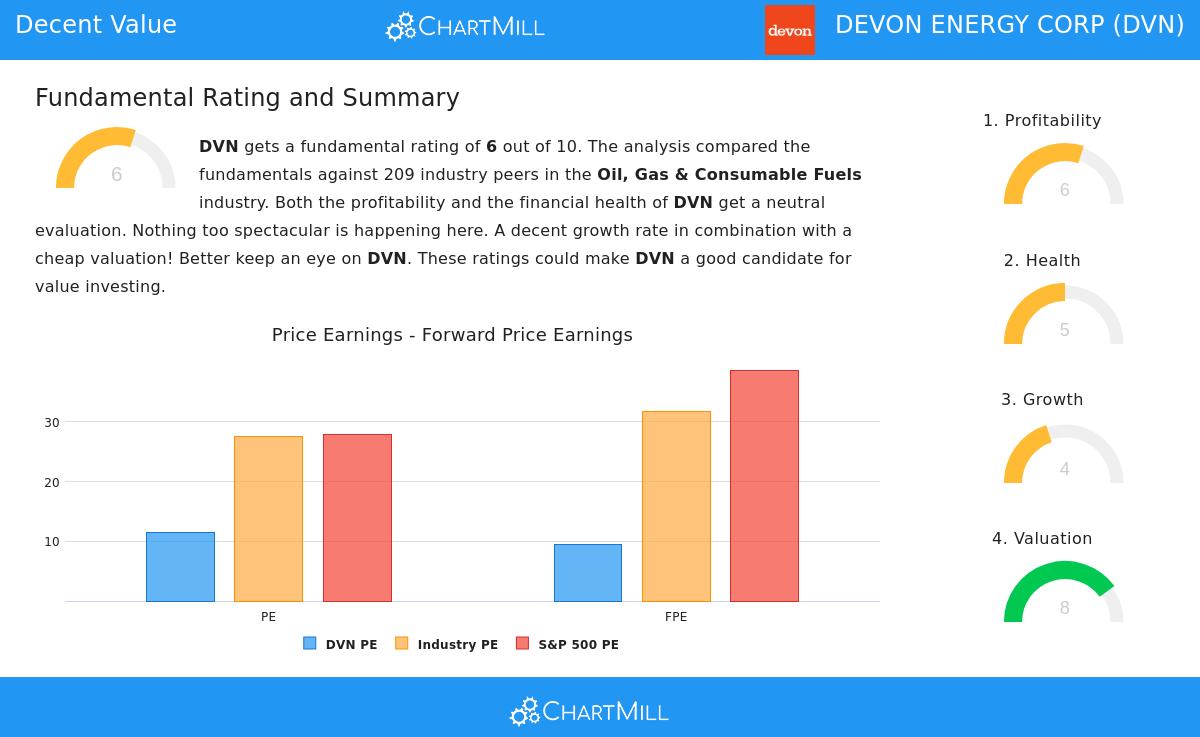
A recent search for such "acceptable value" stocks has identified Devon Energy Corp. (NYSE:DVN), a well-known independent energy company involved in finding and producing oil and natural gas. From a fundamental review, Devon Energy makes a strong argument for investors searching for discounted assets with a good operational base.
Examining Valuation Closely
The central idea of value investing is buying assets worth one dollar for fifty cents. Devon Energy's most persuasive point starts here, with a ChartMill Valuation Rating of 8 out of 10. The company's stock seems low-priced across several important measures when judged against both others in its field and the wider market.
- Price-to-Earnings (P/E) Ratio: At 11.49, Devon's P/E ratio is seen as fair. More significantly, it is lower than about 81% of companies in the Oil, Gas & Consumable Fuels industry. Compared to the S&P 500's average P/E of close to 28, the stock appears clearly discounted.
- Forward P/E Ratio: The valuation case becomes stronger when considering the future. With a forward P/E ratio of 9.48, the company is priced lower than more than 82% of its industry rivals.
- Cash Flow and EBITDA Multiples: The appeal continues with cash-based valuations. Devon's Price-to-Free Cash Flow and Enterprise Value-to-EBITDA ratios are lower than about 87% and 84% of industry peers, in order. These numbers are important for value investors as they are harder to alter with accounting methods than earnings, giving a more direct view of the business's ability to generate cash.
This group of signs pointing to a low price is the first filter value investors use. However, a low-cost stock is only a sound investment if the company itself is financially stable, a mistake called the value trap.
Evaluating Financial Condition and Earnings
A safety buffer is not only about price, it is also about the business's ability to last. Devon Energy's financial condition and earnings ratings give a view into its strength. The company gets a Health Rating of 5 and a Profitability Rating of 6. While these are middle scores, they point to a base stable enough to match the low valuation.
Financial Condition Points: The company shows a good balance between debt and equity, with an acceptable Debt-to-Equity ratio of 0.48. Its Debt-to-Free Cash Flow ratio of 3.01 is good, showing it would need just over three years of present cash flow to clear all debt, a measure better than 77% of the industry. The main warning is in liquidity, with Current and Quick ratios under 1.0, hinting at possible issues in covering immediate bills without more cash flow, a typical trait in the capital-heavy energy field that needs watching.
Earnings Advantages: Even with recent margin pressures noted in the report, Devon's earnings remain strong in key areas. Its Return on Equity (17.01%) and Return on Invested Capital (10.97%) are better than over 81% and 87% of industry peers, in order. For a value investor, these measures are essential. They show that management is using shareholder money effectively to create profits, which is a main force behind long-term real value. The company has also been regularly profitable and cash-flow positive over the last five years, meeting the basic quality tests that value methods need.
Expansion Within the Value Framework
Pure value stocks sometimes do not grow, but the best choice offers a mix, a fair price for a company that is still getting larger. Devon Energy's Growth Rating is a low 4, showing a varied situation. Past earnings per share have fallen, a point of worry. However, this is offset by a high historical revenue growth rate averaging almost 29% each year over recent years. Looking forward, analysts think EPS growth will recover positively at nearly 12% per year, even as revenues might see a small decrease.
For the value-centered investor, this expected earnings growth is key. It suggests the market's current low valuation may not completely include the company's future profit possibility. When joined with a low P/E ratio, it leads to an interesting PEG ratio, which adjusts the valuation for growth and further highlights the stock's low price.
Final Thoughts: A Possibility for the Value-Focused Portfolio
Devon Energy Corp. shows a picture that fits a disciplined value investment method. It sells at a large discount to the market and most of its industry, as shown by its good valuation numbers. This discount is not matched with fundamental trouble, instead, the company displays average financial condition, better-than-average returns on capital, and a route to future earnings growth. This mix helps reduce the danger of a value trap, where a low-cost stock just becomes cheaper.
While the energy field is naturally cyclical and sensitive to commodity price changes, Devon's operational focus on top U.S. basins and its plan to return capital to shareholders give some steadiness. For investors searching for discounted possibilities with good fundamentals, DVN deserves further examination.
You can view the full fundamental analysis report for Devon Energy Corp. here.
This analysis came from a search for stocks with good valuation ratings and acceptable fundamentals. To find more possible choices that match this "acceptable value" description, you can perform the search yourself here.
Disclaimer: This article is for information only and does not form financial advice, a suggestion, or an offer or request to buy or sell any securities. The content shown is based on data thought to be dependable, but its correctness cannot be assured. Investing includes risk, including the possible loss of principal. You should do your own research and talk with a qualified financial advisor before making any investment choices.