

The CAN SLIM system, developed by William O’Neil, is a growth investing methodology that blends fundamental and technical analysis to identify stocks with strong potential for price appreciation. The acronym stands for Current earnings, Annual earnings, New products or management, Supply and demand, Leader or laggard, Institutional sponsorship, and Market direction. The strategy prioritizes companies with accelerating quarterly earnings and sales, strong annual growth, and relative price strength, while also considering institutional interest and overall market trends. By screening for these specific criteria, investors aim to pinpoint high-growth leaders before they become widely recognized. A recent screen based on this approach flagged DRDGOLD LTD-SPONSORED ADR (NYSE:DRD), a South African gold retreatment company, as a candidate worth examining.
Recent Performance and Market Context
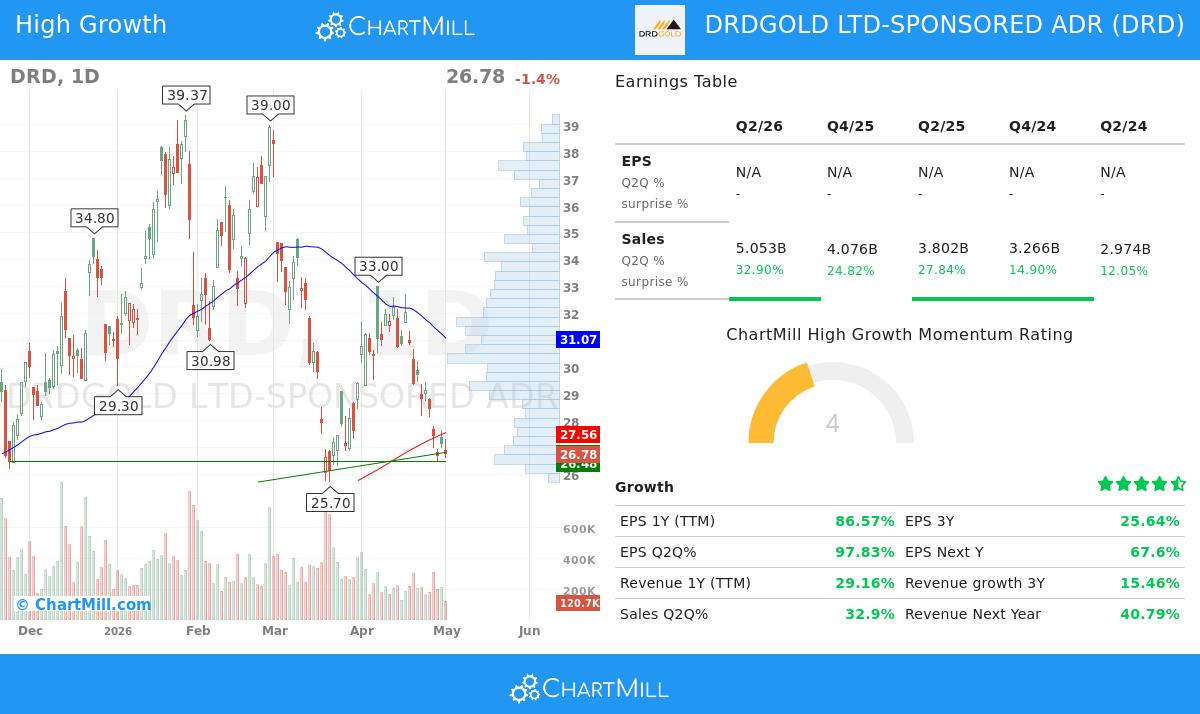
DRD has shown strong momentum over the past year, outperforming 86% of all stocks, which aligns with the CAN SLIM focus on market leaders. However, the short-term picture is less favorable. The stock is currently trading near the lower end of its recent 52-week range, and prices have fallen sharply in the last month. The S&P 500’s long-term and short-term trends are both positive, but DRD’s short-term technical trend is negative, and its long-term trend is neutral. On the technical side, the company earns a rating of 3 out of 10, driven by weak recent price action. The setup quality is also rated 3 out of 10, indicating that the stock is not forming a clear consolidation pattern for entry. Key support lies between $26.14 and $26.48, with resistance near $26.79 to $27.16. For a more detailed technical breakdown, see the full technical analysis report.
Valuation Metrics
Despite the recent pullback, DRD’s valuation remains attractive, which is a positive signal for CAN SLIM investors who want growth without excessive cost. The stock trades at a price-to-earnings (P/E) ratio of 12.17, well below the industry average of 28.55 and the S&P 500 average of 26.64. The forward P/E ratio is even lower at 6.55, suggesting the market expects strong earnings growth ahead. The PEG ratio (price/earnings to growth) is low, meaning the stock’s price is reasonable relative to its expected earnings expansion of 46.40% per year. This combination of strong projected growth and a discounted valuation is a rare find, and it supports the CAN SLIM principle of investing in companies that still have room to run.
Profitability and Health
DRD scores exceptionally well on profitability, earning a 9 out of 10 in the fundamental analysis. The company has been profitable for each of the past five years, with a return on equity (ROE) of 29.74% and a return on invested capital (ROIC) of 21.64%, both among the best in the Metals & Mining industry. Profit margins are also impressive, with a profit margin of 35.06% and an operating margin of 44.29%. These metrics satisfy the CAN SLIM requirement for strong annual earnings and demonstrate efficient management.
Financial health is equally solid, with a health score of 8 out of 10. The Altman-Z score of 8.23 indicates a very low risk of bankruptcy. The company carries virtually no debt, with a debt-to-equity ratio of just 0.0007 and a debt-to-free-cash-flow ratio of 0.01. This aligns with the CAN SLIM preference for companies with low debt levels. The current ratio of 3.01 and quick ratio of 2.49 show strong liquidity, ensuring the company can meet short-term obligations without stress.
Growth Outlook
Growth is the cornerstone of CAN SLIM, and DRD delivers strongly here. The company posted quarterly EPS growth of 97.83% compared to the same quarter last year, far exceeding the 20% minimum typically required by the strategy. Sales growth came in at 32.90% quarter-over-quarter, also well above the 25% threshold. On a longer horizon, the three-year EPS compound annual growth rate is 25.64%, meeting the CAN SLIM target of 25% or more. Future expectations are even brighter, with analysts forecasting EPS growth of 46.40% per year and revenue growth of 29.99% annually. This acceleration in growth—both past and projected—is exactly what the “C” and “A” in CAN SLIM look for.
The overall fundamental rating is 8 out of 10, reflecting strength across profitability, health, valuation, and growth. For complete details, refer to the fundamental analysis report.
Analyst Views and Institutional Interest
Institutional sponsorship, the “I” in CAN SLIM, is present but not excessive. Currently, institutional owners hold 16.86% of DRD’s shares, well below the 85% upper limit that the strategy advises. This leaves room for increased institutional buying, which can drive prices higher as more large investors discover the stock. While analyst reports are not cited here, the strong earnings growth and low valuation suggest that DRD could attract more attention from the institutional community going forward.
The relative strength score of 86.6—meaning DRD has outperformed nearly 87% of all stocks—fulfills the “L” for leader criterion. This is a key filter in the CAN SLIM system, ensuring investors focus on stocks that are already showing market leadership.
Screen Results and Next Steps
DRD currently meets the core CAN SLIM filters used in our screening process, including minimum EPS and sales growth, ROE above 10%, low debt, high relative strength, and moderate institutional ownership. However, the weak technical setup and short-term negative trend suggest that timing an entry requires caution. The strategy emphasizes buying into strength and waiting for proper base formations, which are not present here at the moment.
For investors interested in exploring other stocks that pass the same rigorous screening criteria, you can view the full list of results using our CANSLIM High Growth screen. The screener can be adapted with additional filters such as near 52-week highs or setup patterns to better align with individual risk preferences and entry strategies.
Disclaimer: This article is for informational and educational purposes only and does not constitute investment advice. Always conduct your own research and consider your financial situation before making investment decisions.