

For investors looking for chances where the market price may not completely show a company's actual value, a systematic filtering process can help find possible choices. One such strategy is to look for stocks that show a good basic valuation score while also holding acceptable ratings in other important areas like growth, profitability, and financial soundness. This technique fits with central value investing ideas, which concentrate on finding securities trading for less than their real value, but with the extra safeguards of needing acceptable operational strength and future potential to steer clear of "value traps." A stock that meets this multi-factor filter indicates it is not just low-priced, but low-priced without a clear cause, a beginning for more detailed study.
A Detailed View of the Filtering Conditions
The "Decent Value" filter used here employs the full basic analysis system from ChartMill. It looks for stocks with a Valuation Rating higher than 7 (on a scale from 0 to 10), meaning the market price seems low compared to important financial measures. Importantly, it also sets minimum scores for Growth, Profitability, and Financial Health. This complete perspective is key since a low price by itself can be misleading; a business with worsening finances, weak profitability, or no growth potential may be low-priced for a very good reason. By requiring adequacy across these other areas, the filter tries to find companies where a low valuation could indicate a market mistake instead of a basic problem.
Why DocuSign Inc. (NASDAQ:DOCU) Draws Attention
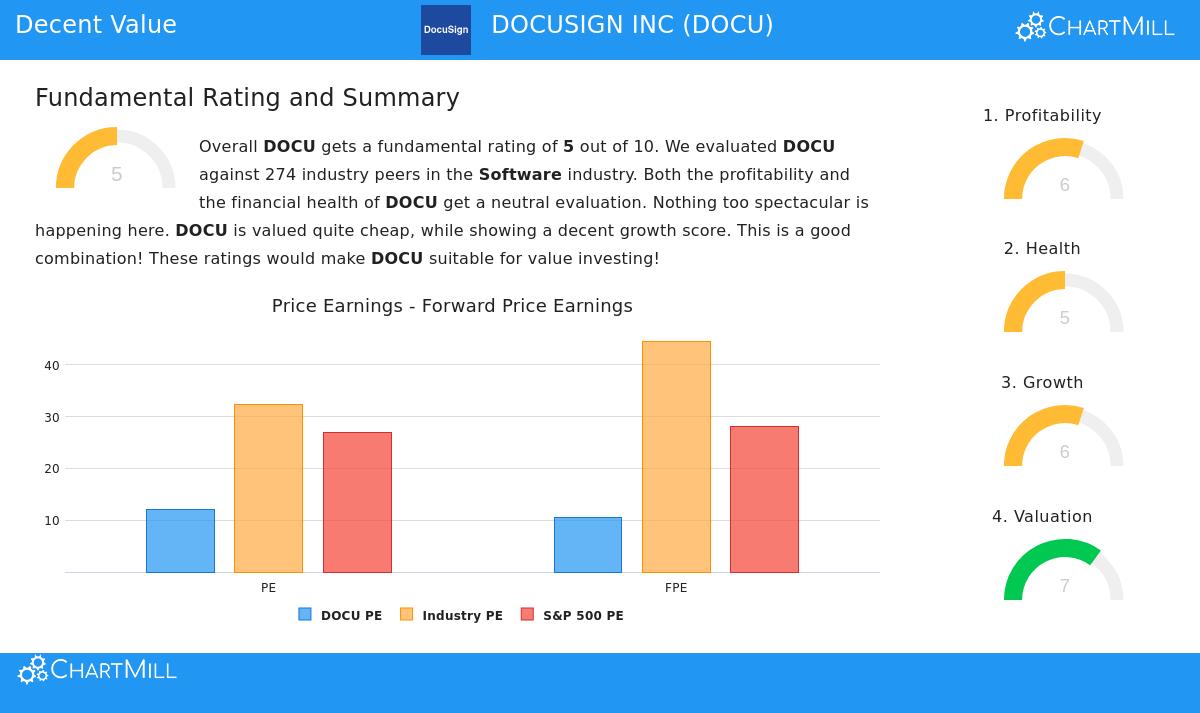
DocuSign, the top company in cloud-based agreement management and e-signature services, comes from this filter as a stock that deserves more examination from value-focused investors. The company's total basic rating is a neutral 5 out of 10, but the details of its scores present a more detailed story that matches the filter's goals.
Valuation: The Main Point of Interest
The filter's first and most significant condition is valuation, and DocuSign meets this with a rating of 7. The basic information shows a stock priced cautiously compared to both its industry and the wider market.
- Price-to-Earnings (P/E): At 12.05, DocuSign's P/E ratio is much lower than the industry average of 32.29 and the S&P 500's average of 26.99. The company is less expensive than about 85% of its software industry competitors on this standard measure.
- Forward P/E: The situation is similar for future estimates, with a Price/Forward Earnings ratio of 10.59, versus an industry average of 44.61.
- Cash Flow & EBITDA: The stock also seems fairly priced based on cash flow, with 92% of industry competitors having a higher Price/Free Cash Flow ratio.
For a value investor, these measures imply the market is using a doubtful or careful multiple on DocuSign's earnings and cash flows, possibly creating a buffer if the company's business shows more strength than anticipated.
Growth, Profitability & Health: The Additional Factors
A low valuation is only interesting if the business is stable. DocuSign's scores in Growth (6), Profitability (6), and Financial Health (5) are not exceptional, but they show a foundation of operational adequacy that backs the valuation argument.
- Growth: The company displays a good past record, with Revenue increasing at an average yearly rate of 25% over recent years and Earnings Per Share (EPS) up a notable 63% on average. While analysts predict a slowdown in growth, a point mentioned in the report, the future projections still indicate consistent, high-single-digit rises in both EPS and Revenue.
- Profitability: DocuSign's profitability measures are mostly good compared to its peers. Its Return on Invested Capital (ROIC) of 9.75% is higher than 84% of the industry, and its Operating Margin of 8.59% is better than 73% of rivals. This shows the company turns sales into profits effectively.
- Financial Health (A Blend): This is the area with the most visible issues. The company carries no debt, a big positive that gives options and lowers risk. However, its liquidity ratios are low, with a Current Ratio and Quick Ratio both at 0.73, which could point to possible difficulties in covering immediate obligations. This split in the health score highlights the value of the filter's need for an "acceptable" score, it identifies the matter for an investor to study more, rather than showing a company in obvious financial trouble.
Combination: A Value Case in Software?
The filter's reasoning suggests that a mix of low valuation and sufficient basics can indicate a chance. In DocuSign's situation, the market appears to be valuing the stock as if its high-growth period is completely finished, using multiples more typical of a slow-growth company. Still, the basic report indicates the company stays reliably profitable, is continuing to grow (though more moderately), and has a balance sheet without debt aside from the liquidity measures. The gap between this operational state and the modest valuation is what makes it a subject for more value investing study. The "buffer" comes from the low earnings multiples, while the verifications on growth and profitability give some confidence that the business itself is not failing.
A Beginning for More Study
It is important to recall that a filter gives a beginning list, not a suggestion to buy. For DocuSign, an investor would need to investigate further into the causes for the slower growth predictions, examine the competitive environment for e-signature and agreement cloud services, and review management's strategies for bettering liquidity. The low current ratio, especially, requires an understanding.
Locate Other Possible Value Choices
The "Decent Value" filter that identified DocuSign can be used on the wider market to find other stocks that meet this particular group of conditions. You can investigate and adjust this filter more through this link: Discover more stocks with strong valuation and decent fundamentals.
Disclaimer: This article is for informational purposes only and does not constitute financial advice, a recommendation, or an offer to buy or sell any securities. All investments involve risk, including the potential loss of principal. Investors should conduct their own independent research and consult with a qualified financial advisor before making any investment decisions. The fundamental data and ratings referenced are provided by ChartMill and are subject to change.