

In the world of long-term investing, few strategies have earned as much respect as the one outlined by legendary fund manager Peter Lynch. His approach, detailed in One Up on Wall Street, focuses on finding companies with solid, sustainable growth that are trading at sensible prices, a philosophy often described as Growth at a Reasonable Price (GARP). The center of the strategy is a fundamental screen that filters for companies with good profitability, strong financials, and a valuation that does not overpay for future prospects. This method avoids speculative high-flyers, instead looking for businesses that can provide steady returns over ten years or more.
One company that recently appeared from such a screen is DICK'S SPORTING GOODS INC (NYSE:DKS), a leading omnichannel sporting goods retailer. For investors following Lynch's principles, DKS presents an interesting case for more study as a possible GARP candidate.
Meeting the Lynch Criteria
The Peter Lynch screen uses several quantitative filters made to find companies with sustainable growth, financial health, and good valuations. DICK'S SPORTING GOODS seems to meet these important benchmarks:
- Sustainable Earnings Growth: Lynch preferred companies increasing earnings per share (EPS) at a good, but not extreme, pace, typically between 15% and 30% each year over five years. Growth beyond that range was often seen as unsustainable. DKS reports a five-year EPS growth rate of 16.89%, fitting within this target area. This shows a history of steady, controlled expansion.
- Sensible Valuation via PEG Ratio: Perhaps the most well-known Lynch metric is the Price/Earnings to Growth (PEG) ratio. A PEG of 1.0 or less suggests the stock's price is sensible relative to its earnings growth. DKS's PEG ratio, based on its past five-year growth, is 0.81. This is below Lynch's threshold, suggesting the market may not be fully valuing the company's historical growth path.
- Strong Profitability (ROE): Return on Equity (ROE) measures how well a company creates profits from shareholder equity. Lynch looked for an ROE above 15%. DKS meets this with an ROE of 15.33%, indicating effective management and a lasting competitive edge.
- Conservative Financial Structure: To limit risk, Lynch liked companies with low debt. The screen uses a Debt/Equity ratio below 0.6, and Lynch himself favored an even stricter sub-0.25 level. DKS's Debt/Equity ratio of 0.34 shows a conservative balance sheet, funded more by equity than debt, which offers strength during economic slowdowns.
- Short-Term Financial Health: The Current Ratio measures a company's ability to pay its short-term bills. A ratio of 1.0 or higher is generally seen as acceptable. DKS's Current Ratio of 1.53 suggests it has enough cash to meet its near-term obligations, a key test for financial stability.
A Snapshot of Fundamental Health
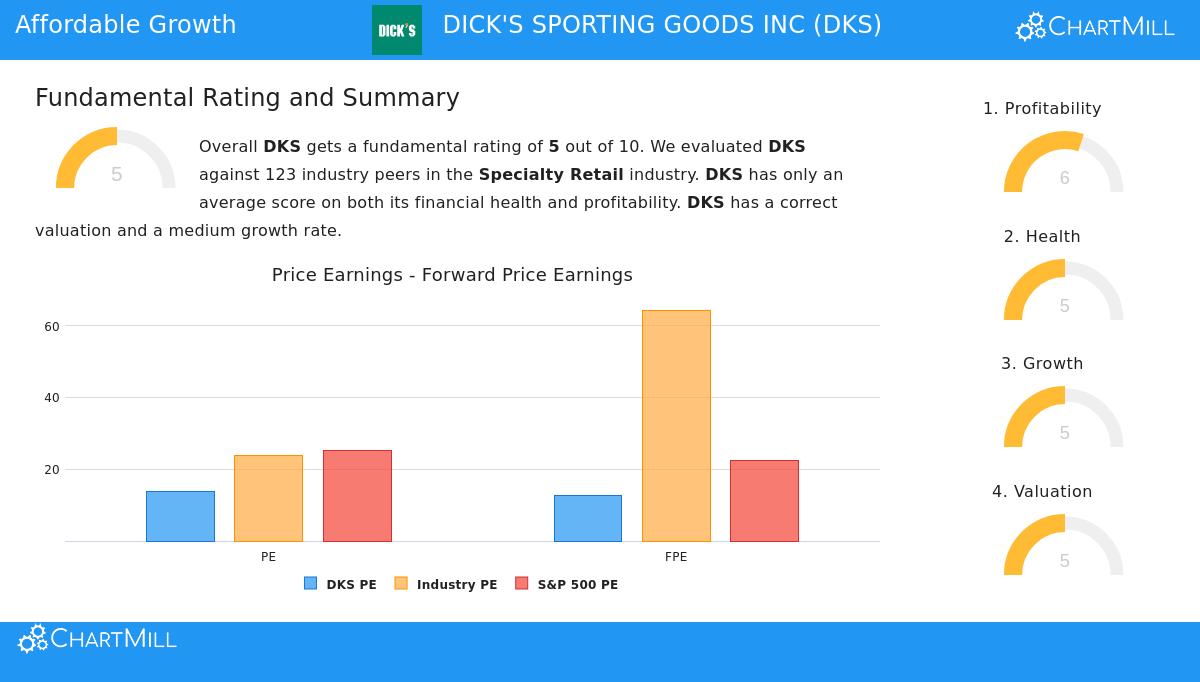
Beyond the specific screen parameters, a wider view of the company's fundamentals gives context. According to a detailed fundamental analysis report, DICK'S SPORTING GOODS has an overall rating of 5 out of 10, placing it as an average performer within the competitive Specialty Retail industry.
The report points out several positives that match a long-term, quality-focused strategy:
- Profitability: The company scores a 6 out of 10 here. It has been regularly profitable with positive cash flow, and its Return on Equity and Profit Margin are better than many of its industry peers.
- Valuation: With a score of 5, the valuation seems fair. Its P/E ratio of 13.72 is lower than both the wider S&P 500 and most of its industry competitors. The good view of its PEG ratio supports the screen's finding.
- Growth: The growth rating of 5 shows a mixed picture. While past revenue growth has been good, recent EPS momentum has weakened, and future growth estimates, though positive, point to a slower speed.
Areas for investor attention include the company's financial health, which also scores a 5. While the debt level is manageable, the report notes an increasing share count and a Quick Ratio that indicates possible liquidity limits. The dividend, while appealing with a yield near 2.6%, has a sustainability score of just 1 because payout growth has been faster than earnings growth.
Investment Considerations and Context
For the GARP investor, DKS represents a classic "steady eddie" opportunity, a well-known business in a common sector showing careful growth without a speculative valuation. Its presence in daily life, a factor Lynch liked, means investors can readily understand its model. The company's ability to increase earnings at a mid-teens rate while keeping high profitability and a strong balance sheet is the precise profile Lynch wanted.
However, the fundamental report notes the need for more careful study. The downward trend in recent profitability margins, questions about dividend sustainability, and a prediction for slower growth are important factors to balance against the good valuation metrics. In the current market environment, where the S&P 500's long-term trend is down, such a stock could offer more stability, but it is not protected from wider economic pressures affecting consumer discretionary spending.
Exploring Further
The Peter Lynch strategy is made to create a beginning list for research, not a buy list. DICK'S SPORTING GOODS is one of a number of companies that passed this strict screen. Investors wanting to see other candidates that fit this disciplined way of finding growth at a sensible price can view the full results via the Peter Lynch Strategy stock screener.
Disclaimer: This article is for informational purposes only and does not constitute financial advice, a recommendation to buy or sell any security, or an endorsement of any investment strategy. The information presented is based on data provided and should not be the sole basis for an investment decision. Investors should conduct their own thorough research and consider their individual financial circumstances and risk tolerance before making any investment.