

For investors aiming to construct a durable, long-term portfolio, the quality investing philosophy offers a strong framework. This method centers on finding companies with lasting competitive strengths, sound financial condition, and reliable earnings—businesses fit to be owned for years, or even decades. The "Caviar Cruise" stock screen puts this philosophy into practice by selecting for firms with a record of solid revenue and profit expansion, high returns on invested capital, good cash flow production, and reasonable debt. It is a process made to distinguish outstanding businesses from the simply acceptable.
One company that appears from using this strict screen is Cummins Inc. (NYSE:CMI), a global power technology frontrunner. The company’s financial picture shows several important traits that match closely with the principles of quality investing.
Matching the Main Quality Standards
The Caviar Cruise screen uses a detailed group of filters to evaluate a company's basic strength. Cummins does well when measured against these numerical standards:
-
Profitable Expansion: The screen demands at least 5% yearly growth in both revenue and EBIT (earnings before interest and taxes) over five years. Cummins passes these minimums, with a 5-year revenue CAGR of 8.57% and a more notable EBIT CAGR of 16.87%. Importantly, EBIT expansion exceeding revenue expansion—as seen here—points to better operational effectiveness and possible pricing strength, signs of a quality business.
-
Outstanding Capital Effectiveness: A central part of the screen is a high Return on Invested Capital (ROIC), specifically looking for a number over 15% when figured on core operating assets (leaving out cash and intangibles). Cummins’ ROICexgc of 17.81% not only meets but goes beyond this level. This shows the company is very good at creating profits from the capital it uses, a main sign of a lasting competitive edge and able management.
-
Sound Financial Condition and Cash Flow: Quality companies do not carry too much debt. The screen applies the Debt-to-Free Cash Flow (FCF) ratio, with a number under 5 seen as good. Cummins’ ratio of 3.17 implies it could pay off all its debt with a little more than three years of present FCF, showing a careful balance sheet. Also, its 5-year average Profit Quality—which gauges how much net income becomes real free cash flow—is a very good 116.63%. This means Cummins’ earnings are of high caliber and supported by actual cash production, giving options for dividends, reinvestment, or handling slow periods.
A View of Basic Strengths and Points to Weigh
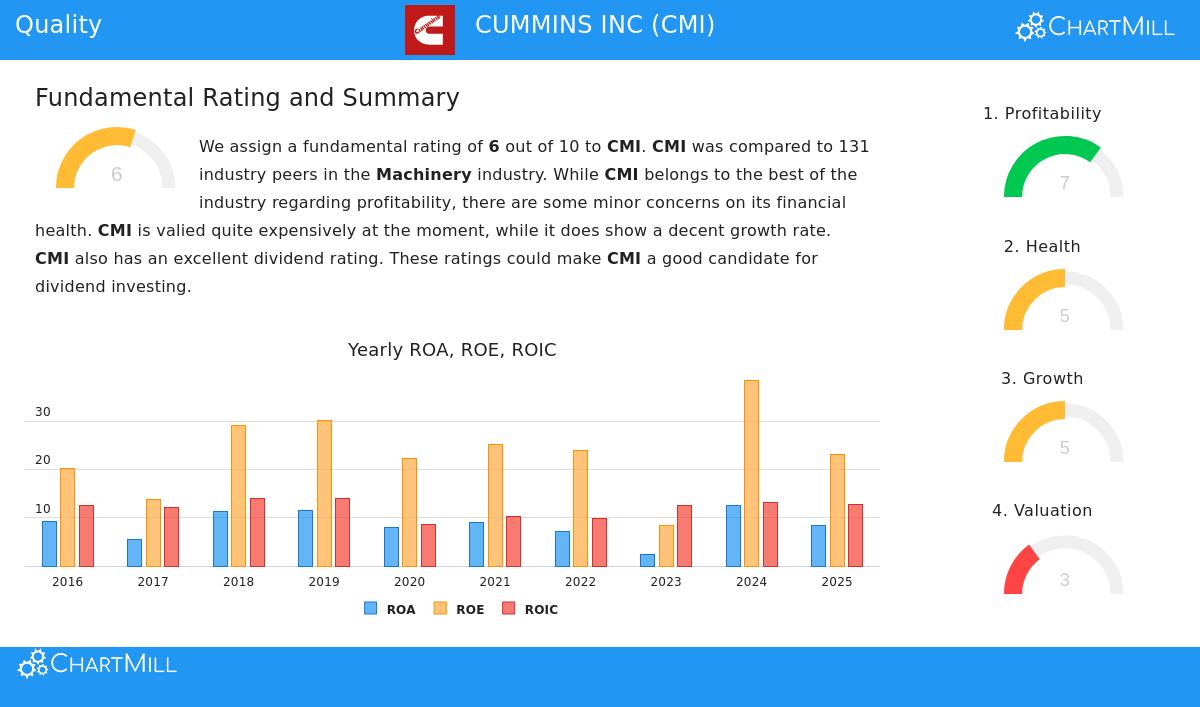
A look at Cummins’ detailed fundamental analysis report gives a wider view for these screen outcomes. The report gives CMI a total score of 6 out of 10, pointing to a varied but mostly firm profile.
- Profitability is a Clear Positive: Cummins scores well on profitability measures, especially its Return on Equity of 23.02%, which puts it in the best group of its machinery industry counterparts. Its margins have been steady and have gotten better over time.
- Dividend Profile is Appealing: The company gets a firm dividend score, backed by a steady 10+ year history of reliable and increasing payments. The dividend growth rate of 7.87% each year and a workable payout ratio make it a notable point for income-focused quality investors.
- Valuation and Expansion Show Detail: The report states that while past EPS expansion has been firm, recent revenue has seen small difficulty. Still, analysts forecast a return to firm growth in both earnings and revenue in the next few years. The main area for attention is valuation; the current P/E ratios are seen as "rather expensive" next to absolute past measures, although they are similar to both industry and wider market averages.
Is Cummins a Quality Choice?
For an investor using the Caviar Cruise method, Cummins makes a strong argument. It successfully meets the main filters intended to find companies with a history of profitable expansion, excellent capital use, and sound financial foundation. Its global leading place in engine and power systems, along with its strategic move into new energy technologies like hydrogen and electrification, points to the non-numerical aspects quality investors look for: a business adjusting to long-term shifts with a clear competitive edge.
The screen that found Cummins is one part of a methodical hunt for quality. You can review other companies that meet this strict group of standards by using the Caviar Cruise stock screener.
In the end, while numerical screens are useful beginning tools, they are not the last stage. Cummins' present valuation requires close study, reminding investors that even for the most sound companies, the price paid is important. A full non-numerical review of its competitive environment, management performance, and cyclical risks stays necessary before any long-term investment choice.
Disclaimer: This article is for informational purposes only and does not constitute financial advice, a recommendation, or an offer to buy or sell any securities. Investors should conduct their own research and consult with a qualified financial advisor before making any investment decisions.