

For investors aiming to create a durable, long-term portfolio, the ideas of quality investing present a strong framework. This method centers on finding companies with lasting competitive strengths, sound financial condition, and the capacity to produce steady, superior profits over many years. Instead of following temporary fashions or large price reductions, quality investors search for businesses that are structured to increase wealth through various economic conditions. One organized way to locate these companies is the "Caviar Cruise" stock screen, which uses a set of strict, measurable filters to separate firms with notable past results, high profitability, and firm financial foundations.
A recent search using this process has identified Abbott Laboratories (NYSE:ABT) as a leading example. As a worldwide healthcare frontrunner with a varied collection covering diagnostics, medical devices, nutrition, and branded generics, Abbott's operation fits the central idea of quality investing: looking for companies that gain from lasting, steady trends. The healthcare field's constant need, fueled by an older population and new developments, supplies a reliable path for expansion. We will look at how Abbott Laboratories matches the particular financial standards established by the Caviar Cruise screen.
Matching the Central Financial Standards
The Caviar Cruise screen is founded on a number of basic filters intended to find excellent financial performance. Abbott Laboratories not only matches but frequently surpasses these marks, showing the traits quality investors value.
-
Maintainable Expansion: The screen calls for a minimum 5% compound annual growth rate (CAGR) for both sales and EBIT (earnings before interest and taxes) over five years. Abbott reports a sales CAGR of 7.06% and an EBIT CAGR of 8.93%, easily passing the requirement. Importantly, its EBIT expansion is faster than its sales growth, a main filter that points to better operational effectiveness and pricing ability, signs of a quality business with competitive edges.
-
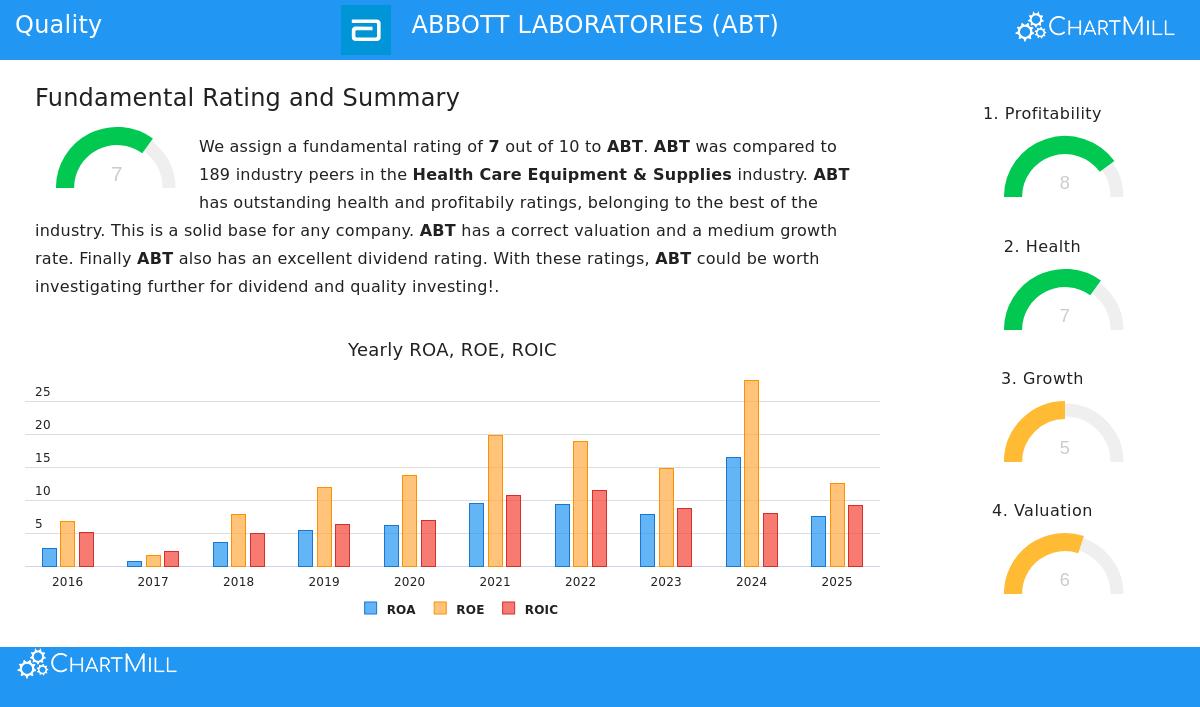
Superior Profitability and Capital Use: Maybe the most important measure for quality investing is Return on Invested Capital (ROIC), which calculates how well a company produces profits from its capital. The screen requires an ROIC (leaving out cash, goodwill, and intangibles) over 15%. Abbott's result of 20.3% is impressive, showing a very profitable core operation that builds significant value for shareholders. This high return suggests a lasting advantage and skilled leadership.
-
Sound Financial Condition and Cash Flow Integrity: A quality company needs a very strong financial position. The screen employs a Debt-to-Free Cash Flow (FCF) ratio below 5, indicating how fast a company could eliminate debt with its cash flow. Abbott's ratio of 1.75 is very good, meaning little financial danger and ample financial room. Also, the screen checks for high "Profit Quality," calculated as the five-year average of FCF to Net Income. Abbott's result of 96.8% is almost ideal, demonstrating that its reported profits are regularly turned into actual, spendable cash, a signal of trustworthy earnings and an established, cash-producing business.
A Broad Fundamental Perspective
An examination of Abbott's wider fundamental picture supports the results from the specific screen. Based on a full fundamental analysis report, Abbott gets a firm 7 out of 10 total, with specific high points in profitability and financial condition.
- Profitability Power: The company receives a high mark of 8 for profitability, having sector-leading profit and operating margins that have grown in recent years. Its ROIC and return on equity also sit in the best group of its healthcare counterparts.
- Dedication to Shareholders: Abbott has a very good dividend history, with a record of raising its payment for more than ten years and a present yield that is above both its industry and the S&P 500 average.
- Moderate Valuation: While its direct P/E ratio might seem high, Abbott sells at a lower price than its industry average on both present and future earnings bases. When weighing its growth and profitability, the price seems fair for a company of its quality.
The report mentions small areas for attention, like a payout ratio over 60% and liquidity ratios that are normal for its field. Still, these are outweighed by its remarkable stability, shown by a very small debt load and a high Altman-Z score, pointing to no failure risk.
The Less Tangible Traits of a Quality Business
Outside the figures, Abbott displays several harder-to-measure features that quality investors appreciate. Its business is fairly simple to grasp: it makes and sells necessary healthcare products across four main areas with international presence. This variety gives steadiness. The type of its products, from critical diagnostics to baby formula, gives it pricing ability and qualities that hold up during downturns. Also, working in the controlled healthcare field builds high entry obstacles, guarding its competitive strengths.
Finding Additional Quality Examples
Abbott Laboratories acts as a classic case of a company that satisfies a strict, numerical quality screen while also having the strategic features that support long-term endurance. For investors curious about using this process to find other possible examples, the Caviar Cruise screen is a useful beginning.
You can see and adjust the Caviar Cruise screen to view other companies that match these strict quality standards here.
Disclaimer: This article is for information only and is not financial guidance, a suggestion, or an offer to buy or sell any security. Investing has risk, including the possible loss of original investment. You should perform your own study and talk with a certified financial consultant before making any investment choices.