

For investors looking for chances where a company's market price seems separate from its basic business condition, a systematic value investing method can be a useful instrument. This method, made famous by Benjamin Graham and Warren Buffett, centers on finding stocks trading for less than their calculated worth, frequently by applying a group of numerical filters to sort for particular financial traits. One filter searches for companies with good valuation measures, indicating they may be priced low, while also keeping acceptable results in earnings, financial strength, and expansion. This pairing seeks to locate stocks priced below their apparent worth that are not weak businesses, but operationally stable companies currently unpopular.
ABM Industries Inc (NYSE:ABM) is a New York-based supplier of integrated facility services, with more than 113,000 workers. A recent study using a "Reasonable Value" filter, which emphasizes good valuations together with acceptable basic factors, has marked ABM as a stock deserving further examination from investors focused on value.
Valuation: The Basis of Chance
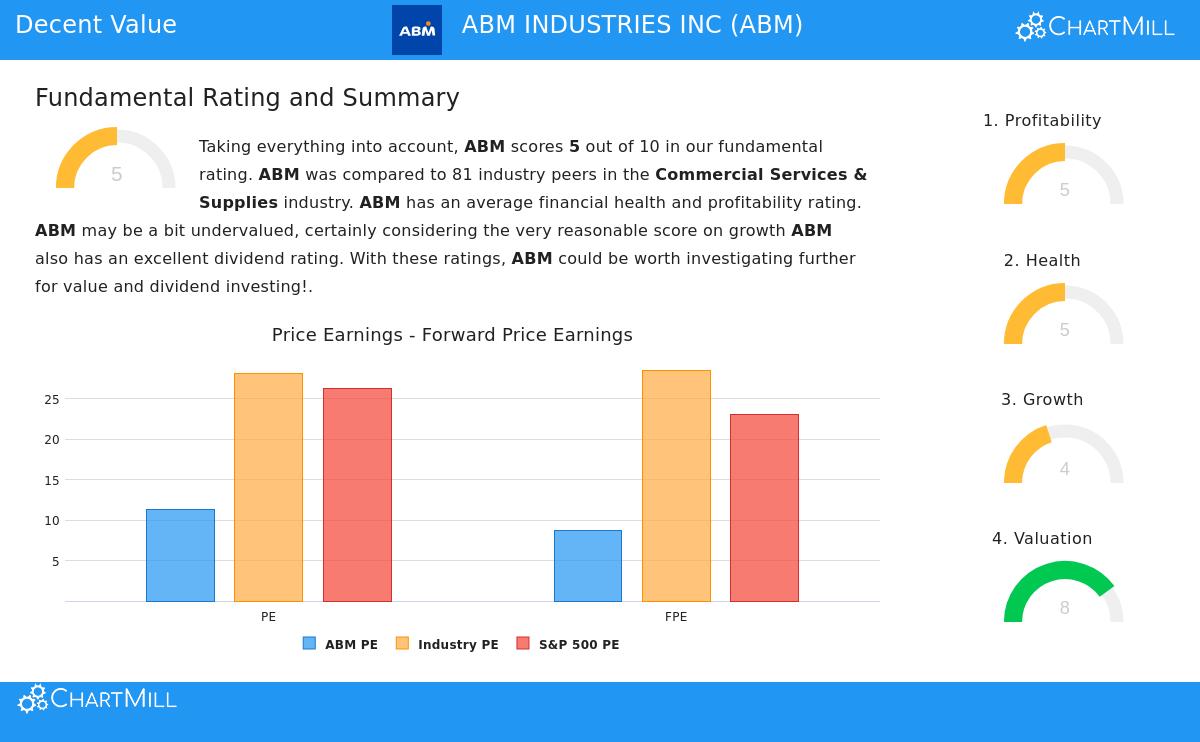
The main attraction for a value investor is a stock's price compared to its income and cash generation. ABM's valuation measures are notable as especially interesting, giving it a high ChartMill Valuation Rating of 8 out of 10. This number comes from measuring the company's important ratios against both its industry group and the wider market.
- Price-to-Earnings (P/E) Ratio: At 11.30, ABM's P/E ratio is much below the industry average of about 28.17. This shows the company is valued lower than almost 88% of its group in the Commercial Services & Supplies field. Compared to the S&P 500's average P/E of 26.21, ABM seems priced very low.
- Forward P/E Ratio: Looking forward, the valuation stays good with a forward P/E ratio of 8.71, which is also lower than about 88% of industry rivals.
- Price-to-Free-Cash-Flow: This measure, which values a company on the cash it produces, adds support to the low valuation idea. ABM is valued lower on this point than over 92% of its industry group.
For a value investor, these measures are important. They imply the market is using a large reduction to ABM's present and future income, possibly forming a "margin of safety"—a cushion between the price paid and the investor's calculation of basic worth.
Financial Strength and Earnings: Evaluating the Base
A low-priced stock is only a sound investment if the company is financially stable. A low valuation joined with poor basics could indicate a weak business, where a stock is low-priced for a bad cause. ABM's results here are moderate but steady, giving a satisfactory base.
The company gets a ChartMill Financial Strength Rating of 5 and an Earnings Rating of 5. These middle scores show it is not a top performer, but also not a company in trouble. Important notes contain:
- Stability and Cash Availability: ABM has a current and quick ratio of 1.50, showing it should have no big problems meeting near-term debts. Its debt amounts, with a Debt-to-Equity ratio of 0.93, are acceptable, though they put it in the lesser part of its industry.
- Earnings Measures: The company is regularly profitable, with positive income and operating cash flow over the last five years. Its Return on Equity (9.14%) and Return on Invested Capital (5.51%) are good, doing better than a majority of industry peers. However, its gross margin of 12.12% is relatively small, which is normal in the facility services industry but stays a point of market pressure.
For the value method, these "acceptable" scores in strength and earnings are necessary filters. They help confirm the investor is not buying a failing operation at a low price, but instead a workable company whose stock is priced below its apparent worth.
Expansion and Dividend: The Possible Drivers
While strict value stocks occasionally lack expansion, ABM shows a varied but hopeful view, with a ChartMill Growth Rating of 4. Its past sales expansion has been consistent, averaging almost 8% each year over five years. More significantly, analysts project earnings per share (EPS) to increase by about 10% each year in the next few years, a rise from recent patterns. This expected gain in earnings could be a driver for the stock price if it happens.
Also, ABM gives a good dividend yield of about 3.09%, which is much above both the industry average (0.86%) and the current S&P 500 yield. The company has a dependable history of paying and raising its dividend for more than ten years. For value investors centered on full return, a maintainable and rising dividend supplies income while they wait for the market to see the stock's basic value.
Conclusion: A Choice for the Value Collection
ABM Industries shows a description that fits a systematic value investing filter: it is basically low-priced on several valuation measures, works with sufficient financial strength and earnings, and gives a shareholder-friendly dividend with projections for better income expansion. It is not a perfect company—its margins are thin and debt exists—but the large price reduction at which it trades may sufficiently balance these concerns for investors with a longer-term view. The stock seems to be a situation where market feeling may not completely show the company's steady, cash-producing business method.
A full study of ABM's basic analysis, including all supporting ratios, is available in its complete ChartMill Fundamental Report.
Investors curious about using this "Reasonable Value" system to find similar chances can use a pre-set filter to see more possible stock choices.
Disclaimer: This article is for information and learning only and does not form a suggestion to buy, sell, or keep any security. The analysis uses data and a particular filtering system; it is not individual investment guidance. Investors should do their own complete study and think about their personal financial position and risk comfort before making any investment choices.