
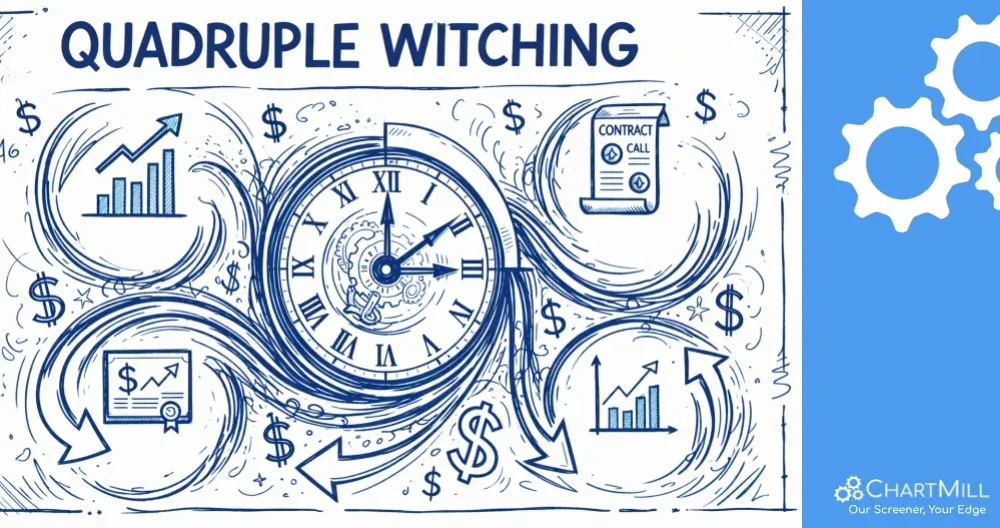
Quadruple Witching: A Trader’s Guide to Arbitrage, Volatility, and Strategy
In the financial markets, certain days act as a magnet for massive trading volume and sudden price swings. None are more famous - or misunderstood - than Quadruple Witching.
Often dubbed "Freaky Friday," this quarterly event represents a critical junction for institutional investors and retail traders alike.
For ChartMill users, Quadruple Witching is more than just a calendar date; it is a period where technical indicators can be skewed by artificial volume and where sophisticated arbitrage strategies take center stage.
This guide explores the mechanics of this phenomenon, its impact on market structure, and how you can navigate the 2026 dates.
What is Quadruple Witching? The Four Components
Quadruple witching refers to the simultaneous expiration of four distinct classes of financial derivative contracts. Understanding the difference between these is key to understanding the market's behavior:
-
Stock Index Futures: Contracts to buy or sell a financial index (like the S&P 500) at a future date. These are cash-settled, meaning no physical assets change hands, only the price difference is exchanged.
-
Stock Index Options: Options that give the holder the right to trade an index. Like futures, these are usually cash-settled.
-
Stock Options: Options on individual companies (e.g., Apple or Nvidia). Unlike index products, these often involve the physical delivery of shares if exercised.
-
Single Stock Futures: Futures contracts on individual stocks.
Cash Settlement vs. Physical Delivery
The friction of Quadruple Witching stems from how these contracts are closed. Because stock options involve the delivery of actual shares, traders who do not wish to own the underlying stock must close or "roll" their positions before the deadline.
This forced activity creates a massive influx of buy and sell orders that would not otherwise exist, leading to the characteristic volume spikes in the final hour of trading.
The Engine of Volume: Index Arbitrage and Program Trading
One reason Quadruple Witching ranks high in trading volume is the role of Index Arbitrage. This is a strategy used by institutional "program traders" to exploit temporary price discrepancies between the stock index futures and the actual stocks that make up that index.
When a futures contract is about to expire, its price must converge with the price of the underlying index. If the future is trading slightly higher than the stocks, arbitrageurs will sell the future and buy the basket of stocks.
This high-frequency "program trading" involves thousands of transactions per second, contributing to the "witching hour" chaos. For the average investor, this looks like random volatility, but for institutions, it is a calculated mechanical process to capture small price gaps.
The "Witching Hour" Mechanics
The actual witching hour occurs during the last 60 minutes of the trading session (3:00 PM to 4:00 PM EST) on the third Friday of March, June, September, and December.
During this window, the market must absorb the rebalancing of massive portfolios and the final settlement of billions of dollars in derivative contracts.
While this leads to high volume, it doesn't always lead to a market crash. In many cases, the market may "pin" to a specific level, a phenomenon where stock prices gravitate toward strike prices with high open interest as market makers hedge their delta exposure.
The Aftermath: The "Monday Effect" and Mean Reversion
A common mistake for traders is assuming the price action on a Quadruple Witching Friday dictates the trend for the next month. In reality, the price movements on "Freaky Friday" are often "noisy" and driven by expiration pressure rather than fundamental shifts.
This leads to what is known as Mean Reversion on the following Monday.
Often, if a stock was pushed artificially high or low during the witching hour due to a large fund closing a position, the price will "snap back" or revert to its previous mean once the expiration pressure is removed.
Savvy traders use ChartMill to identify stocks that have deviated significantly from their moving averages on Friday to look for reversal opportunities when the market reopens.
Quadruple Witching Dates 2026
To prepare your trading plan, keep these dates on your radar for 2026:
-
March 20, 2026
-
June 19, 2026
-
September 18, 2026
-
December 18, 2026
Note: If a holiday falls on the third Friday, the expiration typically moves to the preceding Thursday.
Navigating the Witch
Trading during these periods requires a disciplined approach. Here is how you do it effectively:
Filter Out Volume Noise: Be aware that "Record Volume" on these Fridays is often technical, not a sign of a fundamental breakout.
Monitor the VWAP: The Volume Weighted Average Price (VWAP) is an essential tool during the witching hour to see if the price is being manipulated away from its true intraday value.
Check Relative Strength: Look for stocks that hold their gains despite the broader market volatility during the expiration, these often show true institutional leadership.
Conclusion
Quadruple Witching is a testament to the complexity of modern financial markets. While the name sounds ominous, it is a predictable mechanical event driven by arbitrage and contract settlements.
By understanding the role of program trading and the potential for mean reversion on Monday, you can turn a "freaky" day into a calculated opportunity.
Frequently Asked Questions (FAQ)
What is the difference between Triple and Quadruple Witching?
Triple witching involved the expiration of three contract types. Since the introduction of single stock futures in 2002, it has become "quadruple" witching.
Does Quadruple Witching cause market crashes?
Not necessarily. While it increases the probability of volatility, the primary result is increased volume. The market can just as easily end the day flat after massive swinging.
What is "rolling" a position?
Rolling occurs when a trader closes an expiring contract and immediately opens a new one with a later expiration date to maintain their market exposure.
Why is it called the "Witching Hour"?
The term comes from the folklore idea that supernatural beings are most active at midnight. In finance, it refers to the "supernatural" or unpredictable price action that occurs during the final hour of trading.
How should retail traders handle Quadruple Witching?
Many retail traders choose to step aside during the final hour to avoid wide spreads and "whipsaw" price action, while others look for mean reversion setups for the following week.