

For investors looking to find stocks trading below their estimated real value, a methodical screening process can be a useful beginning. One way is to look for companies that show a good valuation score, meaning they may be priced low compared to their finances, while also holding fair grades in earnings, balance sheet soundness, and expansion. This multi-part test tries to steer clear of the typical "value trap," where a low price signals a failing business instead of a market mistake. By demanding basic strength together with a good price, the method tries to locate companies that are not only low-cost, but possibly priced too low.
Teleflex Inc. (NYSE:TFX), a worldwide supplier of medical technology products, appears as a possibility from this kind of screening. The company's varied collection of products, which includes devices for urgent care, surgery, and interventional methods, operates in a steady healthcare field. A detailed look at its basic report shows a picture that matches the main ideas of a careful value search.
Valuation: The Foundation of the Idea
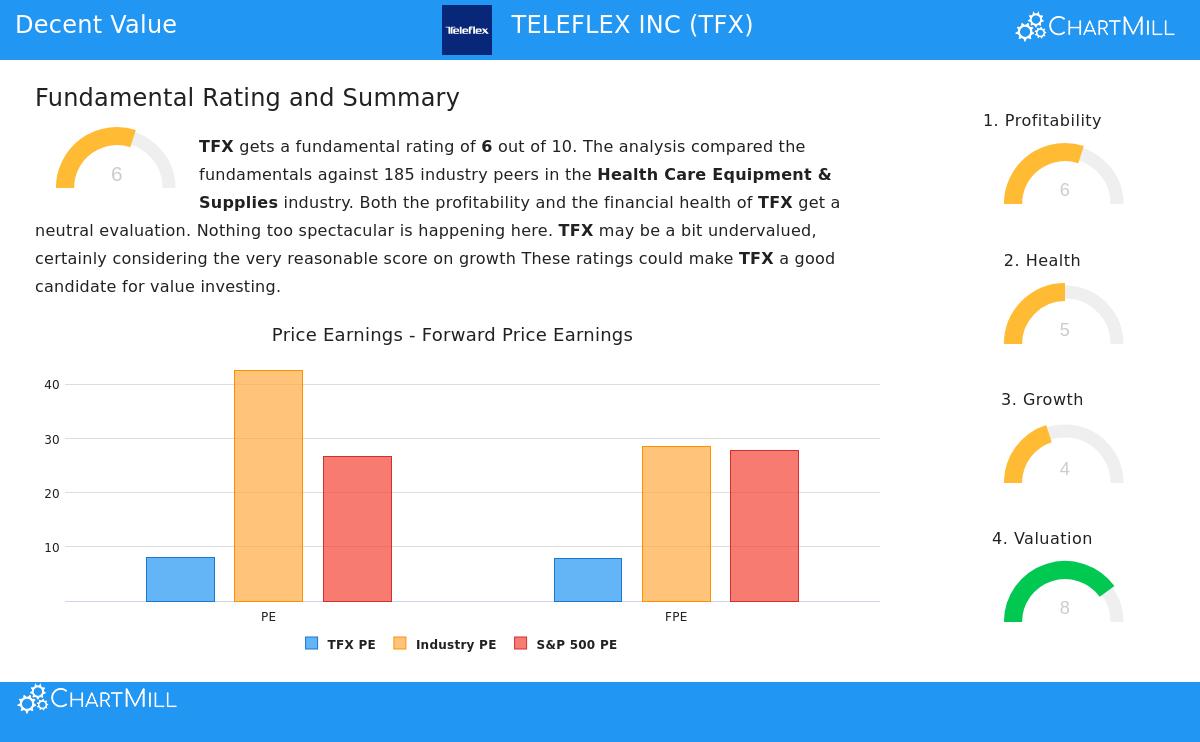
The strongest point for Teleflex as a value possibility is in its price measures. The company's basic report gives it a high valuation grade of 8 out of 10, meaning it looks low-cost next to both its field and the wider market.
- Price-to-Earnings (P/E) Ratio: At 7.96, Teleflex's P/E ratio is called "very cheap." It is valued lower than 97% of similar companies in the Health Care Equipment & Supplies field and is far under the present S&P 500 average of 26.64.
- Forward P/E Ratio: The view stays much the same for the future, with a forward P/E of 7.80, which is also lower than almost 98% of field rivals.
- Other Multiples: The company's Enterprise Value to EBITDA and Price/Free Cash Flow ratios add to the low-cost price story, rating better than more than 90% of the field.
For a value investor, these measures are the first filter. A low P/E can mean the market is pricing a company's earnings too low, possibly making a chance if the business basics are good.
Checking Balance Sheet Soundness and Earnings
A low-cost stock is only a solid investment if the company is financially steady and able to produce earnings. This is where the "fair" grades in soundness (5) and earnings (6) give important background and help reduce risk.
Balance Sheet Soundness (Grade: 5): The report shows a varied but acceptable picture. On the good side, Teleflex shows strong short-term financial ability, with a good Current Ratio of 2.57 meaning no immediate payment issues. The company has also been lowering its share count and reducing its debt-to-assets ratio, which are actions good for shareholders. However, the review points out a somewhat high debt-to-equity ratio compared to peers and a high debt-to-free-cash-flow ratio, meaning the balance sheet has a medium amount of debt that needs watching.
Earnings (Grade: 6): Teleflex shows good operational effectiveness. Its Operating Margin of 17.59% is strong, doing better than nearly 90% of the field. The company has also regularly reported positive profits and operating cash flow over the last five years. While its Return on Assets and Return on Equity are negative because of a recent goodwill impairment charge, a non-cash accounting change, its basic Return on Invested Capital (ROIC) of 6.93% is better than over 80% of its peers. This means the central business is creating acceptable returns on its money.
For the value method, these "fair" scores are key. They show that even with the low price, the company is not in financial trouble and keeps profitable operations, which backs the idea that the low cost may be separate from business facts.
Expansion and the Full View
A full value review must think about expansion, as flat earnings can explain a low price. Teleflex's expansion grade is a low 4. The company shows slow but constant past growth in both sales and earnings per share. More hopefully, the report states that growth is expected to increase a little in the next few years, with analysts forecasting about 6-7% yearly growth in EPS and sales. This expected increase is a good signal that the business is not standing still.
When put together, these parts create a picture of a settled medical device company trading at a large discount to the market and its field. The very good price multiples are backed by acceptable earnings, enough balance sheet soundness, and a path of slow but constant growth. This mix is exactly what the screening process looks for: a stock that is cheap by the numbers but supported by a basically workable business, therefore fitting with the value investing rule of looking for a "margin of safety."
A full list of these basic grades is in the complete Teleflex Inc. Fundamental Analysis Report.
Conclusion
Teleflex Inc. shows an example of using a careful, multi-part filter for value. Its notable price measures quickly get notice, while its medium but enough grades in soundness, earnings, and growth give the needed basic support to suggest the low price may be a chance instead of a caution. As with any investment, more careful study into competition, new products, and management skill is needed. However, for investors searching the market for possibly low-priced assets, TFX shows a picture that deserves more study based on the number-based rules liked by many value-focused methods.
Investors wanting to find other companies that match this picture of good price together with fair basics can see more outcomes using the Decent Value Stocks screen.
Disclaimer: This article is for information only and is not financial advice, a support, or a suggestion to buy, sell, or hold any security. Investing has risk, including the possible loss of the original investment. You should do your own study and talk with a qualified financial advisor before making any investment choices.