

For investors looking for chances where a company's market price may not completely show its basic business quality, a systematic screening method can be a helpful first step. One such technique involves selecting for stocks that show a good basic valuation score, meaning they are priced fairly or low compared to their financial statements, while also holding satisfactory scores in profitability, financial condition, and expansion. This equilibrium is vital; a low price by itself can be a "value trap" if the company's basics are weakening. The aim is to find firms that are not only low-priced by the numbers but also running well, possibly providing a safety buffer for careful, value-focused investors.
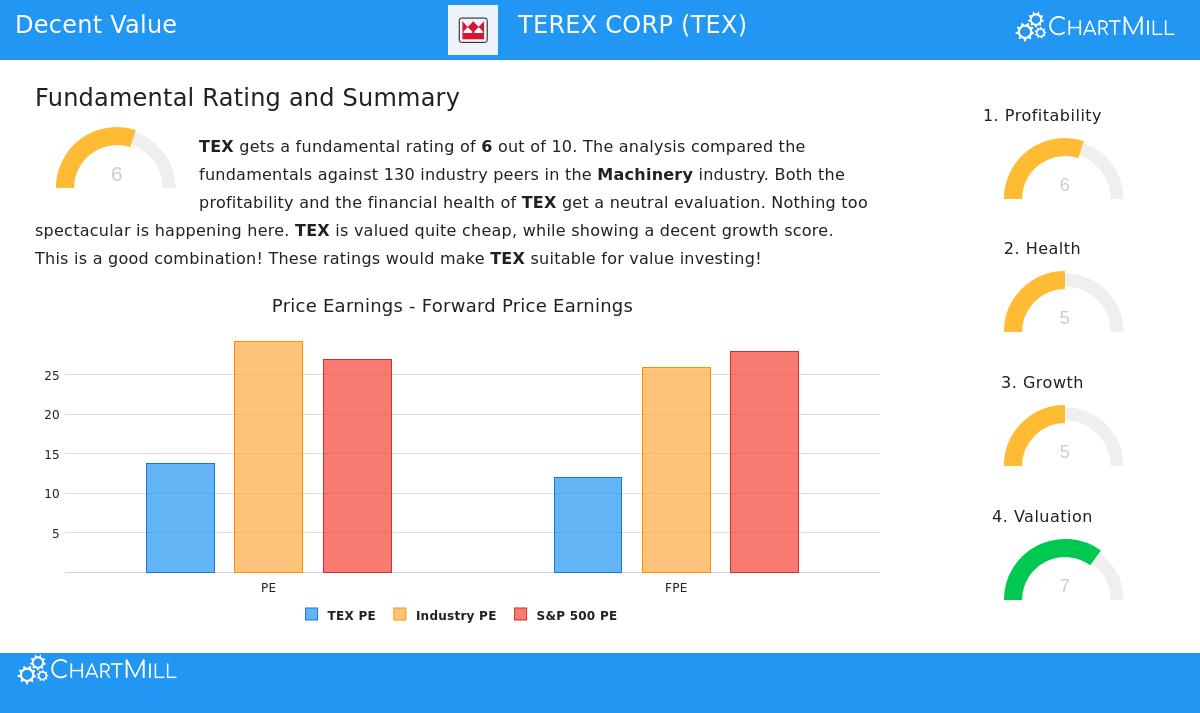
A recent filter using this idea found Terex Corp. (NYSE:TEX), a worldwide maker of materials processing machinery, aerial work platforms, and equipment for environmental solutions. Based on its detailed basic analysis report, Terex shows a picture that matches the central ideas of value investing, where the attention is on the difference between price and inherent value.
Valuation: The Foundation of the Idea
The most persuasive part of Terex's present picture is its valuation. The company's ChartMill Valuation Rating of 7 out of 10 shows it is priced appealingly relative to both its own earnings ability and other companies in its field. This score is the main filter in the "Decent Value" screen, as a good valuation is the beginning for any value investment.
Important measures backing this view include:
- Price-to-Earnings (P/E) Ratio: At 13.80, Terex's P/E ratio is valued lower than 91.54% of similar companies in the Machinery field and is notably under the present S&P 500 average of about 27.
- Forward P/E Ratio: An even more appealing forward P/E of 12.00 implies the market is using a large discount to the company's expected short-term earnings, pricing Terex lower than 96% of its field rivals.
- PEG Ratio: The Price/Earnings to Growth (PEG) ratio, which changes the P/E for expected expansion, is low. This signals the stock's valuation may not be fully rewarding investors for the company's forecasted earnings increase, a typical mark of possible under-pricing.
For a value investor, these measures suggest the market may be missing Terex's earnings potential, forming a possible opening if the company can perform on its basics.
Balancing Valuation with Basic Condition
A low-cost stock is only a sound investment if the company is financially steady. Terex's ChartMill Financial Health Rating of 5 shows a middle but okay standing, which is a vital test against the valuation idea. The report points out a varied situation:
- Liquidity Strength: The company shows good short-term financial adaptability with a solid Current Ratio and Quick Ratio of 2.30. This means Terex has more than enough resources to meet its near-term debts, a good signal of operational steadiness.
- Leverage Worries: The analysis mentions a high Debt-to-Equity ratio of 1.23, which puts Terex in a poorer position than over 80% of its field. This raised debt is a point for care, as it adds financial danger, especially in a weak economy. However, it's partly balanced by the report's comment that the debt-to-assets ratio has gotten better compared to a year ago.
This mix of good liquidity with higher debt highlights the need for the screen's condition for "decent" health, it makes sure the company is not in immediate trouble, even if its balance sheet has some burden.
Profitability and Growth: The Mechanism for Value Achievement
For a low-priced stock to finally have its price increase, the business must be profitable and preferably expanding. Terex's Profitability Rating of 6 and Growth Rating of 5 imply it has the operational mechanism to possibly reduce the valuation difference.
- Profitability History: Terex has recorded positive earnings and operating cash flow for the last five straight years, showing a foundation of operational achievement. Its Return on Equity (ROE) of 10.55% is better than many peers, and its three-year average Return on Invested Capital (ROIC) is good at 12.20%, although the latest ROIC has fallen.
- Growth Path: While last year's earnings per share (EPS) had a small drop, the longer-term view is better. The company's EPS has increased at an average speed of over 110% in recent years, even if from a smaller base. More significant for the future, analysts think EPS will increase at an average rate of over 14% each year in the next few years, along with steady sales increase.
This pairing is central for the value plan. The screen's need for decent growth and profitability helps remove inactive or fading businesses, concentrating instead on companies like Terex that have a believable way to raise their inherent value over time, which should, in logic, be shown in the stock price later.
Conclusion: A Candidate for the Value Watchlist
Terex Corp. illustrates the kind of chance a systematic basic screen tries to reveal: a company trading at a lower price than the market and its field, as shown by its good valuation measures, yet supported by a business that is profitable, cash-producing, and predicted to expand. The existence of higher debt is a noticeable risk that needs watching, but it is weighed against very good liquidity and a record of operational performance.
For investors following a value approach, Terex presents a situation where the "safety buffer" may exist in the separation between its present market price and its basic earnings ability. As with any filter result, this works as a beginning for more thorough, personal investigation.
Interested in examining other stocks that match this "Decent Value" picture? You can use the same screen applied to find Terex and see the present results here.
Disclaimer: This article is for information only and does not form financial guidance, a suggestion, or a bid or request to buy or sell any securities. The analysis is founded on data and ratings given by ChartMill, and investors should do their own study and talk with a qualified financial advisor before making any investment choices. Past results do not show future outcomes.