

For investors looking to assemble a portfolio of durable, high-standard companies, the quality investing method provides a structured system. This approach centers on finding businesses with lasting competitive strengths, sound financial condition, and the capacity to produce reliable and increasing profits over many years. One useful instrument for this hunt is the "Caviar Cruise" stock screen, which uses measurable filters to locate companies displaying signature features of quality: strong profitability, effective use of capital, and financial steadiness.
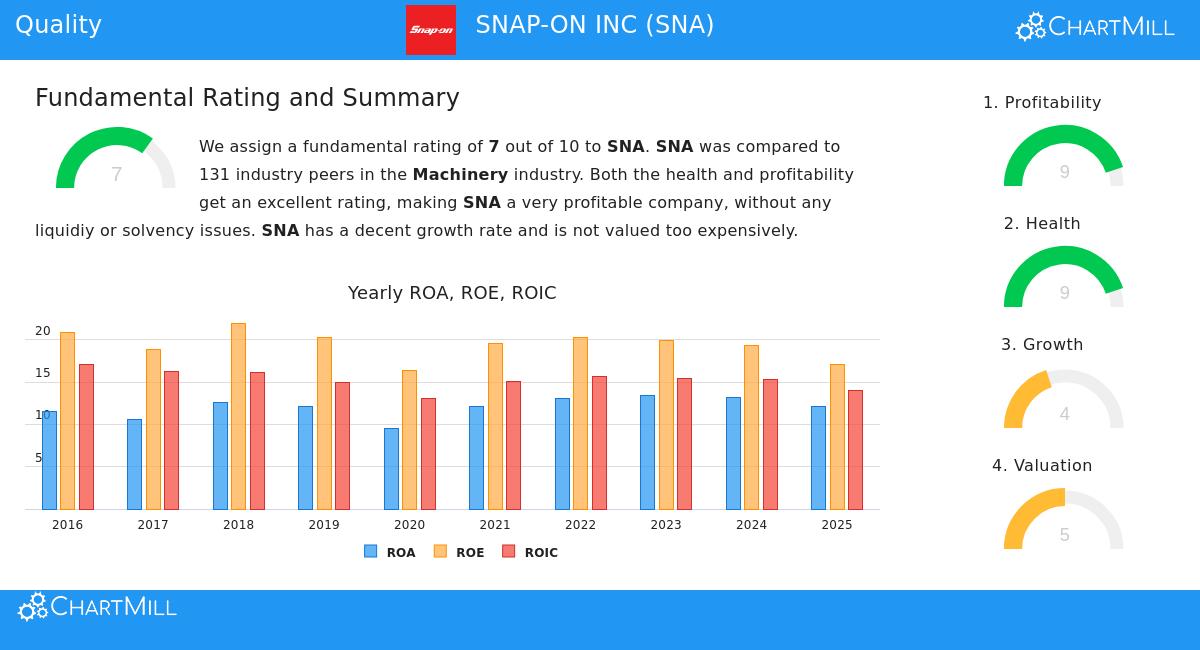
A recent search using this system has identified SNAP-ON INC (NYSE:SNA), a maker of tools, equipment, and diagnostic systems for professional technicians. We will look at how Snap-on's financial picture matches the main principles of quality investing.
Financial Durability and Profitability
Central to quality investing is the search for companies that are not only profitable, but outstandingly so, with the capacity to increase their profit margins over time. This shows pricing strength and operational skill.
- High Profit Margins: Snap-on's financial statements are noted for top-tier profitability. Its operating margin is 26.18% and its profit margin is 19.72%, each putting the company in the top 4% of its machinery industry group. This shows a strong capacity to change revenue into earnings.
- Increasing Bottom Line: Maybe more significant for a quality investor, this profitability is getting better. Over the last five years, Snap-on has recorded an EBIT (earnings before interest and taxes) compound annual growth rate (CAGR) of 8.26%. Importantly, this EBIT growth has been faster than its revenue growth, indicating the company is operating more effectively and profitably as it gets larger, a main filter in the Caviar Cruise screen.
- High-Standard Earnings: The screen stresses "profit quality," or the capacity to change accounting profits into actual cash flow. Snap-on performs well here, with a five-year average free cash flow conversion rate of 97.3%. This means almost every dollar of net income is supported by cash, giving the financial ability to fund operations, pay dividends, and lower debt without depending on outside financing.
Outstanding Capital Effectiveness
Quality investors value companies that produce high returns on the capital put into the business. A high Return on Invested Capital (ROIC) is a clear sign of a lasting competitive edge and capable management.
- Excellent ROIC: Snap-on's ROIC, figured on core invested capital (leaving out cash and intangibles), is a solid 23.43%. This is much higher than the screen's strict limit of 15% and places within the top 13% of the industry. A reliably high ROIC implies the company can put its earnings back into the business at good rates, supporting future growth and building long-term shareholder value.
- Careful Reinvestment: The link between high ROIC and measured reinvestment is positive. While Snap-on's capital spending is more than depreciation, showing it is investing for future growth, it still manages to change almost all its profits to cash. This balance permits expansion while giving significant capital back to shareholders.
Very Strong Financial Condition
A quality company needs to have a very secure balance sheet to endure economic slowdowns and steer clear of the dangers linked to high debt. The Caviar Cruise screen checks this by calculating how fast a company could pay off its debt using its present free cash flow.
- Very Low Debt Load: Snap-on's financial standing is very secure. Its debt-to-free cash flow ratio is a notable 1.20, meaning it could in theory pay off all its debt in just over one year using its yearly cash flow. This is much better than the screen's goal of less than five years and offers great financial safety and choice.
- Secure Liquidity: The company's liquidity measures are also firm, with a current ratio of 4.79 and a quick ratio of 3.68, showing no trouble in meeting near-term responsibilities. Its Altman Z-Score of 7.49 indicates a very small near-term chance of financial trouble.
Valuation and Growth Points
While strict quality investing often means paying a fair price for a superior business, valuation context is still relevant. Snap-on's fundamental analysis report gives a varied but acceptable view.
- Higher Pricing: The stock trades at a forward P/E ratio near 17.7. This is more than the absolute number some strict value investors might want, showing the market's acknowledgment of Snap-on's quality.
- Comparative Value: However, compared to both its industry group and the wider S&P 500, Snap-on's valuation seems more acceptable. It is priced lower than about 66% of its machinery industry rivals and a bit under the S&P 500 average on a forward P/E basis. For a quality investor, paying a market-level or small premium multiple for a company with better financial traits can be an acceptable exchange.
- Stable Growth Picture: Analysts forecast future revenue and EPS growth in the mid-single digits. This fits the screen's need for expected future growth and backs the case for a steady, compounding investment instead of a speculative high-growth prospect.
Summary and Fit for Quality Portfolios
In summary, Snap-on shows a strong profile for a quality-oriented, long-term investor. It leads its niche with outstanding and rising profitability, changes nearly all earnings to cash, and uses its capital with notable effectiveness. Its balance sheet is very secure, with very little debt compared to its cash generation. While its valuation is not very low, it is acceptable relative to the market and the company's high-standard traits. These features, lasting competitive strengths, financial soundness, and the capacity to build value over time, are exactly what the Caviar Cruise screen and the quality investing method aim to find.
Interested in finding other companies that meet this strict quality screen? You can review the complete Caviar Cruise screening results here.
Disclaimer: This article is for information only and does not make up financial advice, a suggestion, or an offer to buy or sell any security. Investing carries risk, including the possible loss of principal. You should do your own research and talk with a qualified financial advisor before making any investment decisions.