

In the world of investing, the search for undervalued opportunities is a constant pursuit. One systematic approach involves screening for companies that appear inexpensive relative to their intrinsic worth while still keeping good underlying business fundamentals. This method focuses on identifying stocks with strong valuation metrics, indicating they may be trading below their true value, along with acceptable scores in financial health, profitability, and growth. The goal is to find potential bargains that are not inexpensive for the wrong reasons, such as worsening operations or high debt, but rather are temporarily missed by the market in spite of their operational strength. This matches core value investing principles, where a margin of safety is looked for in the price paid for a share of a fundamentally good business.
Signet Jewelers Ltd (NYSE:SIG), the large specialty retailer behind well-known brands like Kay, Zales, and Jared, recently appeared through such a screening process. According to a detailed fundamental analysis report, the company presents an interesting profile that calls for a more detailed look from investors interested in value.
Valuation: A Clear Standout
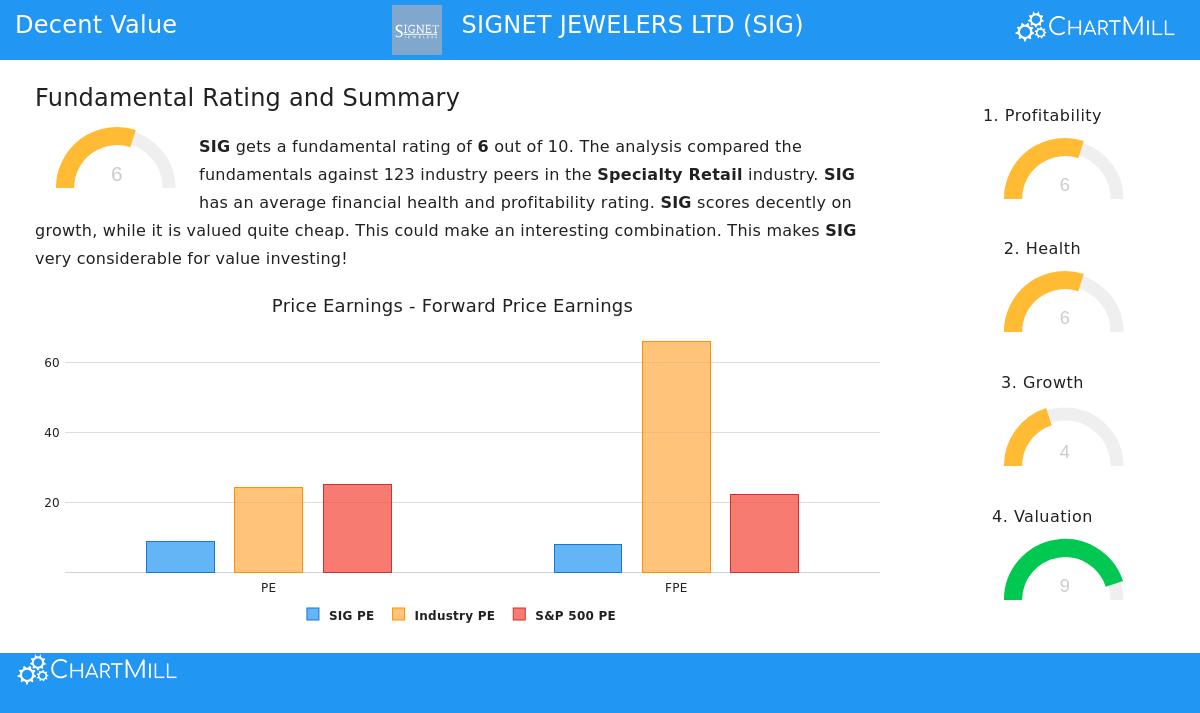
The most noticeable aspect of Signet's current profile is its valuation, which scores a high 9 out of 10. In a market where many stocks trade at high premiums, Signet's metrics suggest it is priced cautiously.
- Price-to-Earnings (P/E): The company trades at a P/E ratio of 8.69, which is seen as reasonable on its own. More importantly, it is less expensive than nearly 90% of its peers in the Specialty Retail industry and sits well below the current S&P 500 average of approximately 24.9.
- Forward P/E: Looking ahead, the valuation seems even more interesting with a forward P/E ratio of 7.92, putting it in the least expensive 10% of its industry.
- Cash Flow and EBITDA: The inexpensive valuation continues to cash-based metrics. Signet is less expensive than 88% of its industry based on its Price/Free Cash Flow ratio and less expensive than 91% based on its Enterprise Value to EBITDA ratio.
For a value-focused strategy, this low valuation is the first point of interest. It suggests the market may be giving a low price to the company's future earnings, possibly creating the "margin of safety" that value investors look for. The important question is whether this low price is a trap or a chance, which is answered by looking at the company's operational fundamentals.
Financial Health and Profitability: A Good Foundation
An inexpensive stock is only a good investment if the company is financially stable. Signet's reports indicate a business on firm ground, with a Financial Health rating of 6 and a Profitability rating of 6. These scores suggest no major warning signs and several key positives.
The company's financial health is supported by a total lack of interest-bearing debt, an uncommon and cautious position that puts it among the top in its sector for solvency. Its Altman-Z score of 3.13 shows a low near-term risk of financial trouble. While its liquidity ratios, like the Current and Quick ratios, are typical for the industry, the clean balance sheet with no debt gives a important cushion.
On the profitability side, Signet shows steady earnings ability. It has been profitable with positive operating cash flow in each of the past five years. Its margins are good:
- An Operating Margin of 7.5% is better than nearly 79% of industry peers and has been getting better.
- A Return on Equity of nearly 15% and a Return on Invested Capital of 7.75% both do better than a majority of competitors.
These health and profitability metrics are important for the value screen. They show that Signet is not a "value trap"—a company that is inexpensive because its business is in decline. Instead, it appears to be a profitable, cash-generating company with a strong balance sheet, suggesting its low valuation may be separated from its fundamental stability.
Growth and Dividend: Supporting Factors
While not the main focus of a deep-value screen, growth prospects give background for future valuation increase. Signet's Growth rating is a 4, showing a varied but acceptable picture. The company's Revenue growth has been small recently, but its Earnings Per Share (EPS) has shown a very strong historical average growth rate of over 44% in recent years. Looking forward, analysts expect EPS to grow at an average rate of about 12% each year.
The company also gives capital to shareholders via a dividend, which yields 1.59%. The dividend has a steady 10-year history and is backed by a maintainable payout ratio of less than 18% of income. Although the dividend amount has fallen a little in recent years, its presence adds a part of total return for patient investors.
Conclusion: A Candidate for Further Research
The screening method that found Signet Jewelers looks for the combination of low price and good business quality. SIG appears to match this profile: its valuation metrics are deeply reduced compared to both the wider market and its own industry, while its fundamentals show a profitable, debt-free company with a history of shareholder returns and expected earnings growth. This mix suggests the stock's current price may not completely show its intrinsic business value.
For investors using a value strategy, this presents an interesting case for more detailed examination. The key will be to judge whether the market is underrating Signet's ability to keep its profitability and manage the retail environment, or if outside reasons explain the reduced multiple.
Interested in finding more stocks that match this profile? You can run a similar "Decent Value" screen yourself to find other chances with strong valuations and good fundamentals via this link.
Disclaimer: This article is for informational purposes only and does not constitute financial advice, a recommendation, or an offer to buy or sell any securities. The analysis is based on data and ratings provided by ChartMill, and investors should do their own independent research and talk with a qualified financial advisor before making any investment decisions.