

In the world of investing, the search for undervalued opportunities is a timeless pursuit. One systematic approach to this hunt involves screening for companies that are fundamentally sound yet priced at a discount to their intrinsic value. A "Decent Value" screen, for instance, filters for stocks with strong valuation ratings, indicating they are cheap relative to their financial performance, while also requiring acceptable scores in profitability, financial health, and growth. This multi-faceted check helps avoid the classic "value trap," where a low price tag masks underlying business deterioration. Instead, it aims to identify companies that are both financially strong and trading at an attractive price, a core idea of value investing.
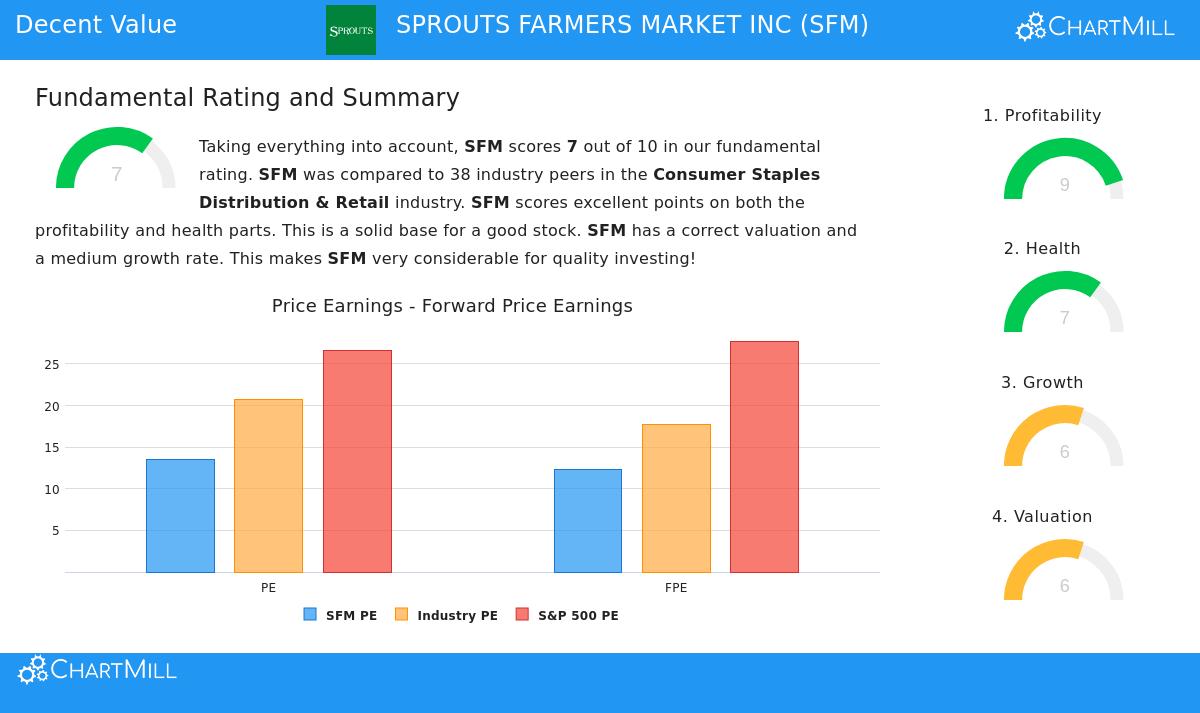
Sprouts Farmers Market Inc (NASDAQ:SFM), a specialty grocery retailer focused on natural and organic products, appears as a candidate from such a screening process. The company’s overall fundamental rating of 7 out of 10 suggests a solid foundation, but a closer look at its individual component scores shows why it might attract the notice of value-oriented investors.
Valuation: An Attractive Entry Point
The main draw for a value investor is an attractive valuation, and Sprouts scores a 7 in this category. The metrics suggest the stock is priced conservatively relative to both its industry and the broader market.
- Price-to-Earnings (P/E): With a P/E ratio of 13.49, Sprouts is valued cheaper than 81.58% of its peers in the Consumer Staples Distribution & Retail industry. This ratio is also notably lower than the current S&P 500 average of 26.64.
- Forward P/E: The view stays consistent looking ahead, with a Price/Forward Earnings ratio of 12.27, which is also cheaper than over 81% of industry competitors.
- Cash Flow & EBITDA: The company’s valuation on a Price/Free Cash Flow and Enterprise Value to EBITDA basis also indicates a somewhat cheap valuation compared to the majority of its industry.
For a value strategy, this relative undervaluation is the starting point. It implies the market may be underappreciating the company’s earnings, creating a potential gap between price and intrinsic value.
Profitability & Health: A Strong Operational Foundation
A low valuation alone is not enough; the business must be fundamentally healthy. Sprouts does well here, with a high Profitability rating of 9. The company shows efficient operations and good returns on capital.
- High Margins and Returns: Sprouts has a Profit Margin of 5.95% and an Operating Margin of 7.86%, placing it in the top tier of its industry. Its Return on Invested Capital (ROIC) of 15.90% is better than nearly 95% of peers, indicating good efficiency in generating profits from its capital.
- Consistent Performance: The company has been profitable with positive operating cash flow in each of the past five years, and key margins have shown good growth recently.
Adding to this, Sprouts holds a solid Health rating of 7. The report highlights very good solvency, though notes some liquidity metrics that require context.
- Strong Solvency: The company has a very low Debt/Equity ratio of 0.06, better than almost 87% of the industry. Its Debt to Free Cash Flow ratio of 0.18 is very good, meaning it could theoretically pay off all debt in just over two months of its current cash flow. An Altman-Z score of 4.35 indicates no bankruptcy risk.
- Liquidity Consideration: While the Current and Quick ratios are below 1, which is often a warning sign, the report notes this must be evaluated against the specifics of the business. Given Sprouts' very good profitability and solvency, these ratios may reflect industry-specific inventory and working capital management rather than a fundamental liquidity problem.
For the value investor, this combination is key. High profitability suggests the business model is sound and competitive, while strong financial health provides a margin of safety, reducing the risk linked to the company’s debt structure during economic downturns.
Growth: A Stable Path
Finally, a "decent value" stock should not be stagnant. Sprouts carries a Growth rating of 6, indicating a stable and positive growth path that supports its valuation.
- Strong Past Performance: Over the past year, Earnings Per Share (EPS) grew by an impressive 40.96%, and the long-term annual EPS growth rate is a solid 16.78%. Revenue has also been growing steadily.
- Positive Future Outlook: Analysts expect this momentum to continue, with forecasted annual EPS growth of 11.27% and Revenue growth of 9.03% in the coming years.
This element completes the strategy. Sustainable growth helps ensure that the intrinsic value of the business continues to rise over time, providing the catalyst that could eventually close the gap with the current market price.
Conclusion
Sprouts Farmers Market presents a case study in what a "decent value" screen seeks to find: a company trading at a discount to its industry (Valuation: 7) while maintaining high profitability (9) and a financially healthy balance sheet (7), all supported by a credible growth story (6). It is not a deep-value turnaround play, but rather a financially sound business that seems to be priced conservatively by the market. Investors can review the full, detailed fundamental analysis report for SFM to examine all underlying metrics.
For those interested in applying this systematic approach to find similar opportunities, the predefined Decent Value Stocks screen can serve as a starting point for further research.
Disclaimer: This article is for informational purposes only and does not constitute financial advice, a recommendation, or an offer or solicitation to buy or sell any securities. The information presented is based on data provided and should not be the sole basis for any investment decision. Investing involves risk, including the potential loss of principal. Always conduct your own due diligence and consider consulting with a qualified financial advisor before making any investment decisions.