

In the world of investing, the search for undervalued companies, those trading for less than their intrinsic worth, remains a cornerstone strategy for many. This approach, known as value investing, seeks to identify solid businesses that the market has temporarily mispriced. A common method to find such opportunities involves screening for stocks that show strong fundamental health and profitability, yet are priced at a discount, suggesting they may be overlooked or undervalued. The goal is to find quality at a bargain price, providing a potential margin of safety for the investor.
NETAPP INC (NASDAQ:NTAP), a provider of data management software and cloud-led services, recently appeared from such a screening process. The company, which helps organizations manage and share data across hybrid cloud environments, seems to present a profile that could interest investors using a disciplined value strategy.
Valuation: An Appealing Entry Point
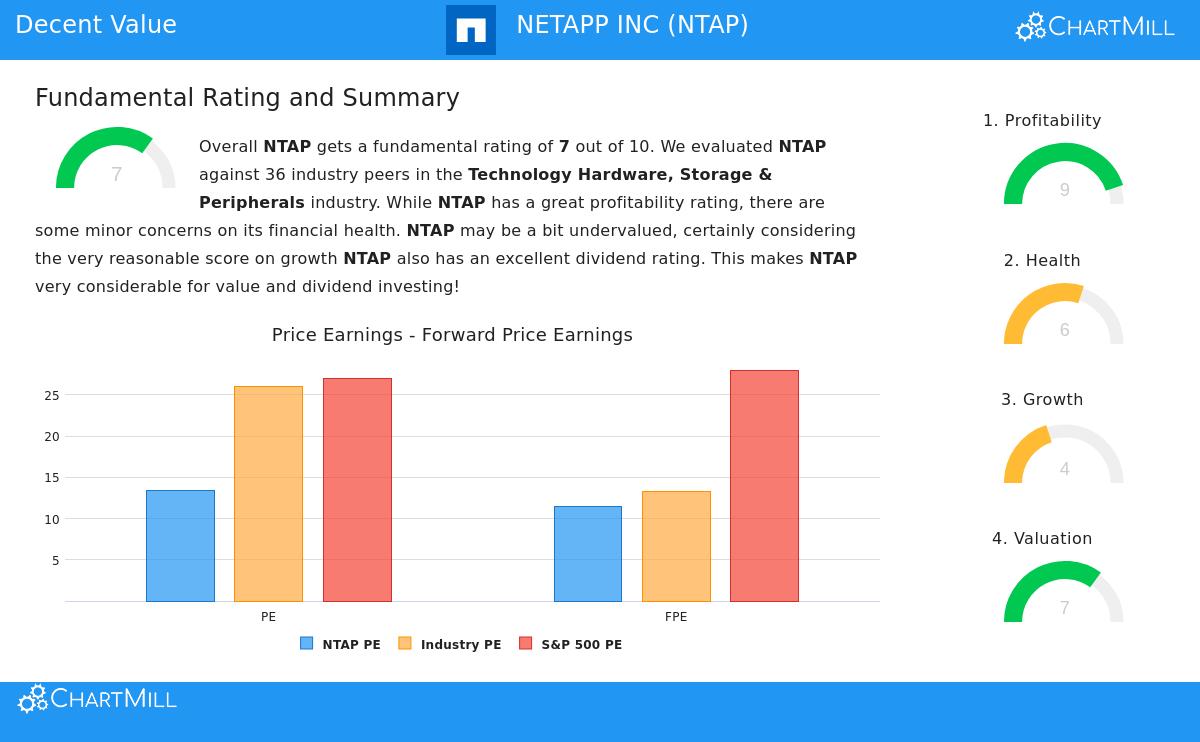
The main attraction for a value investor is an appealing valuation, and NetApp’s metrics indicate it is trading at a discount relative to both its industry and the wider market. According to ChartMill’s fundamental analysis, the stock receives a Valuation Rating of 7 out of 10, pointing to a relatively inexpensive profile.
- Price-to-Earnings (P/E) Ratio: At 13.42, NetApp’s P/E ratio is much lower than the S&P 500 average of about 27. This suggests investors are paying less for each dollar of the company’s earnings compared to the wider market index.
- Forward P/E Ratio: The forward P/E of 11.45 is even more appealing, indicating expectations of future earnings growth at a reasonable price. This ratio is less expensive than over 72% of its peers in the Technology Hardware, Storage & Peripherals industry.
- Enterprise Value to EBITDA & Price/Free Cash Flow: Other valuation measures, such as Enterprise Value/EBITDA and Price/Free Cash Flow, also describe a stock trading at a discount. The report states NetApp is less expensive than about 80% of its industry peers based on these metrics.
For a value investor, these numbers are critical. They represent the quantitative starting point, a stock trading at a price that seems low relative to the company’s current earnings and cash generation. This discount forms the basis of the potential "margin of safety," a key principle of value investing that aims to protect against errors in analysis or unforeseen market downturns.
Profitability and Financial Health: The Basis of Quality
A low valuation alone is not enough; it can sometimes signal a troubled company, a classic "value trap." Therefore, the value strategy requires the support of strong fundamentals. NetApp scores highly here, with a Profitability Rating of 9 and a Financial Health Rating of 6.
The company’s profitability metrics are strong:
- It has a high Return on Equity (119.37%) and a solid Return on Invested Capital (19.95%), both ranking in the top tier of its industry.
- Margins are sound, with a Gross Margin over 70% and a Profit Margin of 17.73%, which has been getting better in recent years.
- The company has regularly reported positive earnings and operating cash flow over the past five years.
Financial health, while not perfect, shows several positive points:
- The company produces sufficient free cash flow, with a Debt to FCF ratio of just 1.48, meaning it could pay off all its debt in under a year and a half, a sign of high solvency.
- While the Debt/Equity ratio is high, the report states this is lessened by strong free cash flow coverage and could be affected by share buyback programs.
- Liquidity ratios (Current and Quick Ratio) are acceptable, indicating the company should not have problems meeting short-term obligations.
These factors are vital for the value approach because they show the business is fundamentally healthy and able to sustain itself. Strong profitability ensures the company can reinvest in its operations and return cash to shareholders, while sound health metrics lower the risk of financial trouble, making the low valuation more likely a market oversight than a sign of underlying problems.
Growth and Dividend: Supporting the Thesis
While not a high-growth story, NetApp shows stability. Its Growth Rating is a modest 4, reflecting steady, single-digit increases. Revenue and earnings per share have grown at a slow but positive rate over recent years, and analysts expect this pattern to continue. For a value investor, moderate and predictable growth can be better than volatile, high-growth projections, as it allows for more dependable valuation models.
Furthermore, NetApp provides an income component with a Dividend Rating of 7. It offers a yield of 2.12%, which is above its industry average, and has a consistent history of paying and not decreasing its dividend for over a decade. The payout ratio is manageable at about 35% of income. This dividend adds a tangible return while investors wait for the market to possibly recognize the company’s intrinsic value.
Conclusion: A Candidate for the Value-Oriented Portfolio
NetApp presents a case that fits several principles of value investing. It trades at valuation measures that are discounted compared to the market and its sector, providing a potential entry point for investors looking for a margin of safety. Importantly, this lower valuation is not paired with weak fundamentals; instead, it is backed by very good profitability, a fairly healthy balance sheet with solid cash flow, a stable growth profile, and a reliable dividend.
This combination, of price disconnect and fundamental strength, is exactly what screens for "decent value" stocks try to find. It suggests a company that is operationally healthy but may be overlooked by the market, offering a potential opportunity for investors with a longer-term view.
Interested in finding more stocks that fit this profile? You can run a similar "Decent Value" screen yourself to find other companies with good valuations and sound fundamentals via this link.
Disclaimer: This article is for informational purposes only and does not constitute financial advice, a recommendation, or an offer to buy or sell any security. Investing involves risk, including the potential loss of principal. Readers should conduct their own research and consult with a qualified financial advisor before making any investment decisions. The analysis is based on data provided and may change with new information.