

The investment philosophy of Peter Lynch, the legendary manager of Fidelity's Magellan Fund, focuses on finding well-run, growing companies trading at reasonable prices, a strategy often termed Growth at a Reasonable Price (GARP). His method highlights sustainable earnings growth, strong financial health, and a valuation that does not overpay for future prospects. A key metric in his toolkit is the Price/Earnings to Growth (PEG) ratio, which seeks to identify stocks where the price is justified by the company's growth rate. We recently used a filter based on Lynch's core ideas on the market, and one name that appeared is North European Oil Royalty Trust (NYSE:NRT).
A Filter for Sustainable Growth and Value
The Lynch-inspired filter selects for companies with a specific financial profile. It looks for a balance between growth and caution, avoiding firms growing at an unsustainable speed. The rules include a five-year earnings per share (EPS) growth rate between 15% and 30%, a PEG ratio at or below 1, a debt-to-equity ratio under 0.6, a current ratio of at least 1, and a return on equity (ROE) above 15%. These rules are made to find businesses that are profitable, financially sound, and fairly priced compared to their growth path.
How North European Oil Royalty Trust Matches the Lynch Profile
North European Oil Royalty Trust, a grantor trust that holds royalty interests in certain German oil and gas fields, presents a strong case when measured against these Lynch rules.
- Sustainable Earnings Growth: Lynch preferred companies growing at a steady, maintainable rate. NRT's five-year average EPS growth rate of 19.1% falls within the filter's target range of 15% to 30%. This shows a history of solid, but not overly aggressive, increase in profitability.
- Attractive Valuation via PEG: The central part of the GARP method is the PEG ratio. A figure at or below 1 indicates the market may be pricing the stock low relative to its growth prospects. NRT's PEG ratio, based on its past five-year growth, is at a very low 0.44. This means investors are paying much less for each unit of historical earnings growth, a positive sign of value within a growth context.
- Strong Financial Health: Lynch required strong balance sheets. NRT does very well here with a debt-to-equity ratio of 0.0, meaning it has no debt. Its current ratio of 1.92 also easily meets the filter's requirement, showing more than enough liquidity to cover short-term obligations.
- High Profitability: The filter's rule for an ROE above 15% selects companies that efficiently create profits from shareholder equity. NRT's ROE of 516.3% is very high, though it is important to understand this is partly due to the trust's unique royalty-based structure and small equity base. Still, it greatly exceeds the profitability level set by the strategy.
Fundamental Analysis Overview
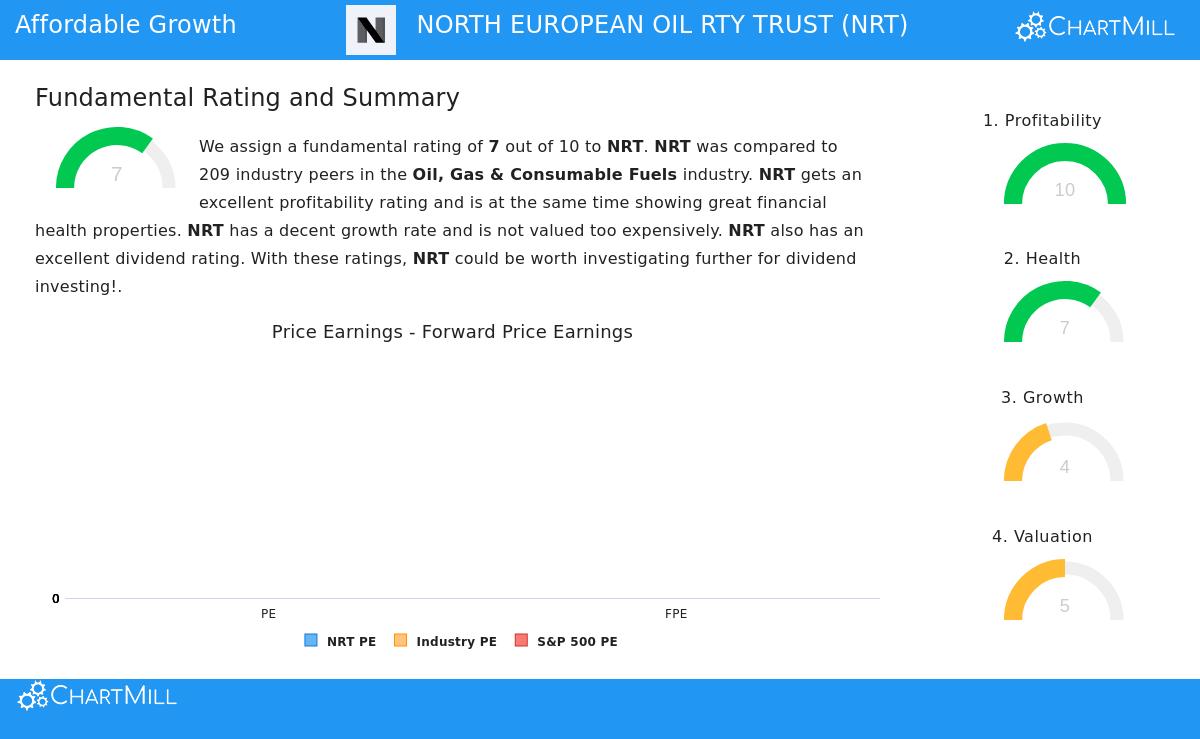
A broader fundamental analysis of NRT agrees with and adds to the Lynch filter results. The trust receives a strong overall fundamental rating of 7 out of 10. Its most notable features are in profitability and financial health, where it gets a near-perfect 10 and a solid 7, respectively, placing it among the best in its industry. The trust has exceptional margins and returns on capital. Its valuation score of 5 points to a fair price-to-earnings ratio of 8.46, which is low compared to both the wider market and its industry peers. Also, NRT has a very good dividend rating, supported by a high yield.
A Candidate for More Study
For investors who follow Peter Lynch's philosophy of looking for fairly priced growth, North European Oil Royalty Trust presents an interesting case. It meets the numerical checks of a Lynch-inspired filter through its mix of steady historical earnings growth, a very attractive PEG ratio, a clean debt-free balance sheet, and high profitability measures. The trust's high dividend yield adds another layer for income-focused investors within a GARP framework.
It is important to note, as Lynch would advise, that passing a filter is only the beginning. The unique structure of a royalty trust, its reliance on specific German gas fields, and the changes in commodity prices are all key factors that need full, fundamental understanding before any investment choice.
Find More Potential Candidates This study focused on one result from our Peter Lynch strategy filter. If you want to see other companies that currently meet these rules for sustainable growth at a reasonable price, you can view the complete, updated filter results here.
,
Disclaimer: This article is for informational purposes only and does not constitute financial advice, a recommendation, or an offer to buy or sell any security. Investing involves risk, including the potential loss of principal. You should conduct your own thorough research and consult with a qualified financial advisor before making any investment decisions.