

The investment philosophy of legendary fund manager Peter Lynch, as detailed in his book One Up on Wall Street, focuses on finding well-run, growing companies trading at reasonable prices. Often described as a "Growth at a Reasonable Price" (GARP) method, Lynch's strategy avoids speculative high-flyers in favor of businesses with lasting expansion, sound financial condition, and valuations that do not overpay for future prospects. His approach uses particular quantitative filters to find candidates, concentrating on earnings growth, profitability, balance sheet soundness, and an important valuation measure that considers that growth.
One company currently meeting a filter built on Lynch's main criteria is North European Oil Royalty Trust (NYSE:NRT). This distinct entity functions as a grantor trust, gathering royalties from natural gas and oil production in particular German regions and paying the net income to its unit holders. Its recent financial measures indicate it matches closely with the principles of long-term, value-aware growth investing.
Match with Peter Lynch's Main Criteria
Lynch's filter stresses several pillars of fundamental soundness. Here is how North European Oil Royalty Trust compares against these important checks:
- Lasting Earnings Growth: Lynch looked for companies with a steady earnings growth history between 15% and 30%, considering growth outside this span possibly not lasting. NRT states a 5-year average annual Earnings Per Share (EPS) growth of 19.13%, putting it directly within Lynch's target area for dependable, steady expansion.
- Reasonable Valuation (PEG Ratio): Possibly the central part of the GARP method, the Price/Earnings to Growth (PEG) ratio compares a stock's valuation (P/E) to its earnings growth rate. Lynch preferred a PEG ratio of 1 or lower, showing the market is not overpaying for the company's growth. With a PEG ratio of 0.49, NRT seems notably undervalued relative to its historical growth path.
- Sound Profitability (Return on Equity): A high Return on Equity (ROE) shows efficient use of shareholder capital. Lynch wanted an ROE above 15%. NRT's ROE of 410.05% is very high, though it is important to recognize this number is typical of royalty trusts with little equity on their balance sheets instead of traditional operating companies. The main point is exceptional profitability.
- Financial Condition (Debt & Liquidity): Careful management was crucial to Lynch. He chose companies with low debt and enough short-term liquidity.
- NRT has no debt, with a Debt/Equity ratio of 0.0, surpassing even Lynch's strict choice for a ratio below 0.25. This removes interest expense risk and gives great financial adaptability.
- The trust's Current Ratio of 1.68 shows it has more than enough current assets to meet its current liabilities, easily satisfying Lynch's minimum requirement of 1.
Fundamental Condition and Dividend Profile
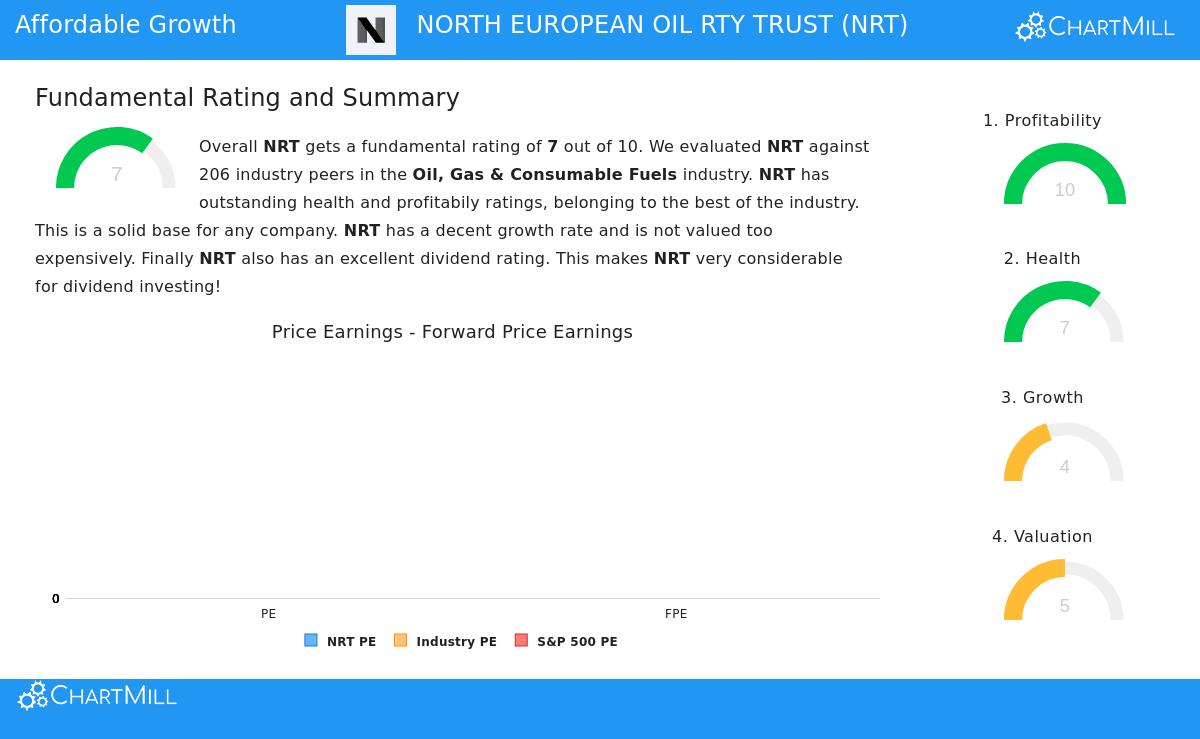
A wider view of the trust's fundamental analysis report supports its strengths. The report gives NRT a total score of 7 out of 10, with especially high grades in Profitability (10/10) and Condition (7/10). Its profit margins are some of the best in the Oil, Gas & Consumable Fuels industry, and its perfect solvency, emphasized by a strong Altman-Z score, indicates very low bankruptcy risk.
For income-focused investors, a notable characteristic is NRT's Dividend Rating of 7/10, supported by a large trailing yield. The trust has a lengthy history of payments, though investors should note the payout ratio and know that payments are directly linked to variable royalty income from commodity prices.
You can examine the full, itemized fundamental analysis for North European Oil Royalty Trust here.
A Classic "Dull" Company?
Lynch famously recommended investing in simple, understandable businesses, often those in "dull" industries that were missed by Wall Street. North European Oil Royalty Trust matches this description. It does not perform exploration or complex refining, it simply collects royalties on production from established German fields run by major oil companies. This clear business model is easy to assess, and its low institutional ownership might fit Lynch's concept of finding chances before they become widely followed.
Conclusion and Additional Research
Based on a quantitative filter taken from Peter Lynch's strategy, North European Oil Royalty Trust shows an interesting profile for investors looking for growth at a reasonable price. It shows lasting historical earnings growth, trades at a good valuation when growth is considered, and has a clean balance sheet with zero debt. Its exceptional profitability and high dividend yield provide more appeal.
However, possible investors must think about the special parts of a royalty trust. Payments are not guaranteed dividends but changeable income amounts heavily reliant on natural gas and oil prices, production rates, and currency exchange changes. This presents a different risk profile compared to a traditional growth stock.
For investors wanting to examine other companies that fit this disciplined GARP method, the complete Peter Lynch strategy filter with present results is accessible here.
Disclaimer: This article is for informational purposes only and does not constitute financial advice, a recommendation, or an offer to buy or sell any security. The analysis is based on historical data and specific investment methods, which do not guarantee future results. Investors should perform their own complete research and consider their personal financial situation and risk tolerance before making any investment decisions.