

The search for undervalued companies is a central part of value investing, a method centered on finding stocks priced below their inherent value. This method, supported by figures like Benjamin Graham and Warren Buffett, uses detailed fundamental study to find chances where the market price does not match the actual business condition. A useful method to apply this strategy is by filtering for stocks that show an attractive mix of a low price next to good financial condition, earnings strength, and acceptable expansion potential. This makes sure an investor is not just buying a "value trap", a company that is numerically inexpensive but in long-term deterioration, but a operationally healthy business obtainable at a lower price.
MGIC Investment Corp (NYSE:MTG), a top private mortgage insurer, appears from such a filtering process as a candidate deserving more examination. The company's newest fundamental study report indicates it may match the description of an undervalued stock with operational quality.
Valuation: The Center of the Chance
For a value investor, price assessment is the main filter. A stock must seem inexpensive compared to its income, cash generation, and resources to justify more review. MGIC's price metrics are notable as especially appealing.
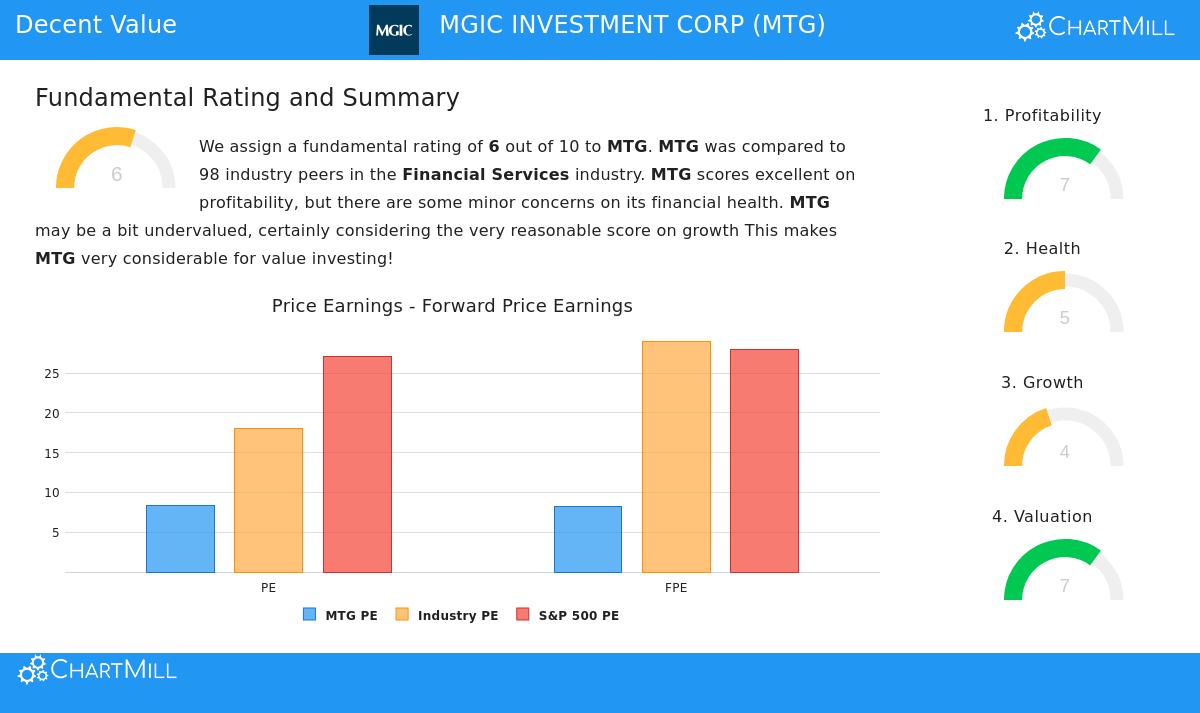
- Price-to-Earnings (P/E) Ratio: At 8.42, MTG's P/E ratio is much lower than the S&P 500 average of about 27. This shows investors are paying less for each dollar of MGIC's income compared to the wider market.
- Industry Comparison: Inside the Financial Services industry, MGIC's price is also attractive. Its P/E ratio is lower than over 70% of its industry competitors, and its forward P/E ratio of 8.27 is lower than 62% of others.
- Cash Flow & EBITDA: The appeal continues to cash-based measures. The company's Price-to-Free Cash Flow and Enterprise Value-to-EBITDA ratios are lower than 86% and almost 90% of industry competitors, in that order, indicating the lower price is not a bookkeeping irregularity but shows a truly low price relative to the cash the business produces.
This overall view of low multiples is precisely what a value filter tries to find, a possible difference between market price and inherent value.
Financial Health: Reviewing the Base
A low price means little if the company's financial position is weak. Financial condition is vital to make sure the business can survive economic drops and keep running. MGIC's condition rating, while not the top, displays several zones of clear force that reduce risk.
- Strong Solvency: The company shows very good solvency measures. Its Debt-to-Free Cash Flow ratio of 0.80 is very strong, meaning it could pay off all its debt in under a year using its present cash generation. This ratio is better than 83% of the industry.
- Conservative Leverage: With a Debt-to-Equity ratio of 0.12, MGIC keeps a very careful capital setup. This small amount of debt gives a important safety net against financial pressure and is stronger than 73% of its competitors.
- Shareholder-Friendly Actions: The report mentions the company has been lowering its share count over the past one and five years, a move that can raise the ownership portion and income per share for continuing investors.
Profitability: The Driver of Value
A genuinely undervalued company should be earning money; if not, the low price may be reasonable. Profit measures show how well a company turns sales into income. Here, MGIC does very well, having some of its top grades.
- Industry-Top Margins: The company's Profit Margin of 62% and Operating Margin of 81% are outstanding, doing better than about 95% and 97% of the industry. These margins signal a very effective business model with important price control or cost benefits.
- Strong Returns on Capital: MGIC produces good returns for its capital base. Its Return on Assets (11.38%) and Return on Invested Capital (12.03%) are in the top group of its industry, doing better than 93% and 89% of competitors, in that order. This shows management's skill in using capital to create profits.
For a value investor, this high profit strength is key. It indicates the business has a lasting competitive edge (or "moat"), which supports the idea that present income is maintainable and not a temporary exception.
Growth & Dividend: The Supporting Parts
While pure value stocks may not be high-expansion stories, some expansion is needed to support future prices, and a dividend can give a return while waiting for the market to see the stock's value.
- Earnings Growth: MGIC has shown good historical expansion in Earnings Per Share (EPS), averaging almost 19% each year over recent years. While future EPS expansion is projected to slow to about 5.6%, it stays positive.
- Reliable Dividend: The company provides a dividend yield of 2.30%, a bit above its industry average and the wider S&P 500. More significantly, it has a steady 10-year history of payments, with a record of raising the dividend at a high yearly rate of over 33%. The payout ratio is a maintainable 17.5% of income, leaving plenty of room for reinvestment and future increases.
The mix of a reasonable expansion path and a well-supported dividend fits with a value investment method, offering both possible price increase and income.
Conclusion
MGIC Investment Corp offers an example of what a value-focused filter tries to locate: a company selling at a important discount to the market and its competitors, as shown by low P/E and cash flow multiples, while also showing strong profit with industry-top margins and a basically sound financial position with little debt. The existence of a rising dividend adds a part of shareholder return during the ownership time. This description indicates the stock may be undervalued relative to its inherent business quality, making it a candidate for more review by investors using a value approach.
Interested in finding more stocks that match this description? You can perform a similar "Decent Value" filter yourself to discover other possible chances. Explore the filter here.
Disclaimer: This article is for informational purposes only and does not constitute financial advice, a recommendation, or an offer to buy or sell any security. The analysis is based on data and ratings provided by ChartMill, and investors should conduct their own thorough research and consult with a qualified financial advisor before making any investment decisions. Past performance is not indicative of future results.