

For investors looking to assemble a group of outstanding companies to hold for many years, the ideas of quality investing provide a useful structure. This method centers on finding businesses with lasting competitive strengths, very good financial condition, and a consistent history of producing high returns on capital. A helpful instrument for this process is the "Caviar Cruise" stock screen, which measures important quality indicators to sort for companies with solid past results, high profitability, and good financial stability. The screen looks for steady revenue and profit increase, high returns on invested capital, reasonable debt, and trustworthy earnings that become free cash flow.
One prominent company that meets this strict filter is Mastercard Inc. A (NYSE:MA), the worldwide payments technology leader. Its business model, which handles transactions between consumers, merchants, banks, and other companies, places it centrally within the continuing shift to digital finance, a significant long-term direction. We will look at how Mastercard matches the main points of the Caviar Cruise screen and why it deserves notice from investors focused on quality.
A History of Profitable Increase
The Caviar Cruise method favors companies that have shown not only increase, but profitable increase. The screen asks for at least 5% yearly growth in both revenue and EBIT (earnings before interest and taxes) over five years, with EBIT growth preferably higher than revenue growth, a signal of better operational efficiency and pricing strength.
Mastercard performs very well on these points:
- Revenue Growth (5Y CAGR): 11.48%
- EBIT Growth (5Y CAGR): 18.90%
The company's EBIT growth is much faster than its already-good revenue growth. This shows Mastercard is effectively turning more of each revenue dollar into operating profit, a sign of a scalable business with strong competitive barriers. This operational advantage comes from the asset-light design of its network, where added transaction volume brings high additional profit.
Outstanding Returns on Capital
Maybe the most important filter in the quality investing set is Return on Invested Capital (ROIC). A high ROIC indicates a company is very effective at using capital to create profits. The Caviar Cruise screen sets a high standard, requiring an ROIC (leaving out cash, goodwill, and intangibles) over 15%.
Mastercard's result here is remarkable:
- ROIC (Excluding Cash & Intangibles): 298.32%
This very high number, which is much greater than the screen's requirement, highlights the capital-efficient nature of Mastercard's network model. It needs little extra capital to handle more transactions, letting it produce large profits from its current systems. For a quality investor, this measure is key as it indicates a business that creates significant value and can build wealth over time.
Financial Soundness and Earnings Trustworthiness
Quality investing also includes examining a company's balance sheet and the dependability of its profits. The Caviar Cruise screen checks debt sustainability by comparing total debt to free cash flow (FCF), looking for a ratio under 5, meaning debt could be paid off with less than five years of cash flow. It also checks "profit quality" by seeing how much net income becomes real FCF, requiring a five-year average over 75%.
Mastercard's financial numbers show notable soundness:
- Debt / Free Cash Flow: 1.16
- Profit Quality (5Y Avg.): 102.77%
A Debt/FCF ratio of 1.16 is very low, showing Mastercard could pay off all its debt in just over a year using its present cash flow. This gives great financial room to maneuver. Also, a profit quality above 100% means the company creates more free cash flow than its accounting net income, a signal of very trustworthy, cash-heavy earnings. This strong cash creation supports ongoing investment, share buybacks, and a rising dividend without stressing the balance sheet.
Fundamental Analysis Summary
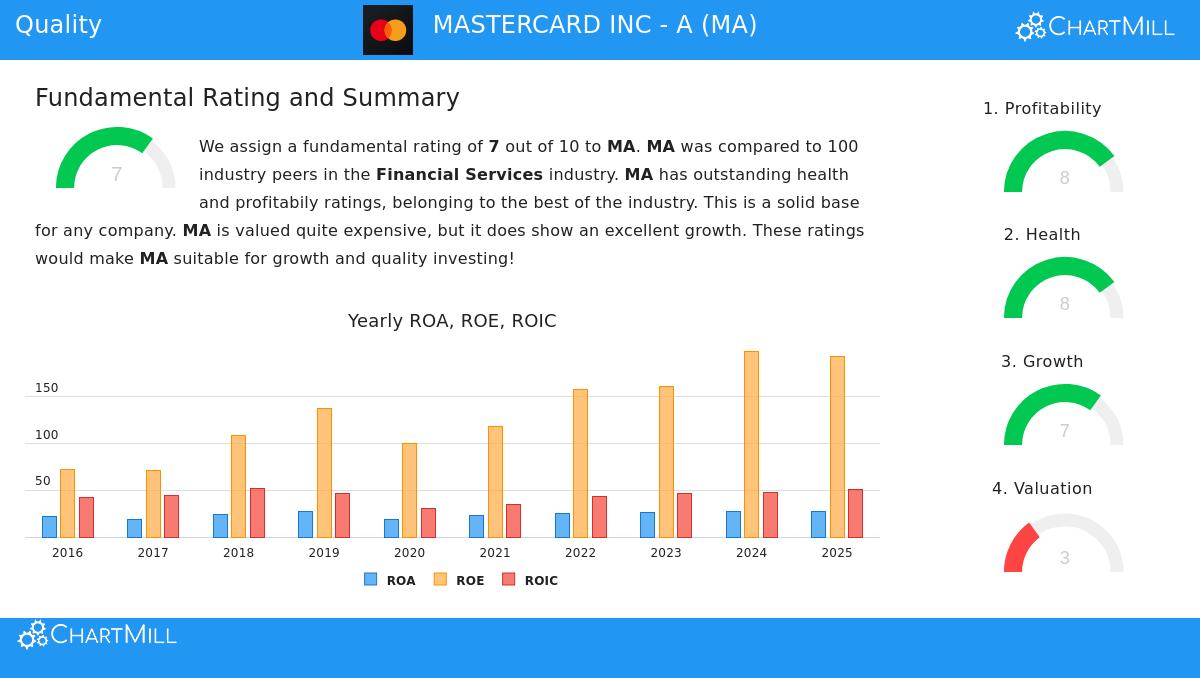
A look at Mastercard's wider fundamental analysis report supports the results from the specific screen rules. The report gives Mastercard a high total score, with special high marks in Profitability and Health. Its profit margins are some of the best in the financial services field, and its financial soundness is viewed as very good. The main point of care, typical for many high-quality businesses, is in Valuation; the stock price is high compared to the market and similar companies, mirroring its high-growth, high-return nature. Still, this is partly reasonable given its excellent growth path and profitability.
Is It a Quality Investment?
Mastercard offers a strong example for quality investing. It runs a worldwide known business that is simple to grasp, gains from the significant trend toward cashless payments, and has a broad competitive barrier along with pricing strength. The number-based filters of the Caviar Cruise screen, good profitable growth, exceptional ROIC, a very strong balance sheet, and high earnings trustworthiness, all indicate a company with the traits quality investors want for a long-term holding.
Naturally, the high price needs thought. A quality investor must judge if the company's lasting strengths and growth potential support the current cost, knowing that exceptional businesses are seldom low-priced.
Find Other Quality Candidates The Caviar Cruise screen is made to methodically find companies with good quality basics. Mastercard is one instance that met the filter. To see the present list of stocks that qualify and do your own analysis, you can open the screen here: Caviar Cruise Quality Stock Screen.
Disclaimer: This article is for information only and is not financial advice, a suggestion, or an offer to buy or sell any security. Investing has risk, including the possible loss of the original amount invested. You should do your own research and talk with a qualified financial advisor before making any investment choices.