

For investors aiming to create a portfolio that produces steady passive income, a methodical process for choosing dividend-paying stocks is important. One useful technique involves searching for companies that provide a good dividend now and also have the fundamental financial soundness to maintain and raise those payments in the future. This plan frequently centers on three main elements: a strong dividend score, which assesses the yield, growth, and record of payments; good profitability, confirming the company makes sufficient money to pay its dividend; and firm financial condition, showing it can endure economic declines without threatening shareholder returns. By sorting for these traits, investors can look past high-yield pitfalls and find companies made for lasting income creation.
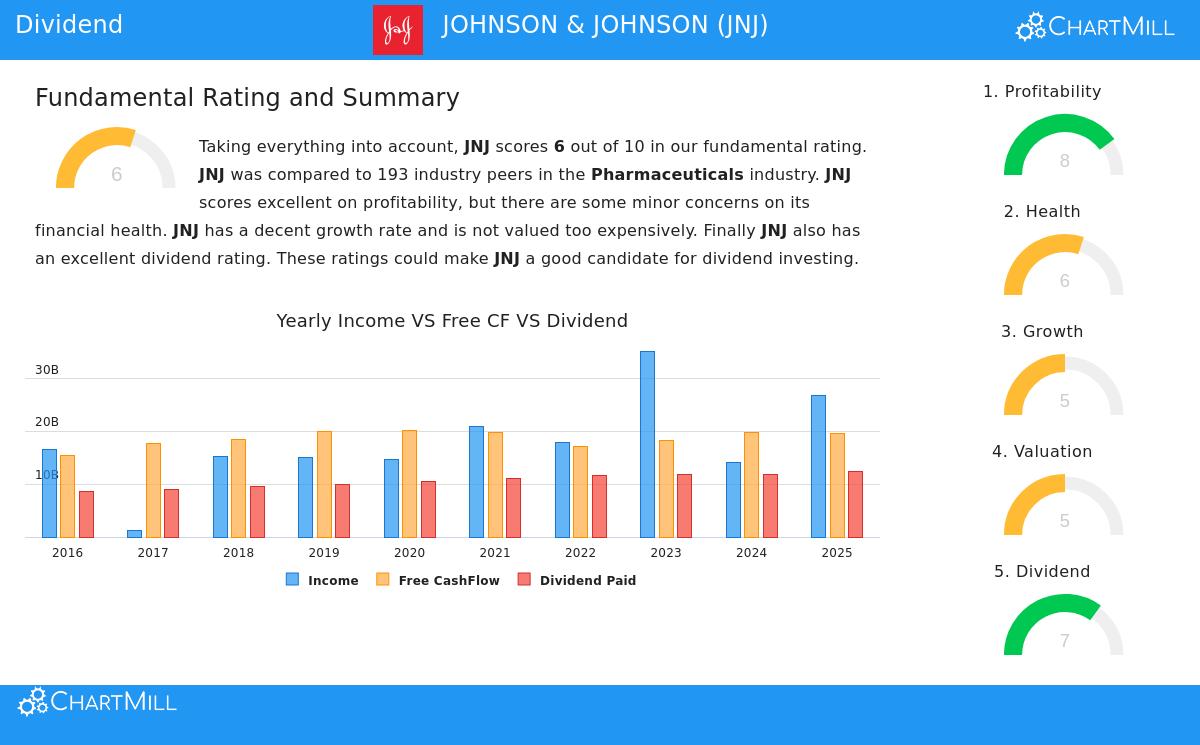
A clear example found through such a search is healthcare leader Johnson & Johnson (NYSE:JNJ). The company’s fundamental picture builds a strong argument for its place in a dividend-oriented portfolio, as explained in its detailed fundamental analysis report.
Dividend Dependability and Growth
The central attraction for income investors is J&J's dividend history and its present qualities. The company’s ChartMill Dividend Rating of 7 shows a good total evaluation of its income-providing abilities.
- Good and Competitive Yield: J&J presently has a dividend yield of 2.14%. This is close to the wider S&P 500 average, but it is notable inside its own field. The average yield for pharmaceutical companies is only 0.68%, so J&J's payment is over three times the industry standard, putting it in the high group of similar companies.
- A Record of Regular Raises: Possibly more significant than the current yield is the dependable rise of the dividend. J&J has raised its yearly payment for more than 60 straight years, giving it the respected name of a "Dividend King." The fundamental report mentions an annual dividend growth rate of 7.68% in recent years, showing a steady dedication to giving more capital to shareholders.
- Maintainable Payout Ratio: A high yield is only useful if it can be maintained. J&J’s payout ratio—the part of its earnings given as dividends—is about 46%. This figure is seen as acceptable; it keeps a large amount of profits to be used in the business for future development while giving a clear and supported income flow to investors. The report states the dividend is increasing at a pace similar to earnings growth, a main sign of lasting sustainability.
Supporting Financial Soundness
A lasting dividend needs a profitable and financially stable business. This is where the search standards for "good profitability and condition" show their value, and J&J performs well on each point.
Profitability Measures: J&J receives a firm ChartMill Profitability Rating of 8, supported by very good margins and returns on capital. Its profit margin of 28.5% and operating margin of 27.8% are some of the highest in the pharmaceuticals industry, doing better than over 93% of rivals. Also, its return on invested capital (ROIC) of 14.4% and return on equity (ROE) of almost 33% are high-quality outcomes. This strong level of profitability is the source that pays for the dividend and offers protection in harder times.
Financial Condition Review: With a ChartMill Health Rating of 6, J&J displays a firm, but not perfect, financial state. The company’s solvency is a specific positive. Its Altman-Z score of 5.05 shows a very small short-term chance of financial trouble, and its debt-to-free-cash-flow ratio of 2.43 is very good, meaning it could clear all its debt in less than two and a half years using its present cash flow. While some liquidity measures, like the current and quick ratios, are below industry averages, the report explains this by pointing out the company’s "very good solvency and profitability." For an established, cash-producing business like J&J, these numbers are less worrisome than they would be for a newer, development-focused company.
Valuation and Development Setting
For dividend investors intending to own for the long term, starting valuation and future outlook are also relevant. J&J’s valuation is fair inside its industry. Its price-to-earnings (P/E) ratio is less costly than over 80% of its pharmaceutical industry counterparts, although it seems more pricey on its own. Moving forward, analysts predict a modest rise in both revenue and earnings per share (EPS) growth, which should help continued dividend raises.
A Subject for More Study
Johnson & Johnson illustrates the kind of company an orderly dividend search plan tries to find: one with a dependable, increasing income flow supported by a profitable and fundamentally sound operation. It shows why sorting for these joined standards is useful—the high dividend score finds the good income, while the firm profitability and condition scores give assurance that the dividend rests on a stable base.
For investors wanting to examine other companies that fit similar standards for maintainable dividend investing, the Best Dividend Stocks screen offers a changing beginning point for more study and idea creation.
Disclaimer: This article is for informational purposes only and does not constitute financial advice, a recommendation, or an offer to buy or sell any securities. Investing involves risk, including the potential loss of principal. You should conduct your own research and consult with a qualified financial advisor before making any investment decisions.