

For investors looking to find stocks trading below their estimated true value, a methodical screening process can be a useful beginning. One method is to look for companies that are low-priced based on core measures, as shown by a high valuation score, while also displaying good business condition, earnings strength, and forward momentum. This technique seeks to find possible situations where the share price may not completely represent the company's financial soundness and capacity to earn, a central idea of value investing. Using this filter, one company that appears for further review is H&R Block Inc (NYSE:HRB).
A Detailed View of the Core Metrics
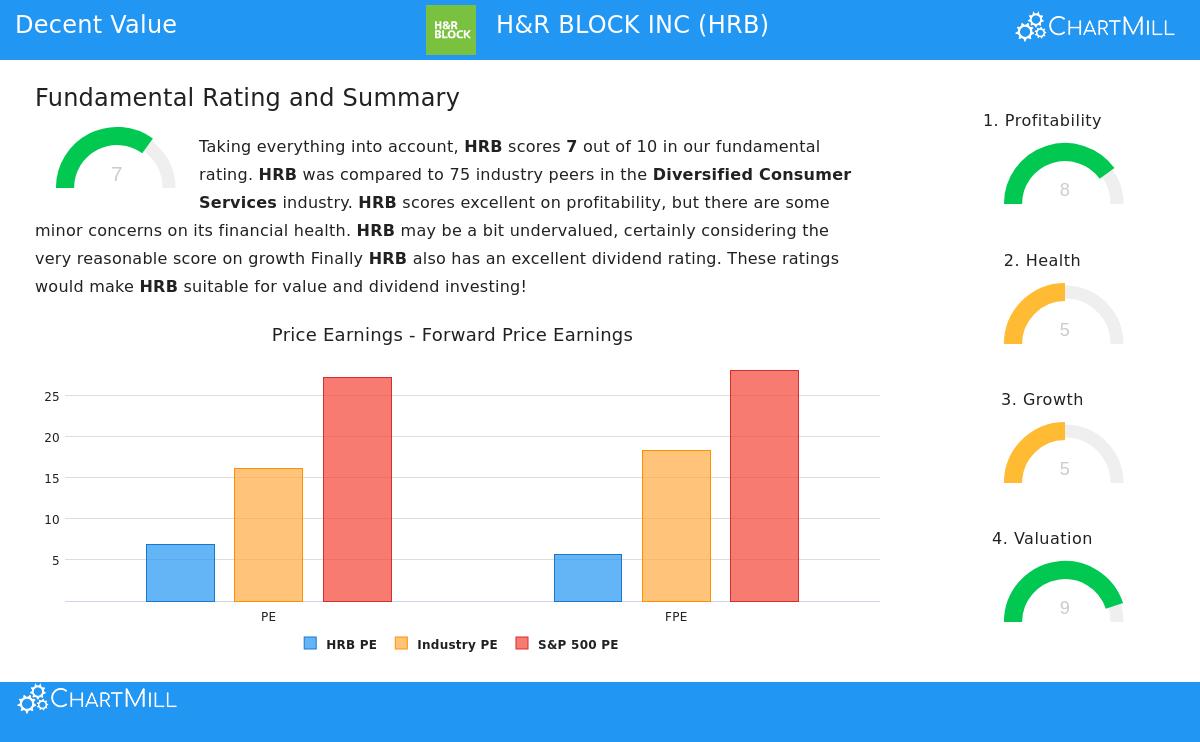
A thorough check of H&R Block’s fundamental analysis report shows a notable profile that matches the "decent value" screening rules. The company receives an overall fundamental score of 7 out of 10, but its individual grades give a more detailed picture, especially noting its valuation attraction.
Valuation: The Main Attraction The most noticeable part of H&R Block’s report is its very high valuation grade of 9 out of 10. This score comes from measures that contrast the company's share price with its profits and cash generation, indicating the stock is valued at a large reduction.
- Price-to-Earnings (P/E) Ratio: At 6.87, HRB’s P/E ratio is labeled "very cheap." This is much lower than the S&P 500 average of 27.27 and also less than over 90% of similar companies in the Diversified Consumer Services field.
- Forward P/E and Cash Flow: The valuation picture stays the same when looking forward. A forward P/E of 5.68 and a good Price/Free Cash Flow ratio support the idea that investors are paying a small amount for the company's present and future profit capacity.
For a value investor, this clear discount is the first point of interest. It implies the market might be setting too low a value on the company's consistent ability to generate cash, offering a possible buffer if the true value estimate is accurate.
Profitability: A Base of Soundness A low valuation is only interesting if the business is essentially in good shape. Here, H&R Block does very well with a profitability grade of 8. The company shows a capability to effectively turn sales into earnings, which is important for maintaining activities and benefiting shareholders.
- Strong Returns: The company has a Return on Invested Capital (ROIC) of 29%, doing better than almost 99% of similar companies in its field. A high ROIC shows management is good at using capital to create earnings.
- Solid Margins: With a Profit Margin of 16.05% and an Operating Margin of 22.26%, H&R Block works with an effectiveness that puts it with the leading companies in its industry.
This good profitability gives assurance that the low valuation is not a sign of a failing business model, but possibly a market mistake. A company that earns well and trades at a low profit multiple is a standard value investing situation.
Financial Condition and Momentum: Backing the Idea While the valuation and profitability grades are prominent, the screen also needed acceptable grades in condition and momentum. H&R Block’s condition grade of 5 shows a satisfactory, though not perfect, financial state. The report states the company is building value (as ROIC is above its cost of capital) and has been lowering its share count, which is an action that benefits shareholders. Liquidity measures are similar to industry averages, suggesting it can handle its near-term debts.
The momentum grade of 5 shows a steady, if not rapid, path. Previous growth in Earnings Per Share (EPS) has been good, averaging close to 44% each year over recent years. While future EPS growth is predicted to slow to a still-sound 12%, it shows the company’s profit capacity is not falling. For many value approaches, steady, dependable momentum is often more desired than uneven, high-momentum possibilities.
Dividend: An Extra Benefit Beyond the main screening rules, H&R Block offers an extra appealing trait for investors focused on income: a high dividend yield of 5.93%, backed by a maintainable payout ratio and a consistent history of regular payments. This yield gives a real return while investors wait for a possible market reassessment of the stock.
Is HRB a Value Find? The screening process that found H&R Block was made to locate stocks where a low price meets adequate core metrics. The company’s profile, marked by a very low valuation, strong profitability, passable financial condition, and stable momentum, fits this model well. It presents a situation where the market’s present valuation may not fully account for the firm's lasting profits and cash flow from its well-known tax preparation service. Naturally, investors must think about industry cycles and the future competitive environment, but judging by the numerical fundamentals, HRB deserves additional review from those using a value-focused method.
This review of H&R Block came from a systematic screen. Investors wanting to locate other companies that fit similar "decent value" rules can examine the ready-made screen here.
Disclaimer: This article is for information only and is not financial guidance, a suggestion, or an offer to buy or sell any security. The review is based on data and scores from ChartMill, and investors should do their own research and talk with a qualified financial advisor before making any investment choices. Past results do not guarantee future outcomes.