

Investors looking for a method to find high-growth stocks frequently use set systems to sort the wide field of possible investments. One framework is described in Louis Navellier's "The Little Book That Makes You Rich," which lists eight basic rules for choosing excellent growth stocks. This method centers on firms showing good earnings revisions and surprises, quickening sales and earnings expansion, rising profitability, solid cash flow, and high returns on equity. The aim is to find businesses with strong basic momentum before it is completely seen in the share price.
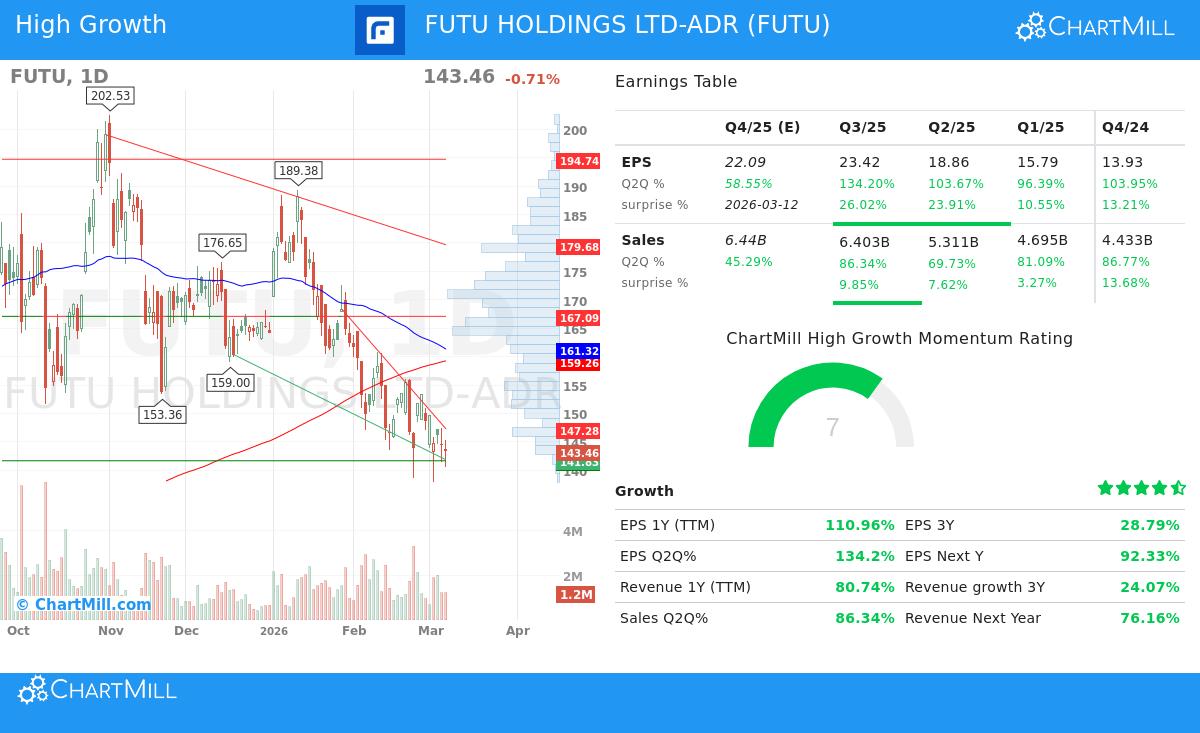
A recent filter using Navellier's rules has identified Futu Holdings Ltd. ADR (NASDAQ:FUTU), a digital brokerage firm serving investors mainly in Asia. The company seems to fit well with the growth-centered ideas of the "Little Book" method, offering a strong reason for more study by growth investors.
Fit with the "Little Book" Growth Rules
The center of Navellier's method is a multi-point list made to find financial momentum. Futu's recent results indicate it satisfies these strict measures.
-
Positive Earnings Revisions & Surprises: A key part of the method is that upward changes in analyst forecasts often come before price gains. Futu's EPS forecast for the next quarter has increased by 10.5% over the past three months, showing more analyst trust. Also, the company has a flawless history of surpassing forecasts, beating EPS estimates in all of the last four quarters by an average of 18.4%. Steady positive surprises can lead analysts to improve their future models, starting a pattern of rising forecasts.
-
Strong and Quickening Expansion: The method looks for companies where expansion is not only happening but speeding up. Futu shows fast growth:
- Revenue increased 80.7% year-over-year (TTM) and 86.3% quarter-over-quarter.
- Earnings per share increased 111.0% year-over-year and a notable 134.2% quarter-over-quarter.
- Importantly, the current quarterly EPS growth (134.2%) is much higher than the growth from the same quarter a year ago (20.0%), a clear mark of positive earnings momentum, another main rule in Navellier's book.
-
Rising Profitability and Solid Cash Flow: It is insufficient to only grow sales; a good growth company must change that growth into higher profits and cash. Futu shows this well.
- Its operating margin grew by 23.9 percentage points over the last year, showing the company is growing efficiently and managing costs as revenue jumps.
- Free cash flow, important for a growing business, jumped by 580.6% over the last year. This large creation of cash gives Futu plenty of means to support more growth, benefit shareholders, or handle economic slowdowns.
-
High Return on Equity (ROE): The last rule focuses on efficiency. ROE shows how well a company creates profits from shareholder equity. Futu's ROE of 26.9% is excellent, putting it in the high group of its industry and indicating very good management of investor money.
Basic Financial Condition and Valuation Setting
Beyond the specific filter rules, a wider basic study gives more setting. According to ChartMill's detailed basic report, Futu has an overall score of 6 out of 10. The report points out a clear split: the company's profitability (score: 9/10) and growth (score: 9/10) are excellent, but notes exist about its financial condition (score: 3/10), including a low Altman-Z score that indicates some balance sheet concern.
From a valuation view, the situation is varied. The stock sells at a P/E ratio of 15.6, which is about equal to its industry group and clearly under the wider S&P 500 average. Its forward P/E of 12.2 and low PEG ratio, which includes its high expected earnings growth, suggest the market may not be completely valuing its future growth potential of over 36% each year. This mix of high growth and fair valuation can be interesting for growth-at-a-reasonable-price (GARP) investors.
A Beginning for More Study
Futu Holdings gives a clear example of a company now meeting a strict, growth-focused filter based on Louis Navellier's system. Its numbers for earnings momentum, sales growth, margin gain, and capital efficiency are good. However, investors must look at the complete situation. The worries noted about financial condition, the company's connection to particular regional markets, and the natural instability in the brokerage field are significant points that require thorough, separate investigation.
For investors wanting to examine other companies that now meet the "Little Book" rules, the filter used for this study is open to the public. You can see and adjust this filter to find more possible growth choices here.
,
Disclaimer: This article is for information only and is not financial advice, a suggestion, or an offer to buy or sell any securities. The study is based on data and a preset filter method; it is not a replacement for personal research. Investing has risk, including the possible loss of principal.