

For investors looking for a dependable source of passive income, a methodical process for choosing dividend stocks is important. One useful technique involves searching for companies that provide an appealing dividend and also show the fundamental financial soundness to maintain and possibly increase those payments over time. This method emphasizes quality and long-term viability over pursuing the highest available yield, which can sometimes indicate a company in trouble. A good initial step is to find stocks with favorable scores in important fundamental categories: a good dividend history, along with satisfactory earnings power and a stable balance sheet. This pairing aids in finding companies that are not only rewarding shareholders now, but are also set to keep doing so for years to come.
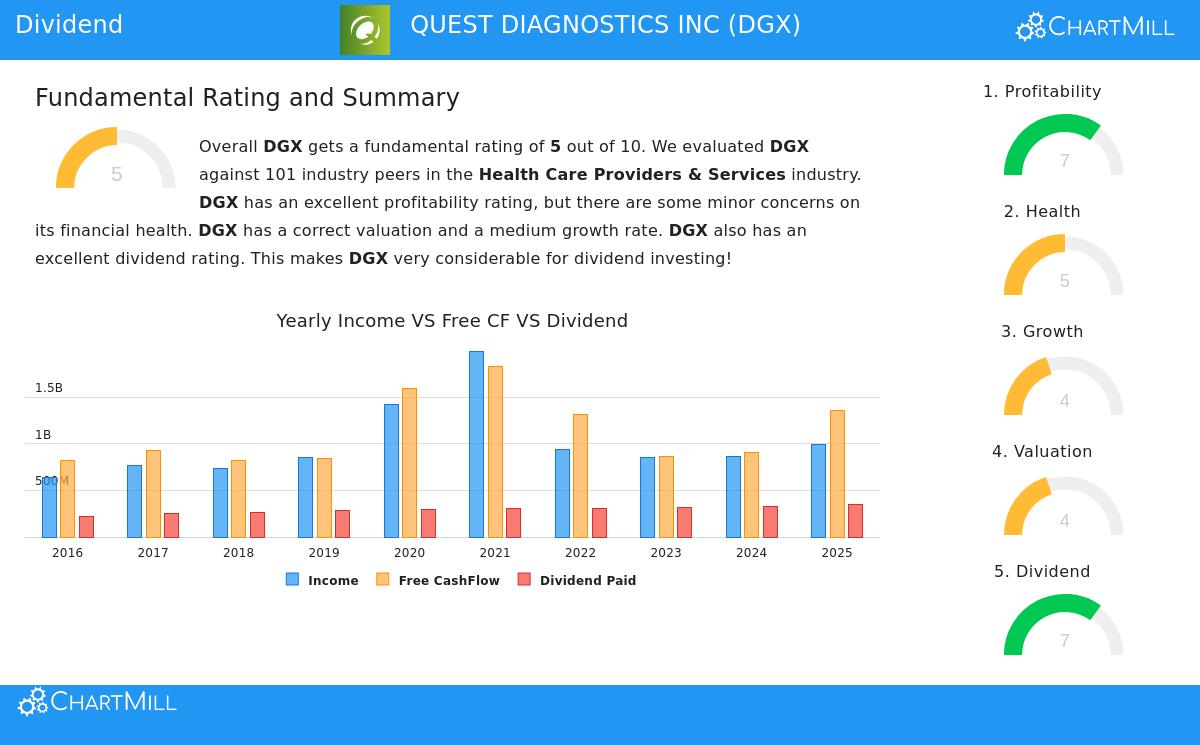
Quest Diagnostics Inc. (NYSE:DGX), a top provider of diagnostic testing and information services, appears as a candidate from this kind of careful screening process. The company’s fundamental report shows a picture that matches the central principles of sustainable dividend investing.
A Focus on Dividend Sustainability
The main attraction for income investors is, naturally, the dividend. Quest Diagnostics receives a good ChartMill Dividend Rating of 7, signaling a respected dividend picture. This score rests on several factors that dividend-oriented methods stress for long-term dependability.
- Reliable Track Record: DGX has built a steady history, having paid and, critically, not cut its dividend for at least ten straight years. This steadiness is a sign of a management team dedicated to giving capital back to shareholders.
- Sustainable Growth: The company has increased its dividend at an average yearly rate of 7.42% over the last five years. This increase is not aggressive; it is backed by a cautious payout ratio of about 36%. This indicates the company uses only around one-third of its profits to pay the dividend, leaving plenty of capacity to put money back into the business, handle economic challenges, and continue lifting the payout.
- Competitive Yield: With a present yield of 1.63%, DGX provides a payment that is much greater than the average for its field (0.48%) and is in line with the wider S&P 500. For a method that considers safety and increase alongside yield, this is a balanced proposition.
The Foundation: Profitability and Financial Health
A lasting dividend needs a profitable and financially stable business. This is why searching for "satisfactory profitability and health" is not a secondary step, it is key to the method. A high yield is irrelevant if the company cannot support it. Quest Diagnostics’ fundamentals supply this necessary base.
Profitability Strength: The company gets a ChartMill Profitability Rating of 7, mirroring its capacity to produce earnings effectively. Important measures are notable:
- A solid Return on Equity of 13.78% and a Return on Invested Capital of 8.88%, both of which do better than most of its competitors in the healthcare services field.
- Good profit and operating margins that place in the higher end of its field, showing pricing ability and operational effectiveness.
Adequate Financial Health: With a ChartMill Health Rating of 5, the company’s financial condition is seen as acceptable, though with some details. The screening rules purposely look for "satisfactory" health, not necessarily the best, to prevent being too limiting while still sorting out financially unstable firms.
- On the good side, DGX has a sound Altman-Z score (3.44), pointing to a low short-term chance of financial trouble, and has been lowering its debt-to-assets ratio.
- Investors should be aware, however, that liquidity measures like the Current and Quick ratios are somewhat low compared to field competitors. This is an item to watch, but it is offset by the company’s good and steady cash flow production, which is the real source for paying dividends and debt.
Valuation and Growth Context
For a dividend investor with a long-term view, valuation makes sure you are not paying too much for the income, while growth potential gives assurance about future dividend raises.
- Valuation: DGX trades at a P/E ratio near 21.5, which is above its own past levels but is still less expensive than the overall market and most of its field peers. When weighing its earnings power and stability, the valuation seems fair rather than high.
- Growth: The company displays stable, if not fast, growth. Revenue has increased steadily, and analysts forecast modest mid-single-digit growth in both revenue and profits moving ahead. This fits with the dividend growth rate, implying the payout raises are based on a practical base of business growth.
A Candidate for Further Research
Quest Diagnostics offers an example of using a measured dividend-investing screen. It displays a wanted combination: a steady and increasing dividend supported by a profitable, essential-service business and an acceptable financial setup. The company’s place in the healthcare system gives a level of recession resilience, further backing the income’s endurance.
For investors constructing or assessing an income portfolio, DGX justifies more examination based on these numerical fundamentals. You can see the complete fundamental analysis that shaped this summary here.
Find More Dividend Ideas The hunt for good dividend payers does not stop with one stock. The screening approach that identified Quest Diagnostics can be used to find other possible candidates. You can examine the fully set "Best Dividend Stocks" screen and its present outcomes yourself here.
Disclaimer: This article is for informational purposes only and does not constitute financial advice, a recommendation, or an offer or solicitation to buy or sell any securities. The analysis is based on data and fundamental reports available at the time of writing. Investors should conduct their own thorough research and consider their individual financial circumstances and risk tolerance before making any investment decisions.