

In the search for market-beating returns, many investors use a dual-lens method, joining the forward-looking discipline of fundamental analysis with the price-action insights of technical analysis. One tactic that uses this pairing is the search for strong growth stocks showing promising technical breakout patterns. The reasoning is clear: first, find companies with strong and accelerating business fundamentals—specifically, high growth, firm profitability, and a sound financial base. These are the engines that can push long-term share price gains. Second, use a technical filter to find moments when the market is starting to see this possibility, often shown by the stock price stabilizing after a fall and indicating signs of moving upward from a time of low volatility. This combination can mark a possible entry point where getting better fundamentals meet changing market opinion.
COMMVAULT SYSTEMS INC (NASDAQ:CVLT) presents a noteworthy case study for this method. The data protection and cyber resilience software provider has reported financial results that match the central ideas of growth investing, while its recent stock price action indicates a technical formation that may justify closer review.
Fundamental Strength: The Growth Engine
A close look at Commvault's fundamentals shows a company performing well on several fronts important for a growth stock. According to its fundamental analysis report, CVLT gets a solid Growth Rating of 8 out of 10, which is the main filter in the screening tactic. This score is supported by notable historical and planned expansion.
- Historical Growth: Over the past year, Commvault has reported an Earnings Per Share (EPS) growth of 20.82% and a Revenue increase of 21.52%. The five-year average annual EPS growth is a strong 20.11%.
- Future Expectations: Analysts expect this momentum to persist, with forward estimates indicating average annual EPS growth of 15.10% and Revenue growth of nearly 10%. Importantly, the Revenue growth rate is expected to speed up relative to its past five-year average.
- Profitability and Health: Backing this growth story are firm profitability and acceptable financial health. The company scores a 7 for Profitability, having solid margins that beat a majority of its software industry peers. Its Return on Equity of over 40% is very good. The Financial Health rating of 5 shows a mixed situation: very good liquidity with no debt is a major plus, but a high share count and a worrying Altman-Z score introduce factors of risk that investors must consider.
This fundamental picture is important because it marks CVLT as a company with a demonstrated and anticipated ability to increase its earnings much faster than the market average—the core description of a growth stock candidate.
Technical Setup: A Pattern of Possibility
While the long-term fundamental story gives the "why," the technical picture gives insight into the "when." Commvault's stock has met significant pressure, trading far below its 52-week high and in a negative long-term trend, matching the wider market's difficulties for growth-focused software names. However, the short-term chart is displaying a possibly constructive formation.
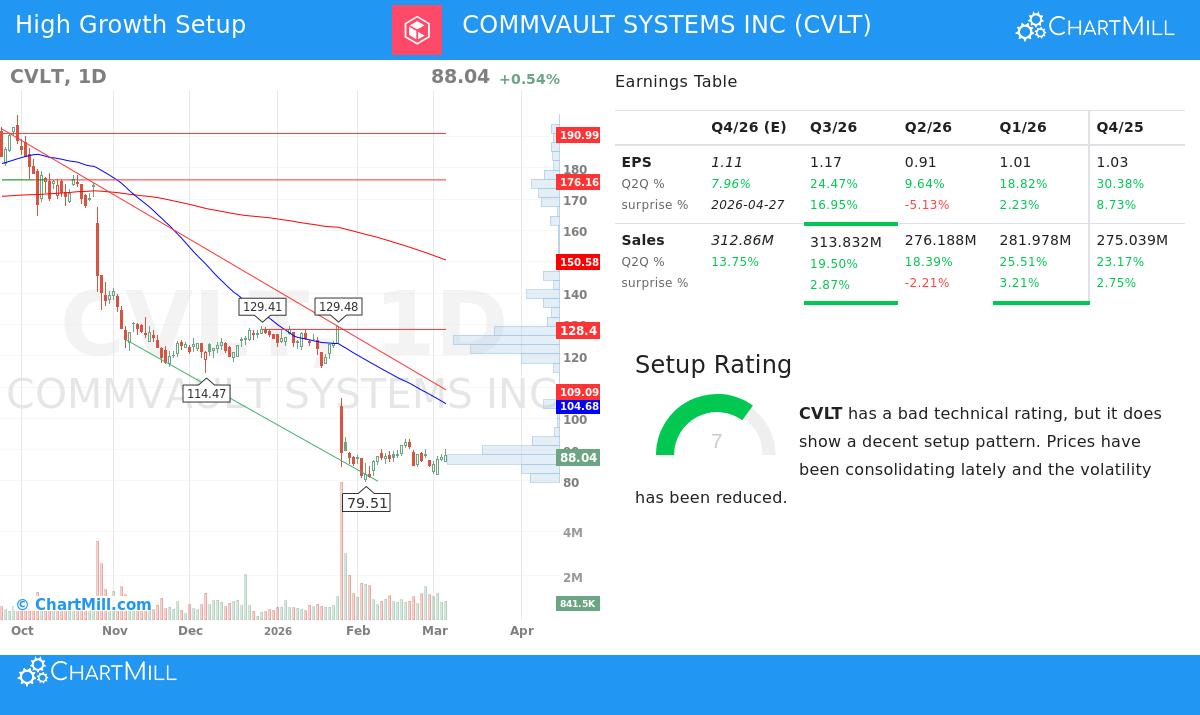
The technical analysis report gives CVLT a low overall technical rating of 1, showing its weak relative performance. Importantly, though, it points out a much more encouraging Setup Rating of 7. This difference is key to the screening tactic.
- Stabilization and Lower Volatility: The report states that over the past month, CVLT has been trading in a set range (approximately $80.91 to $93.28) and is currently stabilizing in the middle of this band. This time of lower volatility after a sharp drop often comes before a notable move.
- Resistance Overhead: The stock meets a clear and nearby resistance area between $91.00 and $92.34, made by multiple trend lines. A clear move above this area on high volume could indicate a change in momentum, possibly giving a technical entry signal for investors persuaded by the core fundamentals.
- The Setup Chance: The heart of the tactic is found in the report's summary: "Although the technical rating is bad, CVLT does present a nice setup chance. We see lower volatility while prices have been stabilizing in the most recent period." This is the exact condition the screen looks for—a fundamentally sound stock coming out of a time of price compression.
Valuation Context
An appealing growth story must also be evaluated for its cost. Commvault's Valuation Rating of 5 suggests it is not extremely overvalued. Its P/E ratio of 21.4 is less expensive than the software industry average and the wider S&P 500. When growth is evaluated via the PEG ratio, the valuation seems more fair. For growth investors, paying a reasonable price for speeding up earnings is a crucial part of the calculation, and CVLT's current valuation does not seem to be a blocking barrier.
Conclusion
Commvault Systems shows the focused method of joining fundamental and technical screens. The company displays the necessary quantitative markers of a growth stock: solid, speeding up earnings and revenue growth backed by good profitability. At the same time, its stock chart displays the qualitative formation of stabilization and a defined setup, suggesting the negative momentum may be halting and forming a base for a possible turn. This match does not assure future results, but it methodically finds a situation where getting better business fundamentals could be at the point of being seen by the market.
For investors wanting to use this same disciplined search for strong growth stocks with encouraging technical patterns, you can review more possible candidates using the Strong Growth Stock Technical Setups screen.
Disclaimer: This article is for informational purposes only and does not constitute financial advice, a recommendation, or an offer to buy or sell any securities. Investing involves risk, including the potential loss of principal. You should conduct your own research and consult with a qualified financial advisor before making any investment decisions.