

For investors aiming to create wealth by finding companies priced below their actual worth, the ideas of value investing supply a proven method. This approach, made famous by Benjamin Graham and then Warren Buffett, consists of looking for stocks with a market price less than a measured guess of their real business value. The aim is to buy these "undervalued" assets and keep them, letting the market price in time match the company's basic soundness. A careful method frequently uses filters to find stocks with good valuation measures, firm financial condition, steady earnings, and acceptable expansion potential, all while requiring a "margin of safety" to allow for mistakes in estimation.
Cognizant Technology Solutions Corp. (NASDAQ:CTSH) recently appeared from such a careful filtering process, which looked for companies with high basic valuation scores while keeping acceptable ratings in earnings, financial condition, and expansion. An examination of its financial details indicates it could be a noteworthy case for investors focused on value.
Good Valuation Measures
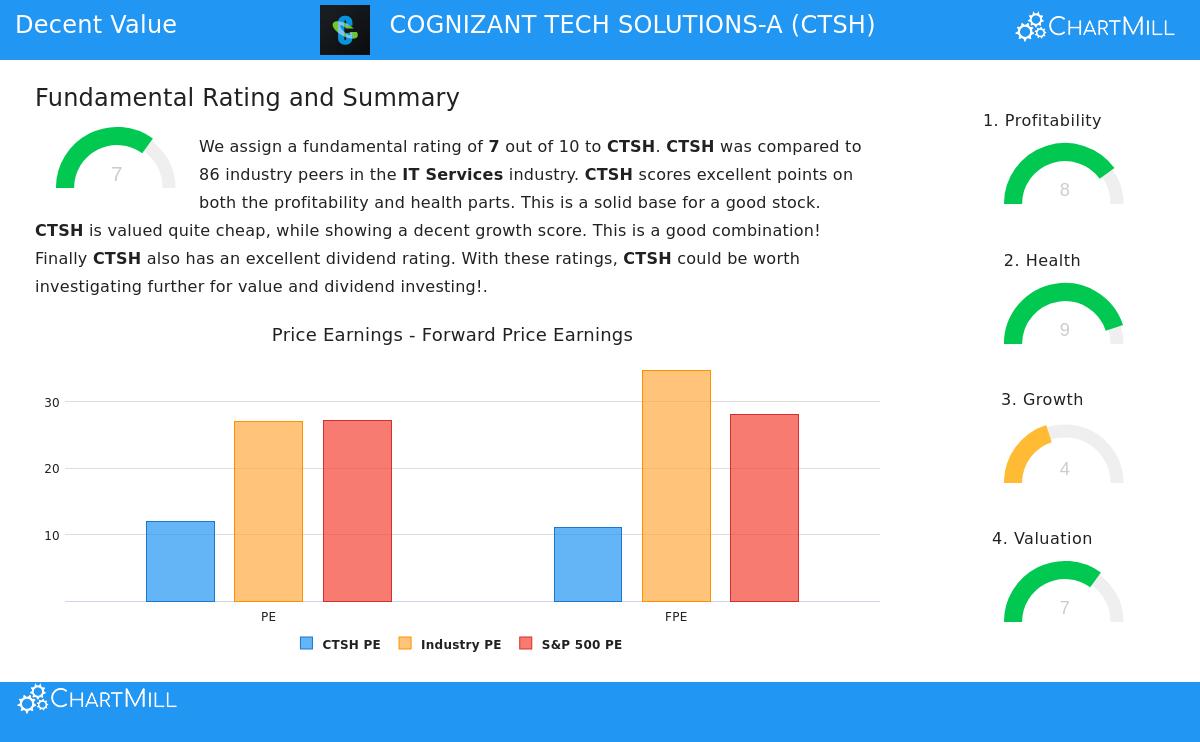
The central rule of value investing is buying a dollar of assets for fifty cents. Cognizant's present valuation measures imply the market might be giving such a chance. Based on ChartMill's basic analysis, the company receives a Valuation Rating of 7 out of 10, showing it is priced lower than many similar companies.
- Price-to-Earnings (P/E) Ratio: At 12.03, CTSH's P/E ratio is much lower than the S&P 500 average of 27.13. It is also valued lower than about 78% of other companies in the IT Services industry.
- Forward P/E Ratio: The view stays good looking forward, with a forward P/E of 11.07. This is under both the industry and wider market averages, with almost 80% of industry peers having a higher price on this measure.
- Enterprise Value to EBITDA: This ratio, which includes debt and cash, also shows CTSH as low-priced, placing it lower than about 85% of its industry rivals.
For a value investor, these numbers are the first step. They show the market is giving Cognizant's earnings and cash flow a cautious price, which is exactly the situation where value chances are frequently discovered.
Strong Financial Condition
A low-priced stock is only a sound investment if the company is financially secure. A firm balance sheet gives the steadiness to endure economic declines and continue working without trouble, a key protection for the "margin of safety" value investors want. Cognizant does very well here, having a high Health Rating of 9 out of 10.
- Low Debt: The company has very little debt reliance, with a Debt/Equity ratio of only 0.04. This is more favorable than over 76% of its industry peers and shows a small chance of financial trouble.
- Firm Solvency: An Altman-Z score of 6.03 shows almost no short-term bankruptcy risk and puts CTSH in the best group of its industry for financial soundness.
- Solid Liquidity: With both a Current Ratio and Quick Ratio of 2.14, Cognizant has more than enough means to meet its near-term debts, giving working adaptability.
This strong balance sheet means the company's low valuation is not a sign of financial frailty. Instead, it suggests the market might be missing a basically firm business.
Strong Earnings
Value investing is not about buying damaged companies; it is about buying good companies at a lower price. Continued earnings are proof of a lasting business model and competitive strengths. Cognizant's Profitability Rating of 8 out of 10 confirms it is a highly efficient operator.
- Efficient Capital Use: The company produces a notable Return on Invested Capital (ROIC) of 14.73%, doing better than over 90% of its industry. Its three-year average ROIC of 14.39% is also high and has gotten better lately.
- Sound Margins: An Operating Margin of 15.76% is in the top quarter of the IT Services sector, and its Profit Margin of 10.56% is also much better than average. Both margins have shown upward movements in recent years.
These measures prove that Cognizant is not just continuing but succeeding, efficiently turning its capital into profits. For a value investor, this quality at a reduced price is the perfect situation.
Acceptable Expansion and Income
While strict value stocks sometimes do not have expansion, Cognizant gives a mixed profile. Its Growth Rating of 4 shows slight but stable increase, which is often suitable for value plans that put price above fast expansion.
- Steady Past Growth: Over the last year, Earnings Per Share increased by 11.16%, with a firm five-year average yearly EPS growth of 9.07%. Sales growth has been more slight but regular.
- Dependable Dividend: The company adds an income part with a Dividend Rating of 7. It gives a yield of 2.03%, which is much higher than the industry average, and has a dependable 10-year history of raising its payment. The dividend is easily supported by earnings, with a maintainable payout ratio of 27.35%.
This mix supplies a total return idea, chance for price increase as the valuation difference narrows, along with a rising flow of dividend income during the wait.
Conclusion
Cognizant Technology Solutions shows a profile that matches important value investing requirements: it seems low-priced on several key price measures, has strong financial condition that gives a margin of safety, shows high and improving earnings, and gives acceptable expansion added by a dependable dividend. The difference between its firm basic performance and its cautious market valuation might stand for the type of chance value investors calmly look for.
For investors wanting to use this method to find other possible chances, you can examine the set "Decent Value Stocks" filter on ChartMill here. This filter methodically selects for stocks with good valuation scores while making sure basic quality in expansion, health, and earnings.
Disclaimer: This article is for information only and does not make up financial guidance, a suggestion, or an offer to buy or sell any security. Investing has risk, including the possible loss of original investment. You should do your own study and talk with a certified financial advisor before making any investment choices.