

The investment philosophy of legendary fund manager Peter Lynch has long been a foundation for investors aiming to build lasting, long-term portfolios. His method, often described as Growth at a Reasonable Price (GARP), centers on finding profitable, financially stable companies that are increasing at a steady rate, all while trading at prices that do not overvalue that increase. It is a plan that puts basic financial soundness ahead of market predictions, supporting detailed study and a long-term view. A filter built on Lynch’s main rules, including earnings increase, price, profitability, and balance sheet soundness, can reveal companies deserving of more study. One such company that recently met this filter is Cabot Corp (NYSE:CBT), a worldwide specialty chemicals company.
Fit with Peter Lynch Rules
Cabot Corp seems to fit well with a number of Peter Lynch's numerical filters, which are made to find companies with steady increase and sensible prices.
- Steady Earnings Increase: Lynch looked for companies with a reliable earnings increase history, but he was cautious of very fast increase that might not continue. The filter needs a 5-year EPS increase rate between 15% and 30%. Cabot's EPS has increased at an average yearly rate of 28.5% over the past five years, putting it near the top limit of Lynch's chosen range, pointing to solid but not extreme historical growth.
- Sensible Price (PEG Ratio): Possibly the main part of the Lynch plan is the Price/Earnings to Growth (PEG) ratio, which tries to price a stock in relation to its increase rate. A PEG ratio of 1 or less is seen as good. Cabot stands out here, with a PEG ratio of 0.37. This low number implies the market might be pricing the company's historical earnings increase too low, a main sign for GARP investors.
- High Profitability (ROE): Lynch preferred companies that effectively produce profits from shareholder equity. The filter requires a Return on Equity (ROE) above 15%. Cabot's ROE of 19.4% easily meets this level, showing management's skill in using capital to gain returns.
- Financial Soundness (Debt & Liquidity): A careful balance sheet was important to Lynch. The plan filters for a Debt-to-Equity ratio below 0.6 and a Current Ratio above 1. Cabot meets both:
- Its Debt-to-Equity ratio is 0.55, showing a balanced funding mix that depends more on equity than debt.
- Its Current Ratio of 1.67 shows sufficient short-term assets to meet near-term debts, giving a buffer against operational issues.
Basic Soundness Summary
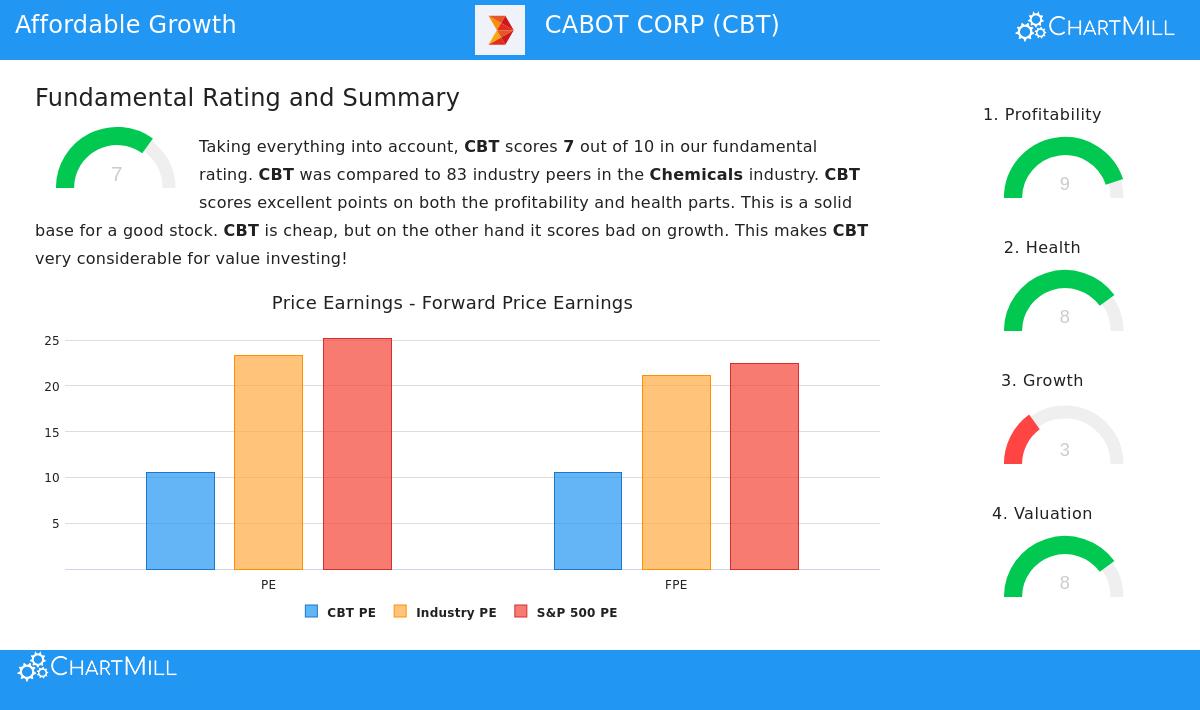
A wider view of Cabot's basic financial profile, as shown in its detailed analysis report, supports the image shown by the Lynch filter. The company receives a solid overall basic rating of 7 out of 10, with specific high points in profitability and financial soundness.
- Profitability Strength: Cabot's profitability numbers are very good compared to others in the chemicals industry. It has high scores for Return on Assets (8.14%), Return on Invested Capital (14.83%), and operating margins (16.50%), with most of these numbers showing gain in recent years.
- Firm Price: The price argument stays strong beyond the PEG ratio. With a P/E ratio of 10.5 and a forward P/E of 10.5, Cabot trades at a notable discount to both the S&P 500 average and the wider chemicals industry. Its Enterprise Value to EBITDA and Price to Free Cash Flow ratios also indicate a low price.
- Points to Consider: The main warning in the report focuses on increase. While the 5-year history is solid, recent yearly EPS and revenue have fallen, and future increase projections are moderate. This matches Lynch's focus on steady, instead of very fast, increase but needs an investor to judge if the present slowdown is temporary or a more lasting change. Also, the company keeps a dependable dividend with a 2.6% yield, though its increase rate is small.
A Subject for More Study
For an investor using a Peter Lynch-style GARP plan, Cabot Corp offers a strong beginning. It meets the necessary points of historical increase at a steady rate, a low price when increase is considered (PEG), high profitability, and a careful financial setup. The company works in the necessary, if sometimes "ordinary," specialty chemicals field, supplying materials key to industries from tires to electronics, a business model Lynch might like for its clarity.
The filter has done its work by pointing out CBT based on a strict set of rules. The following action, as Lynch would suggest, is for the individual investor to study more. This means knowing the causes behind Cabot's past increase, the competitive forces in its two business parts (Reinforcement Materials and Performance Chemicals), and making an opinion on its chance to go back to a more stable increase path in the future years.
You can view the complete list of companies currently meeting the Peter Lynch plan filter here.
Disclaimer: This article is for informational purposes only and does not constitute financial advice, a recommendation, or an offer or solicitation to buy or sell any securities. The information presented is based on data provided and should not be the sole basis for any investment decision. Investors should conduct their own independent research and consult with a qualified financial advisor before making any investment.