

The investment philosophy of Peter Lynch, the famous manager of Fidelity's Magellan Fund, focuses on finding companies that offer "growth at a reasonable price" (GARP). His strategy, described in his book One Up on Wall Street, is a structured, long-term method that does not follow speculative trends. Instead, it aims to find profitable, financially sound companies with maintainable growth rates that are available at prices which do not overestimate that future potential. This technique mixes parts of both growth and value investing, aiming to hold good businesses for a long time instead of attempting to predict market movements.
One company that recently appeared from a filter using Lynch's main standards is CARGURUS INC (NASDAQ:CARG), the company running a major online automotive marketplace. The filter uses specific rules for earnings growth, valuation, profitability, and financial condition, all central parts of Lynch's strategy. We will look at how CarGurus compares to these ideas.
Maintainable Growth at a Steady Speed
A key part of Lynch's method is a liking for steady, maintainable growth over fast but possibly temporary increases. He usually searched for companies with a five-year earnings per share (EPS) growth rate between 15% and 30%. Growth above that level can be hard to keep up, while growth below it might not create the wanted compounding result.
- CarGurus' 5-Year EPS Growth: 15.92%
- Analysis: The company's earnings growth is exactly at the lower end of Lynch's chosen range. This shows a history of good, double-digit profit increase that is not so fast as to be naturally unsteady. For a long-term investor, this record of reliable growth in a busy sector like online automotive sales can be more appealing than a more changeable, high-growth story.
Valuation Balanced by Growth
Lynch was known for using the Price/Earnings to Growth (PEG) ratio to evaluate if a stock's price was fair compared to its growth rate. A PEG ratio of 1 or less implies the market is not paying too much for the company's growth outlook. This measure helps find companies where the growth potential may not be completely shown in the share price.
- CarGurus' PEG Ratio (5Y): 0.96
- Analysis: With a PEG ratio just under 1, CarGurus satisfies Lynch's important valuation check. This means its current price-to-earnings multiple is acceptable, and even a little low, when its past earnings growth is considered. For a GARP investor, this is a vital sign that the company's growth is being obtained at a fair price.
Strong Profitability and Financial Strength
Lynch gave great importance to a company's financial condition and its skill at creating profits from shareholder equity. He preferred companies with good balance sheets, little debt, and high returns on equity (ROE). A high ROE shows management's effectiveness in using investor money to produce earnings.
- CarGurus' Return on Equity (ROE): 41.66%
- CarGurus' Debt/Equity Ratio: 0.0
- CarGurus' Current Ratio: 2.81
- Analysis: The company does very well in these condition and profitability measures. An ROE over 40% is outstanding, putting it in the best group of its industry. Also, CarGurus works with no debt on its balance sheet, a trait Lynch would have liked because it gives great financial options and lowers risk in economic slowdowns. A current ratio much above 1 confirms the company has more than sufficient short-term assets to pay its near-term obligations.
Fundamental Condition Review: A Summary
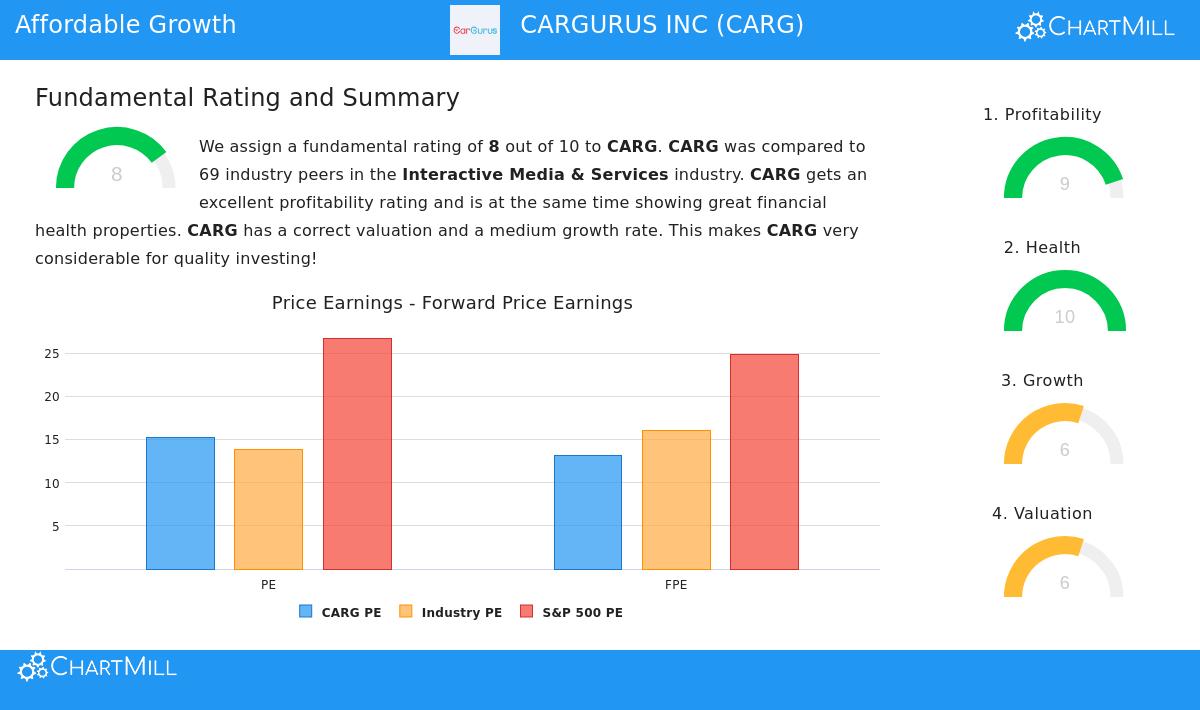
A full fundamental analysis of CarGurus supports the results from the Lynch-based filter. The company gets a good total fundamental score of 8 out of 10, with especially high marks for Profitability (9/10) and Financial Condition (10/10).
Main advantages noted in the report include industry-best returns on assets, invested capital, and equity, together with growing profit margins. The condition analysis notes the safety given by its lack of debt and strong liquidity. On valuation, the report states CarGurus trades at a lower price than both the wider S&P 500 and a large number of its industry competitors, mainly when growth is considered through the PEG ratio.
A Subject for More Study
It is necessary to remember that a filter result is a beginning for more examination, not a suggestion to buy, a rule Lynch supported. The following action for an investor would be to use his extra non-numerical checks: learning CarGurus' business model, its competitive advantage in the online auto field, and the possibility for its newer digital wholesale and transaction services to lead future growth.
For investors wanting to review other companies that currently meet the Peter Lynch strategy filters, you can see the current filter results here: Peter Lynch Strategy Stock Screen.
Disclaimer: This article is for information only and is not financial advice, a suggestion, or an offer to buy or sell any security. The Peter Lynch strategy is a historical model, and past results do not guarantee future outcomes. Investors should do their own complete research and think about their personal financial situation and risk tolerance before making any investment choices.